Sister Butler at Symposium on Consecrated Life
"Apostolic Religious Life: A Public, Ecclesial Vocation"
NORTH EASTON, Massachusetts, OCT. 14, 2008 (Zenit.org).- Here is the address Sister Sara Butler, a member of the Missionary Servants of the Most Blessed Trinity and a professor of dogmatic theology at St. Joseph's Seminary in New York, gave at the Stonehill College symposium on "Apostolic Religious Life Since Vatican II ... Reclaiming the Treasure: Bishops, Theologians, and Religious in Conversation."
The Diocese of Fall River hosted the Sept. 27 event.
* * *
Religious life belongs unquestionably to the life and holiness of the Church, although it is a "charismatic" rather than a "structural" element; one could even say it is an essential expression of that holiness. It is a gift by which God the Father through the Holy Spirit animates and refreshes the Church with an outpouring of grace that calls forth communities distinguished by their courageous faith, steadfast hope, and passionate love for Jesus Christ and the world he came to save. Consecrated religious have a place in the heart of the Church because, by leaving all to follow Christ, they announce with their whole lives that God has made us for himself and our hearts are restless until they rest in him.
We who accept the vocation to religious life make profession of the poverty, chastity, and obedience of Jesus Christ "freely, willingly, and purely for the love of God." In fact, our freedom must be assured; our vows are invalid if we have been subject to any alien pressure. We ask to be admitted to public vows in response to a deep personal experience of being loved and chosen, and in the light of a strong attraction to the charism of a particular institute. This impulse to "sell everything" to buy the field in which we have found the "treasure" (Matthew 13:44) is from the Holy Spirit. If our request is accepted, we commit ourselves to observe the evangelical counsels, to live in community, and to carry out a particular mission in the name of the Church -- according to the charism and constitution of our institute. Because our witness arises from a free personal gift of self, lived according to a way of holiness approved by the Church, it possesses moral authority -- the kind of authority, in fact, that is indispensable for transmitting the faith and accomplishing the Church's mission.
We are here to reflect on our vocation. Most of us are aware that all is not well, that something has been lost and must be reclaimed. What is this "treasure" that needs to be reclaimed? The problem is not only that so few are joining our ranks. It is that the current polarization and division in the Church at large is found among us as well. It exists in the uneasy and even fractured relationships among our apostolic institutes, within many of our institutes, and -- for many -- in the relationships of religious with the diocesan clergy, the bishops, and the Holy See. The reality of this polarization is more than regrettable; it is a cause of scandal, a counter-sign. Our way of life was born from the ardent desire to reproduce the apostolic ideal in which "the company of those who believed was of one heart and one soul,...had everything in common, [and] devoted themselves to the apostles' teaching and fellowship, to the breaking of the bread and the prayers" (Acts 4:35; 2:42).
New communities of apostolic men and women religious seem able to offer this witness. They are attracting vocations, and for this we can all rejoice. Some traditional institutes that made few changes or made them very gradually, and some of the younger institutes that had fewer changes to make, are likewise still welcoming new members. But many communities that were flourishing before the Council are now floundering and dying, despite the evident good will and generosity of most individual religious. We experience a decline in numbers and a rise in median age but also a malaise, an uncertainty about the future. Many are stymied by indecision. They may soldier on, hoping and praying for new members, but they are unable, or perhaps simply afraid to evaluate how their own choices and attitudes affect their situation. Some long to "reclaim the treasure," but meet with inertia or resistance from other members of their institutes and cannot get enough traction to initiate a change of direction. Others are convinced that apostolic religious life as we have known it not only will die, but that it deserves to die. They anticipate a future on the margins of the "institutional Church." Some are "sojourners," already so far out on the "margins" that they expect to leave Jesus Christ and his Church behind for the sake of a new, universal spirituality.
Are apostolic women and men religious doomed to remain divided into factions -- liberals and conservatives, women and men, ordained and non-ordained, Leadership Conference of Women Religious and Conference of Major Superiors of Women Religious? Is this the best we can do? Is this pleasing to God?
I will focus on the theological dimensions of the present dilemma. First I will review three challenges all congregations of apostolic religious had to meet in view of the Council's call for "appropriate renewal." Next I will consider a fourth, unexpected challenge that emerged after the Council, namely, a crisis of faith with respect to the origin, structure, and authority of the Church that has affected the relations between apostolic religious and the hierarchy -- the "institutional Church." I will suggest that our "different ecclesiologies" are a major source of our malaise. Finally, I will venture some thoughts as to the nature of the "treasure" we have lost and identify a fifth challenge that remains to be fully met and that offers us the prospect of reclaiming that "treasure."
Three Challenges Presented by the Council
The Second Vatican Council challenged us to clarify the nature of our vocation as religious in light of the "universal call to holiness" addressed to all the baptized; to adapt our manner of living, praying, working and governing ourselves to meet the apostolic needs of our day; and to expand our apostolic concerns in view of the Church's teaching on social justice. How have these three challenges affected our self-understanding as apostolic religious, our community life, and our ability to bear corporate witness?
1. The Universal Call to Holiness and the Special Vocation of Apostolic Religious
The Council's teaching on the universal call to holiness held an indirect challenge for apostolic religious. If all fully initiated Christians are called, by reason of their Baptism, to imitate Jesus, poor, chaste, and obedient, and to strive for the perfection of charity according to their state of life, what is special about religious life? Some apostolic religious, troubled by this, imagined that the emphasis on the universal call to holiness diminished the value of their own vocation. They asked: If perfection can be attained in other ways of life, why make the sacrifices called for by the vows? Many others embraced the new emphasis. They gladly announced their solidarity with the laity and renounced any vestiges of privilege, deliberately distancing themselves from whatever might signify "elitism" or imply the "superiority" of the religious vocation. In their desire to repudiate "elitism," however, some abandoned not only the privileges they now disdained but also some of the ascetical disciplines and devotional practices that gave public witness to their quest for holiness of life. The effort to avoid "elitism," in fact, led some women and men religious to make adaptations that have obscured their identity as publicly consecrated, ecclesial persons, and sometimes scandalized the laity.
So what is distinctive about the religious life? The Council teaches that the difference lies in the special call religious receive -- a gift of the Holy Spirit -- and in the response by which we commit ourselves to the pursuit of Christian holiness under a new "title." We are called to give a more radical expression to our baptismal vocation and to follow Christ "more closely" by means of our vows of poverty, chastity, and obedience. As Pope John Paul II pointed out in Vita consecrata,
[A]ll those reborn in Christ are called to live out, with the strength which is the Spirit's gift, the chastity appropriate to their state of life, obedience to God and to the Church, and a reasonable detachment from material possessions: for all are called to holiness, which consists in the perfection of love. But Baptism in itself does not include the call to celibacy or virginity, the renunciation of possessions or obedience to a superior, in the form proper to the evangelical counsels.
The religious life, undertaken by means of the vows, presupposes "a particular gift of God not given to everyone . . . a specific gift of the Holy Spirit." We have received this vocation to strive for holiness by means that are "over and above" what is required of all the baptized.
Much attention has been given to the meaning and "witness value" of the vows since the Council. In an effort to "accentuate the positive and eliminate the negative," some have proposed that the vows actually commit us only to the practice of the virtues, e.g., that poverty means "living simply," chastity means "loving generously," and obedience means "listening for indications of God's will." But one cannot vow to do what is already required! The vows are promises made to God "concerning some good that is possible and better." What is this "good"? It is the good of a covenant relationship by which we freely and publicly bind ourselves to the following of "the Lord Jesus, who, virginal and poor (cf. Matthew 8:20; Luke 9:58), redeemed and sanctified [us] by obedience unto death on the cross (cf. Philippians 2:8)."
While it is true that the "perfection" of the vow lies in the practice of the virtues, the vows themselves commit us to very specific obligations that, taken together, give distinctive shape to our way of life. By chastity we oblige ourselves to perfect continence in celibacy; by poverty, to be dependent upon our religious institutes and to observe their laws about the use and disposition of goods; and by obedience, to submit our wills to our lawful superiors when they command in keeping with the constitutions. We freely choose to do this out of a desire to return love for love by making a total gift of self. We make a serious, public commitment, on the order of marriage, and the Church, by accepting our vows, consecrates us -- sets us apart -- as public witnesses to the transcendent value of belonging wholly to the Lord and seeking first the coming of his kingdom.
In relation to our distinctive vocation, then, let us examine our consciences. Have we accepted one of the new "theologies" of religious life that empties the vows of their specific objects and obligations? Have we used our desire for "solidarity" with the laity to excuse ourselves from the asceticism that our life requires if we are to build up the Church by the prophetic witness of holiness? Have we become so "laid back," "relaxed," and immersed in the world shaped by TV and consumerism that we no longer constitute a sign for others, that is, that we are indistinguishable from generous lay persons whose good works are motivated by faith?
2. Adaptation for the Apostolate and the "Monastic" Ideal
Perfectae caritatis directed that the "manner of living, praying and working" of men and women religious should be suitably adapted not only to the modern physical and psychological circumstances of the members but also, as required by the nature of each institute, to the necessities of the apostolate, the demands of culture, and social and economic circumstances. This has been a tall order.
The challenge to make adaptations required by our contemporary situation in ministry led us to consider critically the differences between an "apostolic" as compared to a "monastic" lifestyle. There were immediate and direct implications for religious whose identity as "semi-cloistered" prevented them from everyday interactions with the laity, but the choices we made in this regard have ultimately affected almost all of us. During the years of experimentation, we evaluated practices and patterns that were once assumed to characterize religious life (e.g., a set schedule or horarium, daily liturgical prayer and spiritual exercises in common, a distinctive habit, a local superior in every community). Some of us have abandoned these or made them optional, on the grounds that these elements were vestiges of a "monastic" lifestyle no longer required of or appropriate to apostolic religious. The increasing professionalization and "parochialization" of the ministries has, in fact, seemed to require much more flexibility with respect to certain of them (like the horarium, daily Mass in common, and the religious habit). But it is high time to assess the impact these adaptations have had on our own lives, on the witness we hope to give, and on our ability to attract new recruits. If an institute has abandoned practices the Holy See identifies as "essential" to religious life, for example, one must ask whether it should plan to reclaim that element, or whether it may now belong to some other category of consecrated life.
One such "element" is the obligation of common life. This continues to be the subject of vigorous debate. Some favor re-defining "common life" in such a way that it may be understood to include religious who live alone for the sake of their ministry but come together regularly in small groups for mutual support; others want to insist that it entails actually living together under one roof on a daily basis and under the direction of a local superior. These debates are greatly complicated by the realities of ministry placement (e.g., the difficulties involved in arranging a corporate contract, finding ministries in the same locale, and securing housing). Some may urge that the institute's apostolic goals should take priority over common life, which they regard as a "monastic" value. It is not clear how this tension should be resolved, and the resolution will differ from one institute to another, but these debates should not proceed without reference to the Holy See's determination that common life belongs to the definition of religious life, including apostolic religious life -- by contrast, for example, with secular institutes.
Common life is prescribed not simply for reasons of convenience and economy, nor even for mutual support in ministry, but because it manifests our communion in Christ. By our consecration, we share the same traditions, spirituality, apostolic purpose, resources, and constitutions. Our sisterly or brotherly communion announces that persons who love God are able to love and sustain each other, accept one another's gifts and limitations, share joys and sorrows -- despite differences in age, race, language, nationality, culture, temperament, and ministerial competence. Because the asceticism of community life demands love, forgiveness, patience, and mutual self-giving, it contributes to growth in holiness. Vowed life, in fact, has serious practical consequences chiefly for those who live together. In an age of exaggerated individualism, community life is truly a prophetic sign. By living together, even at great cost, religious are able to bear striking witness to the Trinitarian mystery of self-emptying love.
As regards our adaptation for the sake of mission, let us ask: Have we -- out of necessity or by our own choice -- abandoned elements that are, in fact, essential to religious life? Does our common residence function only as a "hotel"? Are we content to make "common life" optional, as a matter of practical necessity, or do we actively seek ways to live together? Are we willing to give it greater priority for the sake of attracting vocations? Given the "professionalization" of non-ordained ministries, is it possible to reclaim common life even if we want to do so? What factors within and outside of our control now militate against it? What might our bishops, vicars for religious, and pastors do to enable and support common life for apostolic religious?
3. Commitment to Social Justice and the Direct Proclamation of the Gospel
A third challenge faced by most apostolic religious during the immediate post-conciliar era came from the Council's emphasis on social justice. We took up the task of adaptation and renewal during the era of the civil rights movement, the War on Poverty, the Vietnam War, the "second wave" of the feminist movement, the Equal Rights Amendment, and "liberation theology." Apostolic religious who read Gaudium et spes and the 1971 Synod of Bishops' document, "Justice in the World," took very much to heart the assertion that "action on behalf of justice and participation in the transformation of the world fully appear...as a constitutive dimension of the preaching of the Gospel."
Apostolic religious have taken up this challenge with enthusiasm, eager to correct what was for some a rather exclusive preoccupation with the Church's internal life and health, to the neglect of the justice issues of the times, such as racism. Our commitment to justice, peace, and the integrity of creation continues to have high priority in many apostolic institutes. When we discuss our priorities in mission we should not feel forced to make a choice between the commitment to social justice or the direct proclamation of the Gospel with the intention to convert individuals to Christ and bring them to sacramental life in the Catholic Church. These objectives belong together. Evangelization, in the broad sense given it by Paul VI, is not limited to the conversion of individuals to Christ; it must also touch and transform cultures.
Having said this, however, Pope Paul insisted, "There is no true evangelization if the name, the teaching, the life, the promises, the kingdom and the mystery of Jesus of Nazareth, the Son of God are not proclaimed." More recently, Pope John Paul II called for a "new evangelization" of nominal Christians, those among the baptized who live far from Christ and his Gospel. We have, in last spring's report from the Pew Forum, evidence that many Catholics in the U.S. no longer have a sense of living faith. Several studies of young adults and reports from Catholic colleges confirm our suspicion that we may lose another generation to the faith.
How shall we respond? Which of our founders entrusted to us the task of educating the Church's children and youth? Have we stopped worrying about their eternal salvation? The proclamation of the kingdom must include handing on the Gospel message by word and example, in accord with the charism of our own founders. It involves introducing young people to Jesus Christ, calling for conversion of heart, and leading them to full participation in the Church's life. It is puzzling and even a cause for embarrassment that two of our national leadership conferences, LCWR and CMSM, focus so resolutely on the world's agenda and global issues and give so little attention to the urgent needs of the Church. Why do they seem to care more about the future of Earth than the future of the Church? If it is not a matter of "either-or" but of "both-and," what accounts for their selective emphasis? My guess is that the answer is related to the influence, direct or indirect, of the fourth, unexpected challenge, namely, contemporary theological proposals about the nature of the Church.
A Fourth, Unexpected Challenge: Competing "Ecclesiologies"
The fourth challenge has been the advent of unprecedented theological pluralism and public dissent within the Catholic Church. The period of adaptation and renewal coincided with a time of trial for the whole Church in which many religious mourned the departure of friends and colleagues, debated optional celibacy, protested against Humanae Vitae, engaged in a succession of liturgical "experiments," and endured endless meetings. Some undertook civil disobedience on behalf of civil rights and in opposition to the Vietnam War, and applied the lessons learned to internal congregational and ecclesial issues, spurred on by the logic of liberation theology. Many women religious, caught up in the feminist movement, claimed the right to self-determination as regards the future of their own institutes; became advocates for lay ministry, and took the lead in the movement for women's ordination. In 1983, when the revised Code of Canon Law was promulgated and the Holy See proclaimed that the period of "experimentation" had come to an end, many women and men religious had little or no interest in dialoguing with the bishops on how they measured up to the Essential Elements in the Church's Teaching on Religious Life, a document prepared by the Holy See as an assessment tool.
It was more than a matter of poor timing or self-assertion, however, for critical theological questions were part of the mix -- questions concerning method and content, doctrine and morality, historical consciousness and the development of doctrine. I referred earlier to a crisis of faith with respect to the origin, nature, and authority of the Church, and thus of the relation of religious life to the hierarchy, "the institutional Church." Some apostolic religious have approached these questions as "justice issues," in line with this assertion from the 1971 Synod of Bishops: "While the Church is bound to give witness to justice, she recognizes that anyone who ventures to speak to people about justice must first be just in their eyes; hence, we must undertake an examination of the modes of action, of the possessions, and of the lifestyle found within the church itself.""
It was easy to move from protesting injustices in the social order to protesting what were alleged to be injustices in the Church: mandatory celibacy for the clergy, Pope Paul's decision (against the majority opinion) in Humanae vitae; the formal disciplinary measures taken against theologians, like Hans Küng, Leonardo Boff, Charles Curran, and the priests and religious who signed the "abortion" ad in The New York Times; and disciplinary measures against various men and women religious involved in politics. By 1975, the reservation of priestly ordination to men was added to the list of "justice issues," and since that time many Catholics continue to claim, on this account, that women are unfairly barred from "full participation" in the Church. The list of alleged "injustices" grew, and public protests continue to be forthcoming. Today, for example, the issues include claiming certain "rights" for divorced and remarried Catholics and persons with homosexual inclinations. The revelations of clerical sexual abuse and the painfully inadequate response of their bishops and major superiors served to confirm the suspicions of conservatives and liberals alike that the hierarchy cannot be trusted to have the good of the people at heart.
Many apostolic religious, perhaps in response to these decisions and the bitter disappointments of the recent scandals, claim the "prophetic vocation" to denounce injustices in the Church. Some call for "structural change" in the Church. At first this was a way of insisting that women and married men ought to be eligible for ordination to the priesthood; ordination was seen as the route to "full participation." Many today, however, no longer seek priestly ordination because they now envision the "reform" of the Church as its transformation into a "discipleship of equals" which has no place for the ministerial priesthood and apostolic hierarchy.
Some leading feminist theologians publicly promote one or another version of this agenda, and their opinions have influenced the thinking and attitudes of many women religious. Some religious priests also lodge complaints against the hierarchy and even reject the Church's teaching, reiterated at Vatican II, that the ministerial priesthood differs in kind (essentially) and not only in degree from the common priesthood of the faithful. Dissent on whether there is an "essential difference" between the ordained and the non-ordained touches on the sacramental structure and divine constitution of the Church. This inevitably raises the question of authority in the Church. Who has the right to teach and to make decisions in and for the Church -- only the clergy? Should not everyone have a say in what touches everyone? Should not all members have a say about Church teaching and participate directly in decision-making? Have the bishops and the pope simply arrogated to themselves an authority or power over the rest of the baptized that Jesus never intended?
Apostolic religious -- theologians, publishers, social activists, major superiors -- have been entertaining these critical questions, some as protagonists for change and others as protagonists for "fidelity to the magisterium." These disputes have inevitably had an impact on the way we responded to the three challenges mentioned earlier, and have divided us from one another. Even those who want to stand fast in the "radical middle" inevitably feel the influence of these currents of thought.
Polarization: Hierarchically-Structured Church vs. "Discipleship of Equals"
One hears apostolic religious explain their differences by saying, "We have "different ecclesiologies," and they are correct. They usually claim one of two positions. On the one hand, there are the "conservatives" who accept the Church's hierarchical structure, teaching authority, and jurisdiction; they are eager to collaborate with the bishops, gain their approval, and be publicly associated with them. On the other hand, there are the "liberals" (or perhaps, the "radicals") who distinguish between the Church as "the People of God" (which they profess to love) and the "institutional church" (from which they feel alienated). They are wary of distinctions based on sex or status or power, and they long for the day when all "dualistic hierarchies" are brought down and replaced by a "discipleship of equals."
Apostolic religious in the second group are at odds in various degrees with the "institutional Church," that is, with the clergy, and especially the bishops, including the Bishop of Rome. Some of them ("radicals") reject hierarchical authority outright because they think it represents the triumph of patriarchy ("father-rule") and is "contrary to the message of Jesus and antithetical to the reign of God." Others ("liberals") do not reject the hierarchy as such, but only certain of its doctrinal and disciplinary judgments or what they regard as its abusive manner of exercising authority. In either case, apostolic religious in this group claim to owe allegiance to the "People of God," but envision this "People" as an unstructured community of believers, devoid of hierarchical authority. This "model of the Church" is incompatible with Catholic doctrine.
Although radical feminism provides the ideological foundation for this critique, there are male as well as female religious who publicly espouse and promote these anti-hierarchical options. There are others who do not promote the critique directly but do so indirectly by turning a deaf ear to the magisterium's teaching on religious life, moral questions, and matters of doctrine and liturgy. Some who embrace a "prophetic call" to inaugurate the "reform of church structures" assume the role of the "loyal opposition" vis-à-vis the hierarchy. Religious priests in clerical institutes, because they are ordained, have the capacity to develop "alternative" or "parallel" ways of "being church." Some of them exercise considerable influence through their parishes, their preaching and teaching ministries, their retreat and sabbatical programs, and their sponsorship of seminaries, universities, journals, and publishing houses.
By contrast and often in deliberate response to these developments, other women and men religious have firmly and publicly claimed their ecclesial identity, as traditionally understood. They stand as witnesses against their liberal sisters and brothers in religion. The public perception of apostolic religious is that we are divided, as institutes and within many of our institutes, by our "ecclesiologies," our relationship with the hierarchy. We are categorized as "true believers" or "rebels," "restorationist" or "renewed."
I hasten to acknowledge that many apostolic religious remain aloof from this dispute. They are the "silent majority" -- men and women religious who do not want to return to pre-Vatican II patterns but are not ideologically committed to the "radical" program of Church "reform," in spite of some disillusionments and setbacks. They are deeply immersed in their ministry and feel no responsibility for the state of religious life as a whole. At best, they may be troubled by the dearth of new vocations in their own institutes or worried about losing their "job" and having to find a new one. They might pick up a book about religious life on retreat and set it down as offering disturbing or alien advice, but they probably do not mention this for fear of seeming out of step. If a sister or brother is giving the homily at Mass instead of a priest, they may ask why, but they accept someone else's assurance that under some circumstances this is permitted. They may wonder why the community now prays from an alternative Breviary with non-scriptural readings and an alternative doxology, but they assume someone more learned than they knows the explanation. In fact, they probably try to avoid calling each other's judgment into question in order to steer clear of controversy. Perhaps only those in leadership, vocation recruitment, or formation are paying close attention to the consequences that follow from the "radical" or "anti-hierarchical ecclesiology."
The "Discipleship of Equals" Ecclesiology: Some Consequences
What are the consequences, for apostolic religious, of adopting the "discipleship of equals" ecclesiology? First, with respect to our understanding of the vows as a distinctive element in religious life, it must be said forthrightly that those who reject the God-given authority of the hierarchy, for whatever theological reason, simply cut the ground out from under the vocation to "religious life" as the Church understands and regulates it. An anti-hierarchical ecclesiology provides absolutely no justification for professing public vows, in particular, for making a vow of obedience. At most, we could promise each other that we will seek God's will, cooperate in carrying out the institute's mission, and take responsibility for participating in community affairs. We have no reason to promise obedience to God unless we believe that the person who exercises authority does so in his name. If we accept the authority of the hierarchy we do have reason to do this because we understand that the authority the religious superior exercises "proceeds from the Spirit of the Lord" through the hierarchy, that is, because the Bishop or the Holy See "has granted canonical erection to the institute and authentically approved its specific mission." We accept the authority of the hierarchy -- its teaching authority and jurisdiction -- because we believe that Jesus Christ entrusted his ministry to them. This is part of our faith in the Church as the unique mediator of salvation. This is what justifies our decision to imitate the saving obedience of Jesus by surrendering our wills to another whom we confidently believe mediates God's will to us.
With respect to adaptation for the needs of apostolic ministry, we might expect proponents of the "discipleship of equals" to advocate common life as a way of modeling the transformation of the Church they hope to bring about. In practice, however, it seems that the community they envision is based more on a doctrine of equal rights than on a response of self-emptying love. There is no need for a superior with personal authority in their model; it is sufficient to have a facilitator who will insure that everyone has the opportunity to participate and that nothing be imposed that is not supported by the consensus of the group. Dialoguing with the goal of reaching such a consensus is more likely to lead to independent living, communities chosen on the basis of compatibility, or simply "hotel living" than to the witness of common life envisioned by our founders. Apart from the desire to follow Christ even to the Cross, community members with diverse "mindsets" and even diverse "belief systems" will not be motivated to transcend their own interests in self-emptying love.
As regards the "social justice" agenda, we have seen that it leads some to assume a "prophetic" vocation to eradicate alleged injustices in the Church. They justify this by appealing to moments in the history of the Church when apostolic religious brought about the doctrinal and moral reform of the hierarchy. They are on a collision course with the magisterium, however, if they regard the ministerial office instituted by Christ as itself "unjust"; or if they caution us against collaborating in the pastoral care of the faithful lest we shore up the "unjust" clerical system; or if they offer theological and pastoral "alternatives" to Catholics who dissent on matters of faith, morals, or discipline. Can advocates of Church "reform" who defy or ignore the magisterium be trusted to exercise an authentic "prophetic" ministry? Should those who invite apostolic religious to "leave the Church" in order to serve God's cause more faithfully be given a platform in assemblies and institutions sponsored by religious orders? Why should we expect women and men religious who hold these views to be interested in the "new evangelization"?
Some Questions
Apostolic religious did not expect to become caught up in this kind of controversy, but it has become unavoidable. Ideas have consequences, and the anti-hierarchical option -- which is really "congregationalism," a Reformation option -- continues to be tolerated and seems to enjoy the approval and support of some women and men religious who serve in congregational leadership and in the leadership of two of our national conferences, LCWR and CMSM. Do not these leaders unwittingly perpetuate the divisions within their (and our) institutes? Are member institutes, or individuals within them, free to question the directions they have taken? Is a not-so-subtle attitude of resentment against the "institutional church" being perpetuated and passed on to new generations by the very bodies that are charged with coordinating our relationships with the Holy See? Are our institutes well served by these conferences? Is the Holy See well served? Is it time, perhaps, for a formal "visitation"?
Perhaps the crisis of "followership" is just as problematic as the crisis of leadership. How can those religious institutes that once flourished and now flounder proceed with the necessary renewal if there exist among their numbers men and women religious who have freely adopted a "different ecclesiology" based on the feminist critique, some other anti-hierarchical ideology, or the "new cosmology"? How can a superior deal with what are really irreconcilable differences among community members, not only in their "ecclesiologies" but in their commitment to the Catholic faith as a whole? Once the issues have been framed in terms of power and rights, leaders may feel helpless, for in the absence of a voluntary self-surrender -- the free gift of self each of us made at our profession -- what recourse do they have? What responsibility do they have, however, to the congregation as a whole and to its future?
What about the hierarchy? Have our bishops turned these issues over to vicars for religious who themselves favor the "prophetic" witness aimed at reforming the hierarchy? Bishops may fear that confronting leaders of women and men religious will "only make things worse." But can it actually get worse? Have they no interest in the spiritual well-being of religious who find themselves exiles in their own institutes? Have our bishops washed their hands of us? Are they content to extend the annual collection for the support of retired religious and move on to other matters? We do not expect or want our bishops to tell us what to do, but they need to be part of the solution, especially for religious institutes of diocesan right.
The "Treasure" and a Fifth Challenge
What "treasure" do women and men living the apostolic religious life want to reclaim? What has been lost and what do we long for? Let me offer some reflections as a starting point for today's symposium.
Naming the "Treasure"
What is the "treasure"? In the first place, the treasure is our covenant relationship with Jesus Christ who has chosen us and whom we have chosen in return; no one can take this treasure from us. In the great winnowing of the past forty years, each of us has found some way to live our consecration in intimate communion with him -- whatever distress we might experience in trying to live it out in our religious institutes or in the Church. We would not be here today if we had not. With St. Paul, we know that we bear this treasure -- "the light of the knowledge of the glory of God in the face of Christ" -- in earthen vessels "to show that the transcendent power belongs to God and not to us" (2 Cor 4:6-7).
But we cannot have Christ without the Church! We cannot claim to belong entirely to Christ and at the same time repudiate the covenant community which he established, which he loves, for which he sacrificed his life (Eph 5:25). Pope Paul VI said as much in the Apostolic Letter Evangelii nuntiandi, in response to certain anti-hierarchical strains in liberation theology. He refers with sorrow to well-intentioned but misguided Catholics who claim "to love Christ but without the Church, to listen to Christ but not the Church, to belong to Christ but outside the Church." This dichotomy is absurd, he says, as anyone knows who recalls the Lord's saying, "Anyone who rejects you rejects me" (Lk 10:16)
In response to the dichotomy often proposed today, I would add: Nor can we claim to love "the People of God" and at the same time reject the "institutional church," those consecrated and sent by Christ to teach, sanctify, and govern that people. This dichotomy, too, depends on a distortion of Catholic doctrine and the application of a norm extrinsic to our faith, a secular conception of "equal rights" that has no inkling of the desire for self-sacrifice that love alone inspires. The Church cannot be reduced to a sociological entity and then reinvented according to our intuition about what best expresses "equality." The Church is a gift from God in Christ, an internally-differentiated priestly community. It cannot be our "prophetic" vocation as apostolic religious to repudiate the ministerial priesthood and the hierarchical structure of the Church! This does not mean there is no place for "fraternal correction," for we may indeed call one another to a more faithful living out of the Gospel. We may lament the failures of our brothers in the hierarchy, who like us are "earthen vessels," but we cannot reject the Church as a hierarchically-structured community that mediates Christ's salvation. We must expect the Church's pastors, in turn, to call us to fulfill our vocation -- our public, ecclesial vocation, in fact, the "prophetic" vocation entrusted to us by our founders.
The Fifth Challenge: Spiritual Renewal according to the Founding Charism
There was one more challenge the Council put to apostolic religious, namely, the challenge to spiritual renewal according to the Gospel, the legacy or charism of the founder(s), and the authentic traditions of each institute. We may have taken this up years ago, but perhaps the only way to reclaim the treasure now is to return to that task with fresh vigor and determination. If we want to regain the moral authority once enjoyed by apostolic religious, if we long for that "full participation" in the Church's life which is identical with holiness, the perfection of charity, let us "start afresh from Christ" and from the charism of our founders, free of "politically correct" considerations. Why did our founders request canonical status? What is the ideal that attracted us to this institute? How faithfully are we expressing it? What is it our institute continues to offer the Church today?
Let us study, along with our founding stories and documents, the many exhortations addressed to apostolic religious by the Holy See -- from Perfectae caritatis to the most recent instruction on Authority and Obedience. Let us really study them, and use them for individual and communal self-examination. Are we still willing? Do we still desire to profess the poverty, chastity, and obedience of Jesus Christ "freely, willingly, and purely for the love of God"? Shall we help each other to do this?
The "treasure" many of us would like to reclaim, perhaps, is the possibility of living the religious life fully, in peace, according to the charism of our communities, in communion with the hierarchy and collaboration with the laity, that is, according to the ecclesiology of communion, "one in heart and soul" with the Church. Beyond that, the "treasure" might be the confidence that our consecration makes a difference; that we belong to Christ and to his Church in and through the mediation of our religious institute, and that our charism and mission are valued by others in the Church -- laity and hierarchy -- as a gift of the Holy Spirit. We would like to get beyond the stress of being suspicious and being under suspicion, and enter into a realm where we are recognized as a resource, where we are needed and wanted, where we can make a corporate impact through ministerial service that is coordinated with or supplements diocesan plans.
Those of us who choose to remain, and who embrace the obligation to live the religious life as the Holy See defines it, long for the rebirth of relationships in which our place in the Church is clear and unambiguous, and in which we can ask of one another the witness of holiness according to the nature, purpose, and spirit of our institutes. We desire to develop apostolic initiatives that will allow us to live and work together so that our efforts will build up the Church, give striking witness to her mission, and attract vocations so that our charism will continue to be a gift to the Church. Let us keep our eyes on the "treasure." Let us renew our willingness to "sell everything" to possess it.
Tuesday, October 14, 2008

Tuesday, October 07, 2008
Zenit: Pope's Reflection at Synod on Word of God
Pope's Reflection at Synod on Word of God
"The Foundation of Everything, It Is the True Reality"
VATICAN CITY, OCT. 7, 2008 (Zenit.org).- Here is an unofficial Vatican translation of the reflection Benedict XVI gave Monday at the first general congregation of the world Synod of Bishops on "The Word of God in the Life and Mission of the Church," under way in the Vatican through Oct. 26. The Pope addressed the assembly in Latin.
* * *
Dear Brothers in the Episcopacy,
Dear Brothers and Sisters,
At the beginning of our Synod the Liturgy of the Hours proposes a passage from Psalm 18 on the Word of God: praise for His Word, expression of the joy of Israel in learning it and, in it, to learn about His will and His face. I would like to meditate on a few verses of this Psalm with you.
It begins like this: “In aeternum, Domine, verbum tuum constitutum est in caelo... firmasti terram, et permanet”. This refers to the solidity of the Word. It is solid, it is the true reality on which we must base our life. Let us remember the words of Jesus who continues the words of this Psalm: “Sky and earth will pass away, but my words will never pass away”. Humanly speaking, the word, my human word, is almost nothing in reality, but a breath. As soon as it is pronounced, it disappears. It seems like nothing. But already the human word has incredible force. It is words that create history, it is words that form thoughts, the thoughts that create the word. It is the word that forms history, reality.
Even more, the Word of God is the foundation of everything, it is the true reality. And to be realistic, we must rely upon this reality. We must change our notion that matter, solid things, things we can touch, is the most solid, the most certain reality. At the end of the Sermon on the Mount, the Lord speaks to us about the two possible foundations for building the house of one’s life: sand and rock. He who builds on sand only builds on visible and tangible things, on success, on career, on money. Apparently these are the true realities. But all this one day will vanish. We can see this now with the fall of two large banks: this money disappears, it is nothing. And thus all things, which seem to be the true realities we can count on, are only realities of a secondary order. Who builds his life on these realities, on matter, on success, on appearances, builds upon sand. Only the Word of God is the foundation of all reality, it is as stable as the heavens and more than the heavens, it is reality. Therefore, we must change our concept of realism. The realist is he who recognizes the Word of God, in this apparently weak reality, as the foundation of all things. Realist is he who builds his life on this foundation, which is permanent. Thus the first verses of the Psalm invite us to discover what reality is and how to find the foundation of our life, how to build life.
The following verse says: “Omnia serviunt tibi”. All things come from the Word, they are products of the Word. “In the beginning was the Word”. In the beginning the heavens spoke. And thus reality was born of the Word, it is “creatura Verbi”. All is created from the Word and all is called to serve the Word. This means that all of creation, in the end, is thought to create the meeting place between God and His creature, a place where the history of love between God and His creature can develop. “Omnia serviunt tibi”. The history of salvation is not a small event, on a poor planet, in the immensity of the universe. It is not a minimal thing, which happens by chance on a lost planet. It is the motivation for everything, the motivation for creation. Everything is created so that this story can exist, the encounter between God and His creature. In this sense, the history of salvation, Covenant, precedes creation. During the Hellenistic period, Judaism developed the idea that the Torah would have preceded the creation of the material world. This material world seems to have been created solely to make place for the Torah, for this Word of God that creates the answer and becomes the history of love. The mystery of Christ already is mysteriously revealed here. This is what we are told in the Letter to the Ephesians and to the Colossians: Christ is the prototypos, the first-born of creation, the idea the universe was conceived for. He welcomes all. We enter in the movement of the universe by uniting with Christ. One can say that, while material creation is the condition for the history of salvation, the history of the Covenant is the true cause of the cosmos. We reach the roots of being by reaching the mystery of Christ, His living word that is the aim of all creation. “Omnia serviunt tibi”. In serving the Lord we achieve the goal of the being, the goal of our own existence.
Let us take a leap forward: “Mandata tua exquisivi”. We are always searching for the Word of God. It is not merely present in us. Just reading it does not mean necessarily that we have truly understood the Word of God. The danger is that we only see the human words and do not find the true actor within, the Holy Spirit. We cannot find the Word in the words. Saint Augustine, in this context, recalls the scribes and Pharisees consulted by Herod when the Magi arrived. Herod wants to know where the Savior of the world would be born. They know this, they give the correct answer: in Bethlehem. They are great specialists, who know everything. However they do not see reality, they do not know the Savior. Saint Augustine says: they are signs on the road for the others, but they themselves do not move. This is a great danger as well in our reading of the Scriptures: we stop at the human words, words form the past, history of the past, and we do not discover the present in the past, the Holy Spirit who speaks to us today with the words from the past. This is not how we may enter the internal movement of the Word, which in human words hides and opens the divine words. Therefore, there is always a need for “exquisivi”. We must always look for the Word within words.
Therefore, exegesis, the true reading of the Holy Scripture, is not only a literary phenomenon, not only reading a text. It is the movement of my existence. It is moving towards the Word of God in the human words. Only by conforming to the Mystery of God, to the Lord who is the Word, can we enter within the Word, can we truly find the Word of God in human words. Let us pray to the Lord that He may help us to look for the word, not only with our intellect but also with our entire existence.
At the end: “Omni consummationi vidi finem, latum praeceptum tuum nimis”. All human things, all the things we can invent, create, are finite. Even all human religious experiences are finite, showing one aspect of reality, because our being is finite and can only understand one part, a few elements: “latum praeceptum tuum nimis”. Only God is infinite. And therefore His Word too is universal and knows no boundaries. Coming into communion with the Word of God, we enter a communion of the Church that lives the Word of God. We do not enter into a small group, with the rules of a small group, but we go beyond our limitations. We go towards the depths, in the true grandeur of the only truth, the great truth of God. We are truly a part of what is universal. And thus we go out into the communion of all the brothers and sisters, of all humanity, because the desire for the Word of God, which is one, is hidden in our heart. Therefore even evangelization, the proclamation of the Gospel, the mission are not a type of ecclesial colonialism, where we wish to insert others into our group. It means going beyond the individual culture into the universality that connects all, unites all, makes us all brothers. Let us pray once again that the Lord may help us to truly enter the “vastness” of His Word and thus open the universal horizon to humanity, what unites us despite all the differences.
At the end, we return to a preceding verse: “Tuus sum ego:salvum me fac”. This translates as: “I am yours”. The Word of God is like a stairway that we can go up and, with Christ, even descend into the depths of His love. It is a stairway to reach the Word in the words. “I am yours”. The word has a face, it is a person, Christ. Before we can say “I am yours”, He has already told us “I am yours”. The Letter to the Hebrews, quoting Psalm 39, says: “You gave me a body... Then I said, ‘Here I am, I am coming’”. The Lord prepared a body to come. With His incarnation He said: I am yours. And in baptism He said to me: I am yours. In the Holy Eucharist, He always repeats this: I am yours, so that we may answer: Lord, I am yours. In the path of the Word, entering the mystery of his incarnation, of His being among us, we wish to appropriate His being, expropriate our existence, giving ourselves to Him, He who gave Himself to us.
“I am yours”. Let us pray the Lord that we may learn to say this word with our whole being. That way we will be in the heart of the Word. That way we will be saved.
Wednesday, October 01, 2008
Sandro Magister, Benedict XVI Has a Father, Romano Guardini
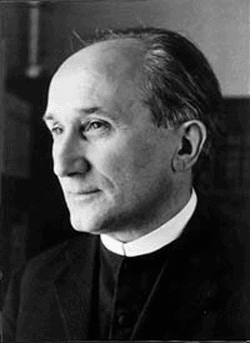

Benedict XVI Has a Father, Romano Guardini
He was the guide of the young Ratzinger, who has not ceased to draw inspiration from his thought. Forty years after the death of the great Italian-German intellectual, an analysis of his influence on the current pope
Featured Author -- Romano GuardiniCIN - Meditations Before Mass, Romano Guardini
St. Anselm of Canterbury and Romano Guardini
Romano Guardini on the Psychology of Christ
Spirit of the Liturgy - Romano Guardini
Zenit: Holy See on Responsibility to Protect
Holy See on Responsibility to Protect
"Invoked As a Pretext for the Arbitrary Use of Military Might"
NEW YORK, SEPT. 30, 2008 (Zenit.org).- Here is the address Archbishop Celestino Migliore, permanent observer of the Holy See to the United Nations, gave Monday at the general debate of the 63rd session of the General Assembly.
* * *
Mr President,
As you assume the presidency of this 63rd session of the General Assembly, my delegation wishes you all the best in your endeavors and looks forward to working with you in order to address the many challenges facing the global community.
This general debate is an occasion for those responsible for the national life of every country to come together to get the pulse of the world situation. By its nature and structure, the United Nations normally creates neither the events nor the trends, but rather, serves as a sounding board where events and trends are submitted for debate and a coherent, consensual and timely response. This year has been dominated by a number of challenges and crises: natural and man-made calamities, staggering economies, financial turmoil, rising food and fuel prices, the impact of climate change, local wars and tensions. We have been called to this Hall once again to identify the common causes and denominators underlying these diverse crises and to craft adequate long-term solutions.
One of the clear facts recognized by all is that every crisis presents a mixture of natural factors and elements of human responsibility. However, these are all too often compounded by tardy response, failures or reluctance of leaders to exercise their responsibility to protect their populations.
When speaking within these walls of the responsibility to protect, the common understanding of the term is found in the 2005 Outcome Document, which refers to the responsibility of the international community to intervene in situations where individual governments are not able or willing to assure the protection of their own citizens.
In the past, the language of "protection" was too often a pretext for expansion and aggression. In spite of the many advancements in international law, this same understanding and practice tragically continues today.
However, during the past year in this same Hall, there has been growing consensus and greater inclusion of this expression as a vital component of responsible leadership. The responsibility to protect has been invoked by some as an essential aspect of the exercise of sovereignty at the national and international levels, while others have re-launched the concept of the exercise of responsible sovereignty.
For his part, Pope Benedict XVI, in his address to the General Assembly of the United Nations last April, also recognized that from the very ancient philosophical discourses on governance to the more modern development of the nation-state, the responsibility to protect has served and must continue to serve as the principle shared by all nations to govern their populations and regulate relations between peoples. These statements highlight the historical and moral basis for States to govern. Likewise, they reassert that good governance should no longer be measured simply within the context of "state's rights" or "sovereignty" but rather, by its ability to care for those who entrust leaders with the grave moral responsibility to lead.
Despite the growing consensus behind the responsibility to protect as a means for greater cooperation, this principle is still being invoked as a pretext for the arbitrary use of military might. This distortion is a continuation of past failed methods and ideas. The use of violence to resolve disagreements is always a failure of vision and a failure of humanity. The responsibility to protect should not be viewed merely in terms of military intervention but primarily as the need for the international community to come together in the face of crises to find means for fair and open negotiations, support the moral force of law and search for the common good.
Failure to collectively come together to protect populations at risk and to prevent arbitrary military interventions would undermine the moral and practical authority of this Organization. The "we the peoples" who formed the United Nations conceived the responsibility to protect to serve as the core basis for the United Nations. The founding leaders believed that the responsibility to protect would consist not primarily in the use of force to restore peace and human rights, but above all, in States coming together to detect and denounce the early symptoms of every kind of crises and mobilize the attention of governments, civil society and public opinion to find the causes and offer solutions. The various agencies and bodies of the United Nations also reaffirm the importance of the responsibility to protect in their ability to work in close proximity and solidarity with affected populations and to put into place mechanisms of detection, implementation and monitoring.
It is incumbent not only upon States, but also the United Nations, to ensure that the responsibility to protect serves as the underlying measure and motivation of all its work.
While many continue to question and debate the real causes and medium and long term consequences of the various financial, humanitarian and food crises around the world, the United Nations and its membership have the responsibility to provide direction, coherence, and resolution. At stake is not only the credibility of this Organization and global leaders but, more importantly, the ability of the human community to provide food and security and to protect basic human rights so that all peoples have the opportunity to live with freedom from fear and want and thus realize their inherent dignity.
The United Nations was not created to be a global government but is the product of the political will of individual member States. Thus, it is the child orphaned by HIV/AIDS, the boys and girls sold or forced into slavery, those who wake each morning not knowing if today they will be persecuted for their faith or the color of their skin, who continue to cry out for an institution and leaders who will back their words with actions, commitments and results. These voices, which are too often ignored, must finally be listened to, so that we can move beyond political, geographical and historical divisions and create an organization which reflects our best intentions rather than our various failings.
One area in which our best intentions require urgent action is climate change. My delegation commends Secretary-General Ban Ki-moon for his leadership in recognizing the urgency to tackle this issue and we commend States and civil society in making the necessary political and personal sacrifices to ensure a better future.
The challenge of climate change and the various solutions proposed and put into action, bring us to point out a preoccupation and inconsistency that exist today in the realm of international and national law, namely, that all that is technically possible must be legally licit.
Sunday, September 28, 2008
1978 Congregation for the Doctrine of Faith document on apparition discernment
source of the unoffical English translation--1978 Congregation for the Doctrine of Faith document on apparition discernment (in French) - the sections in italics are opening and closing remarks by Joachim Bouflet [not reproduced here]- these remarks and the text from the CDF are taken from his book, jointly authored with Philippe Boutry, Un signe dans le ciel, (Grasset, Paris, 1997), pp. 396-99.
Preliminary Note: Origin and character of these norms.
At the time of the Annual Plenary Congregation during November 1974, the Fathers of this Sacred Congregation studied the problems relating to apparitions and supposed revelations, and the consequences which often result from these, and they arrived at the following conclusions:
1. Today more than formerly, the news of these apparitions is spread more quickly among the faithful thanks to the means of information ("mass media"); in addition, the ease of travel supports more frequent pilgrimages. Also, the ecclesiastical authority was itself brought to reconsider this subject.
2. Similarly, because of current instruments of knowledge, the contributions of science, and the requirement of a rigorous criticism, it is more difficult, if not impossible, to arrive as speedily as previously at judgements which conclude, as formerly happened, investigations into this matter (“constate de supernaturalitate, non constat de supernaturalitate”); and because of that, it is more difficult for the Ordinary to authorize or prohibit public worship or any other form of devotion of the faithful.
For these reasons, so that the devotion stirred up among the faithful by facts of this kind can appear as a disposition in full communion with the Church, and bear fruit, and so that the Church itself is able to ultimately distinguish the true nature of the facts, the Fathers consider that it is necessary to promote the following practice in regard to this matter.
So that the ecclesiastical authority is able to acquire more certainty on such or such an apparition or revelation, it will proceed in the following way:
a) Initially, to judge the facts according to positive and negative criteria (cf. below, n.1).
b) Then, if this examination appears favorable, to allow certain public demonstrations of cult and devotion, while continuing to investigate the facts with extreme prudence (which is equivalent to the formula: “for the moment, nothing is opposed to it”).
c) Finally, after a certain time, and in the light of experience, (starting from a particular study of the spiritual fruits generated by the new devotion), to give a judgement on the authenticity of the supernatural character, if the case requires this.
I. Criteria of judgement, concerning the probability at least, of the character of the apparitions and supposed revelations.
A) Positive criteria:
a) Moral certainty, or at least great probability, as to the existence of the fact, [revelation] acquired at the end of a serious investigation.
b) Particular circumstances relating to the existence and the nature of the fact:
1. Personal qualities of the subject—in particular mental balance, honesty and rectitude of moral life, habitual sincerity and docility towards ecclesiastical authority, ability to return to the normal manner of a life of faith, etc.
2. With regard to the revelations, their conformity with theological doctrines and their spiritual veracity, their exemption from all error.
3. A healthy devotion and spiritual fruits which endure (in particular, the spirit of prayer, conversions, signs of charity, etc).
B) Negative criteria:
a) A glaring error as to the facts.
b) Doctrinal errors that one would attribute to God himself, or to the Blessed Virgin Mary, or the Holy Spirit in their manifestations (taking into account, however, the possibility that the subject may add something by their own activity—even if this is done unconsciously—of some purely human elements to an authentic supernatural revelation, these having nevertheless to remain free from any error in the natural order. Cf. St Ignatius, Spiritual Exercises, n. 336).
c) An obvious pursuit of monetary gain in relation with the fact.
d) Gravely immoral acts committed by the subject, or his associates, at the time of the facts, or on the occasion of these facts.
E) Psychic disorders or psychopathic tendencies concerning the subject, which would exert an unquestionable influence on the allegedly supernatural facts, or indeed psychosis, mass hysteria, or other factors of the same kind.
It is important to consider these criteria, whether they are positive or negative, as indicative standards and not as final arguments, and to study them in their plurality and in relation with the other criteria.
II. Intervention of the competent local Authority
1. As, at the time of a presumed supernatural fact, worship or an ordinary form of devotion is born in a quasi spontaneous way among the faithful, the competent ecclesiastical Authority has the serious obligation to inform itself without delay and to carry out a diligent investigation.
2. At the legitimate request of the faithful (when they are in communion with their pastors and are not driven by a sectarian spirit), the competent ecclesiastical Authority can intervene to authorize and promote various forms of worship and devotion if, assuming the criteria given above having been applied, nothing is opposed to it. But there must be vigilance nevertheless, to ensure that the faithful do not regard this way of acting as an approval by the Church of the supernatural character of the event in question (cf. above, Preliminary Note, c).
3. By virtue of his doctrinal and pastoral duty, the competent ecclesiastical Authority can intervene immediately of his own authority, and he must do so in serious circumstances, for example, when it is a question of correcting or of preventing abuses in the exercise of worship or devotion, to condemn erroneous doctrines, to avoid the dangers of a false mysticism etc.
4. In doubtful cases, which do not involve the welfare of the Church, the competent ecclesiastical Authority may refrain from any judgement and any direct action (more especially as it can happen that, at the end of a certain time, the supposedly supernatural event can lapse from memory); but he should not remain less vigilant about the event, in such a way as to be in a position to intervene with swiftness and prudence, if that is necessary.
III. Other Authorities entitled to intervene
1. The foremost authority to inquire and to intervene belongs to the local Ordinary.
2. But the regional or national episcopal Conference may intervene:
a) If the local Ordinary, after having fulfilled the obligations which fall to him, resorts to them for a study of the event in its entirety.
b) If the event assumes national or regional importance.
3. The Apostolic See can intervene, either at the request of Ordinary himself, or at the request of a qualified group of the faithful, or directly by virtue of the immediate right of universal jurisdiction of the Sovereign Pontiff (cf. above, IV).
IV. Intervention of the Sacred Congregation for the Doctrine of the Faith
1. a) The intervention of the Sacred Congregation can be agreed to be necessary either by the Ordinary, after he has fulfilled the obligations falling to him, or by a qualified group of the faithful. In this second case, vigilance is necessary so that the recourse to the Sacred Congregation is not motivated by suspect reasons (for example to force, in one way one or another, the Ordinary to modify his legitimate decisions, or to confirm the sectarian drift of a group, etc.)
b) It belongs to the Sacred Congregation to intervene of its own accord in serious cases, in particular when the event affects a broad portion of the Church; but the Ordinary will always be consulted, as well as the episcopal Conference, if the situation requires it.
2. It belongs to the Sacred Congregation to discern and approve the way of acting of the Ordinary, or, if it proves to be necessary, to carry out a new examination of the facts distinct from that which the Ordinary carried out; this new examination of the facts will be done either by the Sacred Congregation itself, or by a commission especially established for this purpose.
The present norms, defined in the plenary Congregation of this Sacred Congregation, were approved by the Sovereign Pontiff, Pope Paul VI, on February 24 1978.
At Rome, the Palace of the Sacred Congregation for the Doctrine of the Faith, February 27, 1978.
Francis, Cardinal Seper, Prefect, Fr. Jerome Hamer, O.P., Secretary.
Saturday, September 27, 2008
Christian Order: True and False Martyrdom
here
True and False Martyrdom
FATHER PETER JOSEPH, S.T.D.
Here is an eyewitness account of St Cyprian's martyrdom, A.D. 258, in Carthage, near modern Tunis, the capital of Tunisia, North Africa:
The next day, September 14th, a great crowd gathered early in the morning near the Villa Sexti at the command of the proconsul, Galerius Maximus. Then the same proconsul, Galerius Maximus, ordered that Cyprian be brought to him that very day as he was sitting in the atrium at the Sauciolum. When he had been brought forward, the proconsul Galerius Maximus said to the bishop Cyprian, "Are you Thascius, known also as Cyprian?" The bishop Cyprian responded, "I am." The proconsul Galerius Maximus said, "Have you presented yourself to people as the head of a sacrilegious movement?" The bishop Cyprian responded, "I have." The proconsul Galerius Maximus said, "The most sacred emperors have ordered you to offer worship." The bishop Cyprian said, "I will not." Galerius Maximus said, "Have a care for your own interests." The bishop Cyprian responded, "In so just a matter there need be no reflection."
After he had spoken with his council, Galerius Maximus hesitatingly and unwillingly pronounced the sentence in words of this sort: "You have lived for a long time in a sacrilegious frame of mind, have gathered very many other members of this impious conspiracy around you and have set yourself up as an enemy of the Roman gods and their sacred rites. Our pious and most sacred princes, the august Valerian and Gallienus and our most noble Caesar, Valerian, have not been able to call you back to the observance of their worship. Therefore, since you are the author and admitted leader of the most worthless crimes, you will yourself be a warning for these people whom you have gathered around you in your crime. Respect for the law will be confirmed by your blood." Once he had said this, he read out the sentence from the tablet: "It has been decided that Thascius Cyprian is to be executed by the sword." The bishop Cyprian said, "Thanks be to God."
After this sentence, the crowd of the brethren said, "Let us also be beheaded with him." On this account a great commotion broke out among the brethren and a large crowd followed him. Cyprian was led into the field of Sextus. There he took off his mantle and hood, knelt down on the ground and prostrated himself in prayer to the Lord. When he had taken off his dalmatic and given it to the deacons, he stood erect and awaited the executioner. When the executioner came, Cyprian ordered his attendants to give the executioner twenty-five gold coins. Linen cloths and handkerchiefs were spread out in front of him by the brethren [Note: to collect the blood, as the relic of a martyr]. After that, blessed Cyprian put on the blindfold with his own hands, but since he was not able to tie the ends by himself, the priest Julianus and the subdeacon Julianus tied them for him.
In this manner the blessed Cyprian suffered death and his body was laid in a place nearby on account of the curiosity of the pagans. Then it was taken up at night with candles and torches and brought with prayer and great triumph to the cemetery of the procurator Macrobius Candidianus, which is near the pools. After a few days the proconsul Galerius Maximus died.
The most blessed martyr Cyprian suffered on the fourteenth of September under the emperors Valerian and Gallienus, but in the reign of Our Lord Jesus Christ, to whom is honour and glory forever and ever. Amen."
We note three elements of his martyrdom: 1. put to death, 2. for Christ: for the Faith, for refusing to apostasize and offer false worship, etc., and 3. further, Christian joy and gladness to die for Christ's sake (virtuous model).
The true approach to martyrdom is to see it as a triumph. So the early Christians rejoiced when one of their number was faithful unto death. Similarly, during the persecutions of the 16-17th century, seminarians at the English College, Rome, used to gather at the foot of the chapel's painting of the Holy Trinity to sing a Te Deum whenever news arrived that a former student had been put to death for the Faith. It is a victory over the world, the flesh and the devil - everything that opposes your Christian life. It is the greatest way to die; it is the highest form of Christian death. See the section on martyrdom in the Catechism of the Catholic Church #2471-4.
Definition of martyrdom
The great moral theologian, Dominic Prummer O.P., says:
Acts of Fortitude. …these acts reach their peak in martyrdom. Martyrdom is the endurance of bodily death in witness to the Christian religion. Therefore three conditions must be verified for martyrdom: a) actual death; b) the infliction of death by an enemy out of hatred for Christianity. c) the voluntary acceptance of death. - Therefore the following are not genuinely martyrs: those who die by contracting disease in their care of lepers, those who suffer death for natural truths or for heresy, or who [indirectly] bring about their own death to safeguard their person. - The effect of martyrdom is the remission of all sin and punishment, since it is an act of perfect charity.
According to Christian doctrine, martyrdom renders the soul of the martyr worthy of immediate entrance into heaven. The Church prays to the martyrs but has never prayed for the martyrs.
Likewise, Dominican Fr Benedict Ashley says:
True martyrdom requires three conditions: (1) that the victim actually die, (2) that he or she dies in witness of faith in Christ which is directly expressed in words, or implicitly in acts done or sins refused because of faith, and (3) that the victim accepts death voluntarily. They are not martyrs who do not actually die, or die from disease, for the sake of merely natural truths, or heresy, or for their country in war, or through suicide, etc.
Fr Ashley explains:
'Martyr' is often used loosely of anyone who dies for the sake of any cause. But the Christian cause is in fact objectively true, and not a subjective illusion, as are many of the causes for which persons die sincerely but deludedly. Thus those who die for the sake of fanatical religious cults, or as terrorists, or for their own glory, however sincere, are not genuine martyrs, but are objectively suicides. Nor are those who die for a noble but merely human motive, as the parent who dies to save a child, or a soldier for his country, since such virtuous acts can pertain simply to the order of natural virtue.
In 2004, the Pope canonised Gianna Beretta Molla, an Italian mother. During her pregnancy with her fourth child, she was diagnosed with a large ovarian cyst. Her surgeon recommended an abortion in order to save Gianna's life. She refused that, of course, and refused any operation, since that would threaten the life of her baby. So she died a week after childbirth, in 1962, at the age of 39, heroically caring more for her unborn child than for her own life. Today that child is a physician herself, and involved in the pro-life movement in Italy. Her mother is not a martyr, but a hero of love, and her mother's sacrifice brought forth a harvest.
The sacred name of martyr belongs only to one who renders testimony to divine truth. A heretic in good faith who dies for Christ may be counted among the martyrs, but a contumacious heretic who dies for his sect is not a martyr because he does not testify to divine truth but to a (false) human teaching.
Blessed Damien of Molokai is a hero (of charity), but not a martyr. St Pio of Pietrelcina suffered enormously over 50 years with the stigmata, but is not a martyr. In the Missal, a saint who is a martyr is always named such. M. is placed next to their name for Martyr.
We count as an exception the Holy Innocents, whom the Church, although they lack the usual element of acceptance of death, nevertheless honours as martyrs in the liturgy because they died in the place of the infant Christ and received the Baptism of Blood.
Abortion victims cannot be counted as martyrs; they are victims but not martyrs. There is a movement, originating in Surbiton, London, to get them officially canonised - but this is a mistake. If they are martyrs, then every murder victim dying in a state of grace would be a martyr. This is seen to be false from the investigation the Church conducts into a claimed martyr.
For a claimed martyr, the object of the initial diocesan inquiry is threefold: (a) the candidate's life (b) martyrdom (c) reputation for martyrdom. The crucial question to establish martyrdom is: was this person killed for the faith? Not simply: was he murdered? - which is usually obvious.
Death itself might not occur immediately, but if the sufferings inflicted lead to death within a reasonable time, then that will count as martyrdom. In English law, it has been the practice to deem an act "murder" (or manslaughter) if death comes within a year and a day from the injury inflicted.
The Church has always held that martyrdom is equivalent to baptism for those not yet baptised. Baptism of Blood is the name given to this. It is Catholic doctrine that the Baptism of Blood blots out Original Sin, and all actual sin, together with the punishment due to it. This is evident from the words of Christ: He has absolutely promised salvation to those who give their lives for the Gospel: "he who loses his life for my sake will find it"; and again He says, "So everyone who acknowledges me before men, I also will acknowledge before my Father who is in heaven". Moreover, from the Tradition of the Church: the Church honours as martyrs in heaven several who were never baptised: the Holy Innocents massacred by Herod; St Emerentiana (c. 304); one of the 22 Ugandan martyrs, St Mukasa Kiriwawanvu, who was still a catechumen. St Augustine says, "it would be an affront to pray for a martyr: we should rather commend ourselves to his prayers." (Sermon 159)
"Today the term 'martyr' is applied very freely to all sorts of people; for example, the Japanese kamikaze pilots, the Buddhists who burnt themselves as a protest to communism, and the Shiite soldiers in the Iran-Iraq ware are all called 'martyrs'. But this most honourable title, which means 'witness' has a specifically Jewish and Christian meaning."
The Blessed Virgin Mary, since she surpassed the martyrs in her sorrows, is called Queen of Martyrs, but strictly speaking she was not a martyr, since she did not die from her sorrows.
Witness and martyrdom in the Bible
The mission of Jesus was too difficult and too great to be accomplished by simple force. "It had to be accomplished through the much harder way of courageous suffering and dying in witness of the truth. Hence the New Testament model is not the warrior but the martyr, of which Jesus on the Cross is the supreme example, accompanied by his mother Mary, her heart pierced spiritually by the same lance that pierced the heart of her Son (cf. Lk 2:34-35)."
The strict concept of martyrdom is first clearly stated in the Bible in the story of the seven brothers and their mother (2 Macc 7) who died rather than eat pork which the Greek oppressors tried to force upon them to indicate their renunciation of the law and the covenant with God. But in the same persecution, Judas Maccabeus was not a martyr-although he died fighting for the Jewish Law-because he died fighting, not as one submitting to being killed.
Jesus Himself prophetically exhorted His disciples to be the witnesses of His life and His words. He even predicted in detail their lot: they will be chased from the Synagogue, betrayed by their own relatives, accused and hauled before kings and governors, and put to death for His name (Mt 10:17, 24; Lk 21:12).
The first Christian martyr after Jesus Himself was St Stephen, stoned to death in Jerusalem for preaching the Gospel. As they were stoning Stephen, he called out, "Lord Jesus, receive my spirit." Then he fell to his knees and cried out in a loud voice, "Lord, do not hold this sin against them"; and when he said this, he fell asleep (Acts 7:59-60). Even during Our Lord's Public Ministry, St John the Baptist died a martyr's death, in witness to the law of God regarding marriage.
Thus the Christian martyr does not die out of hatred of the enemy as a soldier might, but out of love for his killers, as Jesus taught and lived (Mt 5:43-48). "No man has greater love than this, to lay down one's life for one's friends" (Jn 15:13), but for the Christian our enemies are also our friends as long as their conversion is possible. After Stephen: St Peter, St Paul, and St James the Apostle (Acts 12:2) were all martyrs, and following them a "great cloud of witnesses" (Heb 12:1). In the liturgy of the Church, special honour is given to the Virgin Martyrs (women and men, Rev 14:4) who are models of both the virtues of chastity and courage.
Christians who do not die for the faith, may yet share in martyrdom, as the Virgin Mary did, by being ready to die for it. Christians are engaged in a spiritual warfare:
Put on the whole armour of God, that you may be able to stand against the wiles of the devil. For we are not contending against flesh and blood, but against the principalities, against the powers, against the world rulers of this present darkness, against the spiritual hosts of wickedness in the heavenly places. Therefore take the whole armour of God, that you may be able to withstand. - Eph 6:11-13
Be sober, be watchful. Your adversary the devil prowls around like a roaring lion, seeking someone to devour. Resist him, firm in your faith, knowing that the same experience of suffering is required of your brotherhood throughout the world. - 1 Pet 5:8-9
The value of life and the value of martyrdom
Appreciating the dignity of man made in the image of God, we can appreciate the heinousness of the sin of murder (deliberate killing of an innocent) in any form: homicide, abortion, infanticide, or euthanasia. Human life is a sacred gift from God. No one may take his own life or that of another. From conception until death, innocent human life deserves respect and the protection of law.
However, sacred though life is, it is not the supreme good. We are not bound to do everything to save our life or that of another: in serious illness, one is not bound to accept expensive and burdensome treatments (Catechism of the Catholic Church, 2278); in grave need, one may risk one's life to help others, or even make the supreme sacrifice. The Church honours the martyrs because they sacrificed their lives rather than give up greater and higher goods: the Faith, and union with God. The good of human life is ordained unto eternal life. The goods of bodily life are less in value than the good of spiritual life. Christ and the Church do not urge us to be ready to give up great things for lesser things: that would be an absurdity! It is our love for a higher good that justifies the sacrifice of lesser goods. At the same time, the high value of life tells us the value of martyrdom.
As the Catechism of the Catholic Church says, martyrdom is the highest form of witness to the faith. One contemporary moral theologian writes: "The suffering and death of so many Christian martyrs up to the present time in confession of their religion is the most eloquent witness to the conviction of the Church that the faith may never be denied." Today, many people despise martyrdom. Why is that? Among other factors: loss of strong belief in the next life; loss of belief in the evil of apostasy, leading to the notion that pragmatically it is better to compromise even on essentials; lack of the virtue of fortitude, sapped by easy living; the belief that nothing is worth dying for.
The same moralist writes: "If a man is requested to deny God or to act against the divine will, e.g., to kill an innocent person, he must rather sacrifice his own life than contradict the supreme claims of God upon him. Martyrdom, by which a man lays down his life for Christ and his brothers, as Christ did for us (1 Jn 3:16), is the highest proof of love. 'Though few are presented with such an opportunity, nevertheless all must be prepared to confess Christ before men, and to follow Him along the way of the cross through the persecutions which the Church will never fail to suffer' (LG 42)."
Interestingly, when Jews today complain of what Christians did, or did not do, to save Jews from round-ups and death camps in World War II, they are basing their complaint on this doctrine that men should have given up their lives rather than participate in such heinous deeds; that, no matter what the cost, even if it meant being put to death by Nazis, they should have refused to perform acts against innocent Jews; that they should have been martyrs, if necessary.
"Itaque martyres non facit poena, sed causa."
This is one of the countless great sayings of St Augustine, who said: "Now they are true martyrs, of whom the Lord said, 'Blessed are they who suffer persecution for the sake of righteousness'. Not therefore for the sake of iniquity, or for the sake of an unholy division of Christian unity, but they who suffer persecution for the sake of righteousness-these are the true martyrs … The Lord Himself was crucified with thieves, but they whom suffering joined, the cause separated."
"'Look upon my judgement, my God and my Lord, look upon my cause' (Ps 34:23). Not upon my penalty, but upon my cause … For the penalty is similar for the good and the wicked. Therefore the penalty does not make martyrs, but the cause. For if the penalty made martyrs, all the mines would be full of martyrs, all chains would be dragging along martyrs, all who are slain by the sword would be crowned."
If the cause did not matter, but the mere fact of death, then we should be ready to die for any idea, no matter how false or absurd - as long as holding it leads to martyrdom!
The truth for which you suffer is crucial! One can admire mistaken people who suffer for their beliefs - but one cannot imitate them or commend them. If the truth of the cause, or the goodness of the virtue, were in question, or mistaken, there would be no reason to suffer for them: it would be the height of absurdity!
The Catholic Church never publicly honours non-Catholic "martyrs", because there is a defective element, more or less serious, in the content of their virtue of faith. When canonising the 22 Ugandan martyrs (St Charles Lwanga and his companions), in 1964, Pope Paul VI said, "Nor should we forget those others, of the Anglican communion, who died for the sake of Christ." He did not officially pronounce the Anglican ones 'martyrs' (it was not his office to do so in any case, since they were not members of his flock) but they could rightly be deemed such, since they died for Christ and Christian virtue - and not specifically for the Church of England vs the Catholic Church.
Real martyrs vs false martyrs
The word martyr is often used loosely and even falsely. I want to summarise my main points in eight propositions, and explain each one.
* Real martyrs do not kill themselves
* Real martyrs suffer harm but never inflict harm
* Real martyrs do not seek death but accept it when it comes
* The Christian martyr does not die out of hatred of the enemy, but out of love for Jesus
* Real martyrs die bearing witness to truth
* Martyrdom properly involves death, not just suffering, however intense
* Some people are victims but not martyrs
* Some people are heroes but not martyrs
1. Real martyrs do not kill themselves.
Suicide protestors dousing themselves with petrol, e.g., Buddhist monks in Vietnam in the 1960's; prisoners who hunger strike unto death, e.g., Bobby Sands in Maze prison in Northern Ireland in 1981, and Terence McSweeney, the Mayor of Cork, in 1920, whose bishop (rightly) said he could not receive Holy Communion or be anointed; Palestinian suicide bombers - all these are not martyrs.
2. Real martyrs suffer harm but never inflict harm.
Japanese kamikazes, or the September 11 Muslim kamikazes: their courage is extraordinary, but their beliefs are wrong, and their virtue is misguided-the Japanese ones less so, since it was in warfare.
The title of martyr is only given to those who do not try to save their lives by resistance. Archbishop Michael Sheehan, one-time co-adjutor Archbishop of Sydney, wrote, "Christ was slain by the enemies of truth, the enemies of God, and offered no resistance. The martyr's death is like the death of Christ; hence its great fruitfulness for the soul. Resistance, so far as it spoils the likeness to our Saviour's Passion, is inconsistent with martyrdom; that likeness is not, of course, spoiled in the case of one who resists an unchaste assailant solely for the purpose of escaping sin and defilement. Soldiers who fall on the battle-field, fighting for God or virtue, may be martyrs, but since, in their case, it would be difficult to establish that there is no admixture of any merely human motive, such as self-protection or the desire of distinction, the Church follows the rule that those who die as combatants must not be honoured as martyrs."
3. Real martyrs do not seek death but accept it when it comes.
Some of the early Fathers told their more zealous parishioners, "Do not go to the officers of the law and denounce yourselves as Christians!" St Thomas More did not seek martyrdom: he had great courage and prudence.
4. The Christian martyr does not die out of hatred of the enemy, but out of love for Jesus.
Thus the Church as a precautionary measure does not honour combatants as martyrs. However, they can be praised for their heroic deaths and for showing "no greater love than to lay down their lives for their friends." There is no canonised martyr whose last words expressed spite or anger or vengeance. Many of the English martyrs prayed for Queen Elizabeth who had decreed their execution, e.g., St Edmund Campion, and their love of enemies was always a powerful testimony to their Christian virtue and holiness.
5. Real martyrs die bearing witness to truth.
The fact of dying in itself does not render one a martyr. The Anglican boys murdered in Uganda were martyrs who died for Christian morality - but not the three Anglican bishops put to death under Queen Mary in 1555 and 1556: Hugh Latimer, Nicholas Ridley and Thomas Cranmer, who died while holding out against the Catholic religion.
For martyrdom, it must be ascertained: first, that the killer hated the Faith, and second, that the victim died as a witness to the Faith or a Christian virtue. The cause, then, must be either a belief or a virtue. St Maria Goretti died for the virtue of chastity, and also while warning her assailant, "No, Alessandro, it is a sin; you will go to Hell." She was more concerned for his soul than for her own safety. Her heroic virtue, as well as that of her mother, was evident when her mother said to her in hospital, "Maria, you must forgive Alessandro." And Maria replied, "I have already."
St Thomas More died for the truth, for the Papacy, for the Catholic religion; he was not a 'martyr for conscience' as some people like to say. Australian political activist B.A. Santamaria (1915-1998) explained so well why this is so:
The Protestant Reformation had established the fundamental distinction between the Protestant and the Catholic positions. The Protestant took his stand on the ultimate sovereignty of the Bible and, subject to that, the finality of the private judgement of the individual conscience on matters of both faith and morality. The Catholic position was that, when either Pope or Council spoke 'authoritatively' on matters of faith or morals, the content of those declarations was binding on the conscience of the Catholic. If a Catholic believed that such definitions were outrageously wrong then he must come logically to the conclusion that the Church which promulgated them could not be guaranteed in the rightness of its declarations by God Himself. It was difficult to see what point there was in belonging to a Church whose basic claim had thus been falsified in the event. If, however, the Catholic believed that the fundamental basis of divine guidance on this quite restricted list of subject-matters was established, he was clearly bound by what was thus guaranteed.
There are strong arguments for both Protestant and Catholic positions, both of which have been held by strong intellects animated by high principles. But they are basically opposed positions. … The binding force of this external authority is the exact difference between the Catholic and the Protestant positions. It is in fact what the Reformation was all about. It is why Thomas More and John Fisher went to execution.
…In one of the more ironic manifestations of the general mood, St Thomas More was invoked as authority for the dubious proposition that the private conscience was the supreme arbiter of a Catholic's religious and moral beliefs: that so long as it was done in good conscience the obligation of Sunday Mass could be set aside (if the ceremony 'did you no good'), or that pre-marital sex was permissible (so long as the couple genuinely loved each other).
Some five centuries too late, one began to feel a little sorry for the martyred Chancellor. It was bad enough to be beheaded in the sixteenth century. It was much worse to become a cult figure in the twentieth. Because of the dramatic brilliance of Robert Bolt's A Man for All Seasons, he came to be regarded as the patron saint of 'protest', in the name of individual conscience against external authority: a kind of sixteenth-century Jane Fonda.
… it became necessary to point out that Thomas More was nothing of the kind. His carefully framed last words - 'the King's good servant, but God's first' - indicated the opposite.
… It is now claimed, with increasing emphasis, that Thomas is not only, in Bolt's words, a 'man for all seasons', but the common property of all Christian religious persuasions. For, it is said, he died for conscience, and this is the only thing which really matters. For this reason, Thomas More is sacred to all Christians, regardless of denomination, just as are Latimer and the Anglican martyrs, who also died, equally and undoubtedly, for conscience.
In our own age, we have seen Marxists, anarchists, Serbs, Croats, Macedonians, all die bravely for conscience. Like all brave men who die for ultimate conviction, they are worthy of our admiration, however one may judge their principles.
But it is a very different thing to imply either that the principles for which men die are all equally valid, because heroic men have died for all of them; or equally unimportant, since what matters is not the principles but the tribute of conscience, regardless of the principle, in the martyr's final testimony.
Such a view seems to make a nonsense of their decision to die at all. Why die violently, when what you think you are dying for is not of ultimate worth at all?
Sir Thomas More refused to attend Henry VIII's second marriage and he refused to sign the Act of Parliament making the King head of the Church in England. He never said, "I die for my conscience". Conscience is like a watch - you have to set it to the right time. It does not have a primacy. Truth, the Word of God, the teaching of the Church - all the same thing - have the primacy. Conscience is subject to them; not they to conscience. Cardinal George Pell of Sydney said in 2003, "I believe strongly in the importance of individual conscience. It is indispensable. … In the past I have been in trouble for stating that the so-called doctrine of the primacy of conscience should be quietly dropped. I would like to reconsider my position here and now state that I believe that this misleading doctrine of the primacy of conscience should be publicly rejected."
What about those who are sincere in their errors? God alone can judge them. However, we must remember that we have to give an account to God, not only of our actions but also of our beliefs, since we may have been guilty of refusing Him the obedience of faith. We are responsible for our beliefs; and there is culpability in rationalisation and seeking the easy way out of duty.
6. Martyrdom properly involves death, not just suffering, however intense.
Sometimes people say: "He was a martyr for the cause; he was martyred for standing up for his beliefs"-when a man loses his job or position or whatever, but not life itself. Sometimes the phrase white martyrs is used, meaning Christians, such as in China, who have endured decades of imprisonment or ill-treatment, e.g., Archbishop Dang S.J. who spent 22 yrs in prison in China, 7 of them in solitary confinement; Cardinal Francis Xavier van Thuan who died in 2002: he was imprisoned from 1975, at the fall of Saigon to the Communists, until 1988.
7. Some people are victims but not martyrs:
Victims murdered out of revenge or killed in a robbery. Blessed Mary of Jesus (Sr Deluil-Martiny) of Belgium, born 1841, murdered in 1884 by a freemason who had declared his intention to kill - but there was an element of personal revenge for losing his job as convent gardener.
8. Some people are heroes but not martyrs:
Policemen who are shot dead in the line of duty; firemen who die while fighting fires or trying to rescue people; rescue workers who perish while saving others or trying to do so.
The witness of the martyrs
The fortitude of the Church's martyrs has been miraculous: because some persecutions extended over decades or centuries (such as in the Roman Empire, or in recent centuries, China, Japan or Vietnam); because vast numbers of every rank and age have suffered, including little children; because they endured, without surrender, the most terrible tortures; because they were unmoved in the face of the attractive rewards promised them, if they yielded; because, in the throes of death, they gave a beautiful and superhuman manifestation of Christian virtue, of the joyful acceptance of death and suffering, and of the very spirit of Christ on the Cross, praying for the salvation of their enemies, and blessing their killers.
The blood of martyrs is the seed of Christians
"Crucify us [Christians], torture us, condemn us, grind us to dust; your injustice is the proof that we are innocent", says Tertullian to the Roman authorities. "Nor does your cruelty, however exquisite, avail you; it is, rather, an incitement to us. The more often we are mown down by you, the more we grow in number: the blood of Christians is the seed."
Martyrdom today
And the martyrdoms continue: it is estimated that every two weeks at least one Catholic missionary somewhere is put to death. There were more martyrs for Christ in the 20th century than in all the previous nineteen centuries put together. These countless deaths have not been without fruit. Now as earlier, the blood of martyrs is the seed of Christians: apart from that major fruit garnered by the martyrs themselves - undying glory in Paradise - the Church universal has continued to expand: in Africa, Catholics numbered two million in 1900, and now number 110 million. "Christus vincit, Christus regnat, Christus imperat!": "Christ conquers, Christ reigns, Christ rules!"
The lesson for us today is clear: we have so little to complain of when we read the lives of the martyrs. We are called to be ready to lay down our lives; and we prepare ourselves by giving our lives to Christ. In the meantime, we are called to endure what we might loosely call "the martyrdom of daily duty." Performing our daily duties; being honest and virtuous even when this means being ostracised or mocked; refusing to compromise on our Christian morality; refusing to sell immoral devices; never voting for evil in a club or association; refusing to take part in dishonest or obscene enterprises; being faithful to our marriage even when our marriage partner has abandoned us.
"Be faithful unto death," says the Lord in Revelations 2:10, "and I will give you the crown of life."
The author is the Chancellor of the Maronite Diocese of Australia and editor of the revised edition of Archbishop Sheehan's Apologetics and Catholic Doctrine (Saint Austin Press, London 2001).
Subscribe to:
Posts (Atom)