Saturday, February 24, 2007

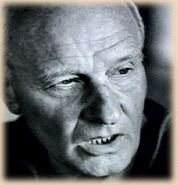
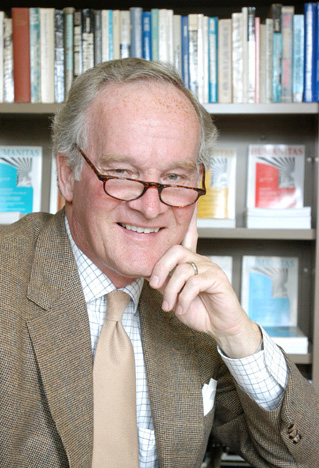
Claes G. Ryn


(National Humanities Institute)
Member of the Politics Department Faculty at CUA:

Claes G. Ryn
Ryn’s areas of research and teaching include ethics and politics, politics and the imagination, historicism and the theory of knowledge, the history of Western political thought, American political thought and constitutionalism. The recipient of many grants and awards, Professor Ryn was named Outstanding Graduate Professor by the CUA Graduate Student Association. He has taught also at the University of Virginia and Georgetown University. Ryn’s many books include, A Common Human Ground, America the Virtuous, Will, Imagination and Reason, and Democracy and the Ethical Life. Ryn is widely published on both sides of the Atlantic and in China. In 2000 he gave the Distinguished Foreign Scholar Lectures at Beijing University. The same university published (in Chinese translation) the book based on the series. Ryn is editor of Humanitas and chairman of the National Humanities Institute (NHI). He served as president of the Philadelphia Society. He was chairman of the Department.

(Professor, Ph.D. Louisiana State, 1974)


CV

Where in the World Are We Going?

Introductory remarks for The Philadelphia Society meeting

The Ideology of American Empire

Which American? by Claes G. Ryn

Defining Historicism

American Conservative articles:
A Jacobin in Chief
What is Left? What is Right?

Books:
A common human ground: universality and particularity in a ...
America the Virtuous

Friday, February 23, 2007

Behe recommendations

From an email I received:

Here are a couple references on flagellum assembly:Minamino,T. and Namba,K. 2004. Self-assembly and type III protein export of the bacterial flagellum. J. Mol. Microbiol. Biotechnol. 7:5-17.Macnab,R.M. 2003. How bacteria assemble flagella. Annu. Rev. Microbiol. 57:77-100.Kalir,S., McClure,J., Pabbaraju,K., Southward,C., Ronen,M., Leibler,S., Surette,M.G., and Alon,U. 2001. Ordering genes in a flagella pathway by analysis of expression kinetics from living bacteria. Science 292:2080-2083.

He also sent me an excerpt from a book chapter he wrote (Behe,M.J. 2004. Irreducible Complexity: Obstacle to Darwinian Evolution. In Debating Design: from Darwin to DNA. (eds. WA Dembski and M Ruse), pp 352-370. Cambridge University Press: Cambridge). It is a response to arguments by Ken Miller regarding the bacterial flagellum.

Finally, rather than showing how their theory could handle the obstacle, some Darwinists are hoping to get around irreducible complexity by verbal tap dancing. At a debate between proponents and opponents of intelligent design sponsored by the American Museum of Natural History in April 2002, Kenneth Miller actually claimed (the transcript is available at the website of the National Center for Science Education) that a mousetrap isn’t irreducibly complex because subsets of a mousetrap, and even each individual part, could still “function” on their own. The holding bar of a mousetrap, Miller observed, could be used as a toothpick, so it still had a “function” outside the mousetrap. Any of the parts of the trap could be used as a paperweight, he continued, so they all had “functions.” And since any object that has mass can be a paperweight, then any part of anything has a function of its own. Presto, there is no such thing as irreducible complexity! Thus the acute problem for gradualism that any child can see in systems like the mousetrap is smoothly explained away.Of course the facile explanation rests on a transparent fallacy, a brazen equivocation. Miller uses the word “function” in two different senses. Recall that the definition of irreducible complexity notes that removal of a part “causes the system to effectively cease functioning.” Without saying so, in his exposition Miller shifts the focus from the separate function of the intact system itself to the question of whether we can find a different use (or “function”) for some of the parts. However, if one removes a part from the mousetrap I pictured, it can no longer catch mice. The system has indeed effectively ceased functioning, so the system is irreducibly complex, just as I had written. What’s more, the functions that Miller glibly assigns to the parts—paperweight, toothpick, key chain, etc.—have little or nothing to do with the function of the system of catching mice (unlike the mousetrap series proposed by John McDonald, discussed below), so they give us no clue as to how the system’s function could arise gradually. Miller explained precisely nothing.With the problem of the mousetrap behind him, Miller moved on to the bacterial flagellum—and again resorted to the same fallacy. If nothing else, one has to admire the breathtaking audacity of verbally trying to turn another severe problem for Darwinism into an advantage. In recent years it has been shown that the bacterial flagellum is an even more sophisticated system than had been thought. Not only does it act as a rotary propulsion device, it also contains within itself an elegant mechanism to transport the proteins that make up the outer portion of the machine, from the inside of the cell to the outside. (Aizawa 1996) Without blinking, Miller asserted that the flagellum is not irreducibly complex because some proteins of the flagellum could be missing and the remainder could still transport proteins, perhaps independently. (Proteins similar—but not identical—to some found in the flagellum occur in the type III secretory system of some bacteria. See Hueck 1998). Again he was equivocating, switching the focus from the function of the system to act as a rotary propulsion machine to the ability of a subset of the system to transport proteins across a membrane. However, taking away the parts of the flagellum certainly destroys the ability of the system to act as a rotary propulsion machine, as I have argued. Thus, contra Miller, the flagellum is indeed irreducibly complex. What’s more, the function of transporting proteins has as little directly to do with the function of rotary propulsion as a toothpick has to do with a mousetrap. So discovering the supportive function of transporting proteins tells us precisely nothing about how Darwinian processes might have put together a rotary propulsion machine.

Aizawa, S. I. Flagellar 1996. Assembly in Salmonella Typhimurium. Molecular Microbiology 19: 1-5.Hueck, C. J. 1998. Type III Protein Secretion Systems in Bacterial Pathogens of Animals and Plants. Microbiology and Molecular Biology Reviews 62: 379-433.

Monday, February 19, 2007

Scott Carson, Aristotle's Philosophy of Biology

check at BC

G-L on St. Thomas and supernatural contemplation

here!


St. Thomas shows in the Summa (12) that contemplation is an act of the intellect superior to reasoning, a simple view of the truth; (13) and, when it is a question not of philosophical contemplation, but of that contemplation which the saints speak of, it springs from love, not only from the love of the knowledge habitual to philosophers, but from the love of God, from charity. (14) It proceeds consequently from living faith enlightened by the gifts of the Holy Ghost, especially by those of understanding and wisdom, which render faith penetrating and sweet.(15) Supernatural contemplation thus conceived supposes the special inspiration of the Holy Ghost, which His gifts dispose us to receive with promptness and docility,(16) as the wide-spread sails on a boat receive the impulsion of a favorable wind; then the boat advances more easily than by the labor of the rowers, a symbol of discursive meditation united to the practice of the virtues. From this point of view, contemplation, because of the special inspiration which it supposes, deserves to be called, not acquired but infused, although at the beginning it may quite frequently be prepared for by reading, affective meditation, and the prayer of petition.(17) The soul thus actively prepares itself to receive the special inspiration of the Holy Ghost, which will at times be strong enough so that discursive meditation will no longer be necessary, as when a favorable wind is strong enough to make the boat advance, the work of the rowers may cease.

This special inspiration of the Holy Ghost given to make us taste the mysteries of faith, uses the connaturality or sympathy with divine things that is rooted in charity.(18) This special inspiration gives rise in us to an act of infused love and of living, penetrating, and sweet faith, which shows us how revealed mysteries, although still obscure, wonderfully correspond to our deepest and loftiest aspirations. These acts of love and of penetrating and sweet faith are said to be infused, not only because they proceed from infused virtues, in this case from the theological virtues, but because they suppose a special inspiration of the Holy Ghost, and because we cannot move ourselves to them with the help of common actual grace. In this case God moves us, not by inclining us to deliberate, but to acts above all discursive deliberation.(19) For example, on reading the Gospel of the day at Mass, some expression that we have read many times is illuminated and captivates us, such as the words of Jesus to the Samaritan woman: "If thou didst know the gift of God!" (20) In like manner a preacher vividly experiences this illumination we are speaking of when at first he feels deeply his powerlessness to preach the Passion in a fitting manner on Good Friday, and then receives the animating breath which vivifies his thought, his will and his feelings, that he may do good to souls.

At times contemplation rises toward God by a straight movement from a sensible fact, for example, from a parable such as that of the prodigal son, to the wonderful vision of the divine mercy.(21) At other times contemplation rises by an oblique movement, for example, from the mysteries of salvation, from those of the childhood of our Savior and of His passion, to the living and profound thought of eternal life.

Lastly, there is occasionally contemplation, called circular, of the infinite goodness of God which radiates on all things, on all the mysteries of salvation. This prayer is a very simple, most loving gaze, which reminds one of the circular flight of the eagle high up in the air, hovering as it gazes at the sun and its radiation over the horizon.(22)

These principles thus formulated by St. Thomas illumine the traditional teaching on contemplative prayer which we found expressed in the works of St. Francis de Sales. This same teaching appears also in a concrete and experiential form in the writings of St. Teresa.


Compare with Fr. Giertych.

Friday, February 16, 2007

"All religions just teach us to be good."

Often the atheist will argue that belief is not necessary, what is necessary is being a good person, someone who will respect others and not injure them. This he has in common with the liberal, who believes that the only purpose of government is to prevent people from hurting each other. Indifferentists will argue that all religions are the same, that it doesn't matter what one believes, as long as one is a good person and does good things. According to them, the primary purpose of religion is to teach people to follow the Golden Rule.

What of the virtues with regard to the self? It seems that most will not acknowledge these, believing that one is free to do whatever one wants with regards to onself, as long as one does not injure someone else in the process, or use someone else as a "means to an end."

In one way, they are correct--with regareds to political life, the virtue of justice is the summit of virtue. But it isn't the greatest virtue, and with respect to our moral formation, it is perhaps easier to grasp than the other moral virtues. At least the habit of not harming others can be inculcated rather easily, as it can be backed up with punishment. The demands of justice are easy to explain--to understand how we are to behave towards others, we can reflect upon how we want to be treated.
Once we understand that other people are like us, and how we can be harmed, we know what can harm others.

The precepts of the moral virtues that pertain to the self, like temperance, can be more difficult to recognize, especially if we have not been brought up with good habits. Once reason has been corrupted, if we become slave to our sense appetites, it will be difficult to convince us that a virtue of temperance is possible or worth pursuing.

More importantly, religion is a form of justice, rendering what is due to God, and not all belief systems are the same in this regard. If we receive existence from some source, we owe something to that source. So those who claim to put a premium on justice are actually neglecting the most important form of justice.

[If there had been no sin… in a created ordered directed to a natural end, would God send his angels to punish sin and to save men?]

Monday, February 12, 2007

Kurt P. Wise


Testimony excerpted from In Six Days.
Bio at Creation Super Library
His review of Stephen J. Gould's Wonderful Life

The Flores Skeleton and Human Braminology pdf
A Refined Baramin Concept pdf
Biblical Typology pdf
The Language of DNA pdf
Ankerberg Theological Research Institute science files
Faith, Form, and Time

Sunday, February 11, 2007

Paul E. Rorem


Professor Paul E. Rorem, Benjamin B. Warfield Professor of Medieval Church History at Princeton Theological Seminary will be giving a Boston Colloquy in Historical Theology lecture on "Love above Knowledge in the Dionysian Commentaries of Eriugena and Hugh of St. Victor."

The lecture will be held on Thursday, February 8, 2007, in Hovey House Library, Hammond St., 7:30 p.m., Boston College, Chestnut Hill, MA.

faculty page
Google Books: Pseudo-Dionysius: The Complete Works - Google Books Result
Oxford University Press: Hugh of Saint Victor: Paul Rorem

I have some notes on this lecture--if I can find them I should type them up...

Ottaviani intervention

text ( PDF)

Alternate sites
Fisheaters.com
Paul Halsall
Catholic Restoration
Latin Mass Society
EWTN
Catholic Tradition
Traditio
Matt1618


St. Joseph's Church
(Translation)
Rome, September 25th, 1969

Most Holy Father,

Having carefully examined, and presented for the scrutiny of others, the Novus Ordo Missae prepared by the experts of the Consilium ad exequendam Constitutionem de Sacra Liturgia, and after lengthy prayer and reflection, we feel it to be our bounden duty in the sight of God and towards Your Holiness, to put before you the following considerations:

1. The accompanying critical study of the Novus Ordo Missae, the work of a group of theologians, liturgists and pastors of souls, shows quite clearly in spite of its brevity that if we consider the innovations implied or taken for granted which may of course be evaluated in different ways, the Novus Ordo represents, both as a whole and in its details, a striking departure from the Catholic theology of the Mass as it was formulated in Session XXII of the Council of Trent. The "canons" of the rite definitively fixed at that time provided an insurmountable barrier to any heresy directed against the integrity of the Mystery.

2. The pastoral reasons adduced to support such a grave break with tradition, even if such reasons could be regarded as holding good in the face of doctrinal considerations, do not seem to us sufficient. The innovations in the Novus Ordo and the fact that all that is of perennial value finds only a minor place, if it subsists at all, could well turn into a certainty the suspicions already prevalent, alas, in many circles, that truths which have always been believed by the Christian people, can be changed or ignored without infidelity to that sacred deposit of doctrine to which the Catholic faith is bound for ever. Recent reforms have amply demonstrated that fresh changes in the liturgy could lead to nothing but complete bewilderment on the part of the faithful who are already showing signs of restiveness and of an indubitable lessening of faith.

Amongst the best of the clergy the practical result is an agonising crisis of conscience of which innumerable instances come tour notice daily.

3. We are certain that these considerations, which can only reach Your Holiness by the living voice of both shepherds and flock, cannot but find an echo in Your paternal heart, always so profoundly solicitous for the spiritual needs of the children of the Church. It has always been the case that when a law meant for the good of subjects proves to be on the contrary harmful, those subjects have the right, nay the duty of asking with filial trust for the abrogation of that law.

Therefore we most earnestly beseech Your Holiness, at a time of such painful divisions and ever-increasing perils for the purity of the Faith and the unity of the church, lamented by You our common Father, not to deprive us of the possibility of continuing to have recourse to the fruitful integrity of that Missale Romanum of St. Pius V, so highly praised by Your Holiness and so deeply loved and venerated by the whole Catholic world.


--------------------------------------------------------------------------------

THE ACCOMPANYING STUDY
BRIEF SUMMARY
I: History of the Change.
The new form of Mass was substantially rejected by the Episcopal Synod, was never submitted to the collegial judgement of the Episcopal Conferences and was never asked for by the people. It has every possibility of satisfying the most modernist of Protestants.
II: Definition of the Mass.
By a series of equivocations the emphasis is obsessively placed upon the 'supper' and the 'memorial' instead of on the unbloody renewal of the Sacrifice of Calvary.
III: Presentation of the Ends.
The three ends of the Mass are altered:- no distinction is allowed to remain between Divine and human sacrifice; bread and wine are only "spiritually" (not substantially) changed.
IV:- and of the essence.
The Real Presence of Christ is never alluded to and belief in it is implicitly repudiated.
V:- and of the four elements of the sacrifice.
The position of both priest and people is falsified and the Celebrant appears as nothing more than a Protestant minister, while the true nature of the Church is intolerably misrepresented.
VI: The destruction of unity.
The abandonment of Latin sweeps away for good and all unity of worship. This may have its effect on unity of belief and the New Order has no intention of standing for the Faith as taught by the Council of Trent to which the Catholic conscience is bound.
VII: The alienation of the Orthodox.
While pleasing various dissenting groups, the New Order will alienate the East.
VIII: The abandonment of defences.
The New Order teems with insinuations or manifest errors against the purity of the Catholic religion and dismantles all defences of the deposit of Faith.


--------------------------------------------------------------------------------

HISTORY OF THE CHANGE
In October 1967, the Episcopal Synod called in Rome was required to pass judgement on the experimental celebration of a so-called "normative Mass" (New Mass), devised by the Consilium ad exsequendam Constitutionem de Sacra Liturgia. This Mass aroused the most serious misgivings. The voting showed considerable opposition (43 non placet), very many substantial reservations (62 juxta modum), and 4 abstentions out of 187 voters. The international press spoke of a "refusal" of the proposed "normative Mass" (New Mass) on the part of the Synod. Progressively-inclined papers made no mention of it. In the Novus Ordo Missae lately promulgated by the Apostolic Constitution Missale Romanum, we once again find this "normative Mass" (New Mass), identical in substance, nor does it appear that in the intervening period the Episcopal Conference, at least as such, were ever asked to give their views about it.
In the Apostolic Constitution, it is stated that the ancient Missal promulgated by St. Pius V, 13th July 1570, but going back in great part to St. Gregory the Great and still remoter antiquity, was for four centuries the norm for the celebration of the Holy Sacrifice for priests of the Latin rite, and that, taken to every part of the world, "it has moreover been an abundant source of spiritual nourishment to many holy people in their devotion to God". Yet, the present reform, putting it definitely out of use, was claimed to be necessary since "from that time the study of the Sacred Liturgy has become more widespread and intensive among Christians".

This assertion seems to us to embody a serious equivocation. For the desire of the people was expressed, if at all, when - thanks to Pius X - they began to discover the true and everlasting treasures of the liturgy. The people never on any account asked for the liturgy to be changed, or mutilated so as to understand it better. They asked for a better understanding of the changeless liturgy, and one which they would never have wanted changed.

The Roman Missal of St. Pius V was religiously venerated and most dear to Catholics, both priests and laity. One fails to see how its use, together with suitable catechesis, could have hindered a fuller participation in, and great knowledge of the Sacred Liturgy, nor why, when its many outstanding virtues are recognised, this should not have been considered worthy to continue to foster the liturgical piety of Christians.

REJECTED BY SYNOD
Since the "normative" Mass (New Mass), now reintroduced and imposed as the Novus Ordo Missae (New Order of the Mass), was in substance rejected by the Synod of Bishops, was never submitted to the collegial judgement of the Episcopal Conferences, nor have the people - least of all in mission lands - ever asked for any reform of Holy Mass whatsoever, one fails to comprehend the motives behind the new legislation which overthrows a tradition unchanged in the Church since the 4th and 5th centuries, as the Apostolic Constitution itself acknowledges. As no popular demand exists to support this reform, it appears devoid of any logical grounds to justify it and makes it acceptable to the Catholic people.
The Vatican Council did indeed express a desire (para. 50 Constitution Sacrosanctum Concilium) for the various parts of the Mass to be reordered "ut singularum partium propria ratio nec non mutua connexio clarius pateant." We shall see how the Ordo recently promulgated corresponds with this original intention.

An attentive examination of the Novus Ordo reveals changes of such magnitude as to justify in themselves the judgement already made with regard to the "normative" Mass. Both have in many points every possibility of satisfying the most Modernists of Protestants.

II DEFINITION OF THE MASS
Let us begin with the definition of the Mass given in No. 7 of the "Institutio Generalis" at the beginning of the second chapter on the Novus Ordo: "De structura Missae":
"The Lord's Supper or Mass is a sacred meeting or assembly of the People of God, met together under the presidency of the priest, to celebrate the memorial of the Lord. Thus the promise of Christ, "where two or three are gathered together in my name, there am I in the midst of them", is eminently true of the local community in the Church (Mt. XVIII, 20)".
The definition of the Mass is thus limited to that of the "supper", and this term is found constantly repeated (nos. 8, 48, 55d, 56). This supper is further characterised as an assembly presided over by the priest and held as a memorial of the Lord, recalling what He did on the first Maundy Thursday. None of this in the very least implies either the Real Presence, or the reality of sacrifice, or the Sacramental function of the consecrating priest, or the intrinsic value of the Eucharistic Sacrifice independently of the people's presence. It does not, in a word, imply any of the essential dogmatic values of the Mass which together provide its true definition. Here, the deliberate omission of these dogmatic values amounts to their having been superseded and therefore, at least in practice, to their denial.

In the second part of this paragraph 7 it is asserted, aggravating the already serious equivocation, that there holds good, "eminently", for this assembly Christ's promise that "Where two or three are gathered together in my name, there am I in the midst of them" (Matt. XVIII, 20). This promise which refers only to the spiritual presence of Christ with His grace, is thus put on the same qualitative plane, save for the greater intensity, as the substantial and physical reality of the Sacramental Eucharistic Presence.

In no. 8 a subdivision of the Mass into "liturgy of the word" and Eucharistic liturgy immediately follows, with the affirmation that in the Mass is made ready "the table of the God's word" as of "the Body of Christ", so that the faithful "may be built up and refreshed"; an altogether improper assimilation of the two parts of the liturgy, as though between two points of equal symbol value. More will be said about this point later.

This Mass is designed by a great many different expressions, all acceptable relatively, all unacceptable if employed, as they are, separately in an absolute sense.

We cite a few: The Action of the People of God; The Lord's Supper or Mass, the Pascal Banquet; The Common Participation of the Lord's Table; The Eucharistic Prayer; The Liturgy of the Word and the Eucharistic Liturgy.

As is only too evident, the emphasis is obsessively placed upon the supper and the memorial instead of upon the unbloody renewal of the Sacrifice of Calvary. The formula "The Memorial of the Passion and Resurrection of the Lord", besides, is inexact, the Mass being the memorial of the Sacrifice alone, in itself redemptive, while the Resurrection is the consequent fruit of it.

We shall later see how, in the very consecratory formula, and throughout the Novus Ordo, such equivocations are renewed and reiterated.

III PRESENTATION OF THE ENDS
We now come to the ends of the Mass.
1. Ultimate End. This is that of the Sacrifice of praise to the Most Holy Trinity according to the explicit declaration of Christ in the primary purpose of His very Incarnation: "Coming into the world he saith: 'sacrifice and oblation thou wouldst not but a body thou hast fitted me' ". (Ps. XXXIX, 7-9 in Heb. X, 5).

This end has disappeared: from the Offertory, with the disappearance of the prayer "Suscipe, Sancta Trinitas", from the end of the Mass with the omission of the "Placet tibi Sancta Trinitas", and from the Preface, which on Sunday will no longer be that of the Most Holy Trinity, as this Preface will be reserved only to the Feast of the Trinity, and so in future will be heard but once a year.

2. Ordinary End. This is the propitiatory Sacrifice. It too has been deviated from; for instead of putting the stress on the remission of sins of the living and the dead, it lays emphasis on the nourishment and sanctification of those present (No. 54). Christ certainly instituted the Sacrament of the Last Supper putting Himself in the state of Victim in order that we might be united to Him in this state but his self- immolation precedes the eating of the Victim, and has an antecedent and full redemptive value (the application of the bloody immolation). This is borne out by the fact that the faithful present are not bound to communicate, sacramentally.

3. Immanent End. Whatever the nature of the Sacrifice, it is absolutely necessary that it be pleasing and acceptable to God. After the Fall no sacrifice can claim to be acceptable in its own right other than the Sacrifice of Christ. The Novus Ordo changes the nature of the offering turning it into a sort of exchange of gifts between man and God: man brings the bread, and God turns it into the "bread of life"; man brings the wine, and God turns it into a "spiritual drink".

"Thou are blessed Lord God of the Universe because from thy generosity we have received the bread (or wine) which we offer thee, the fruit of the earth (or vine) and of man's labour. May it become for us the bread of life (or spiritual drink)".

There is no need to comment on the utter indeterminateness of the formulae "bread of life" and "spiritual drink", which might mean anything. The same capital equivocation is repeated here, as in the definition of the Mass: there, Christ is present only spiritually among His own: here, bread and wine are only "spiritually" (not substantially) changed.

SUPPRESSION OF GREAT PRAYERS
In the preparation of the offering, a similar equivocation results from the suppression of two great prayers. The "Deus qui humanae substantiae dignitatem mirabiliter condidisti et mirabilius reformasti" was a reference to man's former condition of innocence and to his present one of being ransomed by the Blood of Christ: a recapitulation of the whole economy of the Sacrifice, from Adam to the present moment. The final propitiatory offering of the chalice, that it might ascend "cum adore suavitatis", into the presence of the divine majesty, whose clemency was implored, admirably reaffirmed this plan. By suppressing the continual reference of the Eucharistic prayers to God, there is no longer any clear distinction between divine and human sacrifice.
Having removed the keystone, the reformers have had to put up scaffolding; suppressing real ends, they had to substitute fictitious ends of their own; leading to gestures intended to stress to union of priest and faithful, and of the faithful among themselves; offerings for the poor and for the church superimposed upon the Offering of the Host to be immolated. There is a danger that the uniqueness of this offer will become blurred, so that participation in the immolation of the Victim comes to resemble a philanthropical meeting, or a charity banquet.


--------------------------------------------------------------------------------

IV THE ESSENCE
We now pass on to the essence of the Sacrifice.
The mystery of the Cross is no longer explicitly expressed. It is only there obscurely, veiled, imperceptible for the people. And for these reasons:

1. The sense given in the Novus Ordo to the so-called "prex Eucharistica" is: "that the whole congregation of the faithful may be united to Christ in proclaiming the great wonders of God and in offering sacrifice" (No. 54. the end)

Which sacrifice is referred to? Who is the offerer? No answer is given to either of these questions. The initial definition of the "prex Eucharistica" is as follows: "The centre and culminating point of the whole celebration now has a beginning, namely the Eucharistic Prayer, a prayer of thanksgiving and of sanctification" (No. 54, pr.). The effects thus replace the causes, of which not one single word is said. The explicit mention of the object of the offering, which was found in the "Suscipe", has not been replaced by anything. The change in formulation reveals the change in doctrine.

2. The reason for this non-explicitness concerning the Sacrifice is quite simply that the Real Presence has been removed from the central position which it occupied so resplendently in the former Eucharistic liturgy. There is but a single reference to the Real Presence, (a quotation - a footnote - from the Council of Trent) and again the context is that of "nourishment" (no. 241, note 63)

The Real and permanent Presence of Christ, Body, Blood, Soul and Divinity, in the transubstantiated Species is never alluded to. The very word transubstantiation is totally ignored.

The suppression of the invocation to the Third Person of the Most Holy Trinity ("Veni Sanctificator") that He may descend upon the oblations, as once before into the womb of the Most Blessed Virgin to accomplish the miracle of the divine Presence, is yet one more instance of the systematic and tacit negation of the Real Presence.

Note, too, the suppressions:

of the genuflections (no more than three remain to the priest, and one, with certain exceptions, to the people, at the Consecration; of the purification of the priest's fingers in the chalice;
of the preservation from all profane contact of the priest's fingers after the Consecration; of the purification of the vessels, which need not be immediate, nor made on the corporal; of the pall protecting the chalice;
of the internal gilding of sacred vessels;
of the consecration of movable altars;
of the sacred stone and relics in the movable altar or upon the "table" - "when celebration does not occur in sacred precincts" (this distinction leads straight to "Eucharistic suppers" in private houses);
of the three altar-cloths, reduced to one only;
of thanksgiving kneeling (replaced by a thanksgiving, seated, on the part of the priest and people, a logical enough complement to Communion standing);
of all the former prescriptions in the case of the consecrated Host falling, which are now reduced to a single, casual direction: "reventur accipiatur" (no. 239)
All these things only serve to emphasise how outrageously faith in the dogma of the Real Presence is implicitly repudiated.

3. The function assigned to the altar (no. 262). The altar is almost always called 'table', "The altar or table of the Lord, which is the centre of the whole Eucharistic liturgy" (no. 49, cf. 262). It is laid down that the altar must be detached from the walls so that it is possible to walk round it and celebration may be facing the people (no. 262); also that the altar must be the centre of the assembly of the faithful so that their attention is drawn spontaneously towards it (ibid). But a comparison of no. 262 and 276 would seem to suggest that the reservation of the Blessed Sacrament on this altar is excluded. This will mark an irreparable dichotomy between the presence, in the celebrant, of the eternal High Priest and that same presence brought about sacramentally. Before, they were 'one and the same presence'.

SEPARATION OF ALTAR & TABERNACLE
Now it is recommended that the Blessed Sacrament be kept in a place apart for the private devotion of the people (almost as though it were a question of devotion to a relic of some kind) so that, on going into a church, attention will no longer be focused upon the Tabernacle but upon a stripped, bare table. Once again the contrast is made between 'private' piety and 'liturgical' piety: altar is set up against altar.
In the insistent recommendation to distribute in Communion the Species consecrated during the same Mass, indeed to consecrate a loaf for the priest to distribute to at least some of the faithful, we find reasserted disparaging attitude towards the Tabernacle, as towards every form of Eucharistic piety outside of the Mass. This constitutes yet another violent blow to faith in the Real Presence as long as the consecrated Species remain.

The formula of Consecration. The ancient formula of consecration was properly a sacramental not a narrative one. This was shown above all by three things:

a) The Scriptural text not taken up word for word: the Pauline insertion "mysterium fidei" was an immediate confession of the priest's faith in the mystery realised by the Church through the hierarchical priesthood.

b) The punctuation and typographical lay-out: the full stop and new paragraph marking the passage from the narrative mode to the sacramental and affirmative one, the sacramental words in larger characters at the centre of the page and often in a different colour, clearly detached from the historical context. All combined to give the formula a proper and autonomous value.

"To separate the Tabernacle from the Altar is tantamount to separating two things which, of their very nature, must remain together". (PIUS XII, Allocution to the International Liturgy Congress, Assisi-Rome, Sept. 18-23, 1956). cf. also Mediator Dei, 1.5, note 28.

c) The anamnesis ("Haec quotiescompque feceritis in mei memoriam facietis"), which in Greek is "eis emou anamnesin" (directed to my memory.) This referred to Christ operating and not to mere memory of Him, or of the event: an invitation to recall what He did ("Haec . . . in mei memoriam facietis") in the way He did it, not only His Person, or the Supper. The Pauline formula ("Hoc facite in meam commemorationem") which will now take the place of the old - proclaimed as it will be daily in vernacular languages will irremediably cause the hearers to concentrate on the memory of Christ as the 'end' of the Eucharistic action, whilst it is really the 'beginning'. The concluding idea of 'commemoration' will certainly once again take the place of the idea of sacramental action.

The narrative mode is now emphasised by the formula "narratio institutionis" (no. 55d) and repeated by the definition of the anamnesis, in which it is said that "The Church recalls the memory of Himself" (no. 556).

In short: the theory put forward by the epiclesis, the modification of the words of Consecration and of the anamnesis, have the effect of modifying the modus significandi of the words of Consecration. The consecratory formulae are here pronounced by the priest as the constituents of a historical narrative and no longer enunciated as expressing the categorical affirmation uttered by Him in whole Person the priest acts: "Hoc est Corpus meum" (not, "Hoc est Corpus Christi").

Furthermore the acclamation assigned to the people immediately after the Consecration: ("We announce thy death, O Lord, until Thou comest") introduces yet again, under cover of eschatology, the same ambiguity concerning the Real Presence. Without interval or distinction, the expectation of Christ's Second Coming at the end of time is proclaimed just at the moment when He is substantially present on the altar, almost as though the former, and not the latter, were the true Coming.

This is brought out even more strongly in the formula of optional acclamation no. 2 (Appendix): "As often as we eat of this bread and drink of this chalice we announce thy death, O Lord, until thou comest", where the juxtaposition of the different realities of immolation and eating, of the Real Presence and of Christ's Second Coming, reaches the height of ambiguity.


--------------------------------------------------------------------------------

V THE ELEMENTS OF SACRIFICE
We come now to the realisation of the Sacrifice, the four elements of which were: 1) Christ, 2) the priest, 3) the Church, 4) the faithful present.
In the Novus Ordo, the position attributed to the faithful is autonomous (absoluta), hence totally false - from the opening definition: "Missa est sacra synaxis seu congregatio populi" to the priest's salutation to the people which is meant to convey to the assembled community the "presence" of the Lord (no. 48). "Qua salutatione et populi responsione manifestatur ecclesiae congregatae mysterium".

A true presence, certainly of Christ but only a spiritual one, and a mystery of the Church, but solely as an assembly manifesting and soliciting such a presence.

This interpretation is constantly underlined: by the obsessive references to the communal character of the Mass (nos. 74-152); by the unheard of distinction between "Mass with congregation" and "Mass without congregation" (nos. 203-231); by the definition of the "oratio universalis seu fidelium" (no. 45) where once more we find stressed the "sacerdotal office" of the people (populus sui sacerdotii munus excercens") presented in an equivocal way because its subordination to that of the priest is not mentioned, and all the more since the priest, as consecrated mediator, makes himself the interpreter of all the intentions of the people in the Te igitur and the two Memento.

In "Eucharistic Prayer III" ("Vere sanctus", p. 123) the following words are addressed to the Lord: "from age to age you gather a people to yourself, in order that from east to west a perfect offering may be made to the glory of your name", the 'in order that' making it appear that the people rather than the priest are the indispensable element in the celebration; and since not even here is it made clear who the offerer is, the people themselves appear to be invested with autonomous priestly powers. From this step it would not be surprising if, before long, the people were authorised to join the priest in pronouncing the consecrating formulae (which actually seems here and there to have already occurred).

PRIEST A MERE PRESIDENT
2) The priest's position is minimised, changed and falsified. Firstly in relation to the people for whom he is, for the most part, a mere president, or brother, instead of the consecrated minister celebrating in persona Christi. Secondly in relation to the Church, as a "quidam de populo". In the definition of the epiclesis (no. 55), the invocations are attributed anonymously to the Church: the part of the priest has vanished.
In the Confiteor which has now become collective, he is no longer judge, witness and intercessor with God; so it is logical that his is no longer empowered to give the absolution, which has been suppressed. He is integrated with the fratres. Even the server address him as such in the Confiteor of the "Missa sine populo".

Already, prior to this latest reform, the significant distinction between the Communion of the priest - the moment in which the Eternal High Priest and the one acting in His Person were brought together in the closest union - and the Communion of the faithful has been suppressed.

Not a word do we now find as to the priest's power to sacrifice, or about his act of consecration, the bringing about through him of the Eucharistic Presence. He now appears as nothing more than a Protestant minister.

The disappearance, or optional use, of many sacred vestments (in certain cases the alb and stole are sufficient - no. 298) obliterate even more the original conformity with Christ: the priest is no more clothed with all His virtues, become merely a "non-commissioned officer" whom one or two signs may distinguish from the mass of the people: "a little more a man than the rest", to quite the involuntarily humorous definition of a modern preacher. Again, as with the "table" and the Altar, there is separated what God has united: the sole Priesthood and the Word of God.

3) Finally, there is the Church's position in relation to Christ. In one case only, namely the "Mass without congregation", is the Mass acknowledged to be "Actio Christi et Ecclesiae" (no. 4, cf. Presb. Ord. no. 13), whereas in the case of the "Mass with congregation" this is not referred to except for the purpose of "remembering Christ" and sanctifying those present. The words used are: "In offering the sacrifice through Christ in the Holy Ghost to God the Father, the priest associates the people with himself" (no. 60), instead one ones which would associate the people with Christ Who offers Himself "per Spiritum Sanctum Deo Patri".

In this context the follows are to be noted:

1) the very serious omission of the phrase "Through Christ Our Lord", the guarantee of being heard given to the Church in every age (John, XIV, 13-14; 15; 16; 23; 24);

2) the all pervading "paschalism", almost as though there were no other, quite different and equally important, aspects of the communication of grace;

3) the very strange and dubious eschatologism whereby the communication of supernatural grace, a reality which is permanent and eternal, is brought down to the dimensions of time: we hear of a people on the march, a pilgrim Church - no longer militant - against the Powers of Darkness - looking towards a future which having lost its line with eternity is conceived in purely temporal terms.

The Church - One, Holy, Catholic, Apostolic - is diminished as such in the formula that, in the "Eucharistic Prayer No. 4", has taken the place of the prayer of the Roman Cannon "on behalf of all orthodox believers of the Catholic and apostolic faith". Now we have merely: "all who seek you with a sincere heart".

Again, in the Memento for the dead, these have no longer passed on "with the sign of faith and sleep the sleep of peace" but only "who have died in the peace of thy Christ", and to them are added, with further obvious detriment to the concept of visible unity, the host "of all the dead whose faith is known to you alone".

Furthermore, in none of three new Eucharistic prayers, is there any reference, as has already been said, to that state of suffering of those who have died, in none the possibility of a particular Memento: all of this again, must undermine faith in the propitiatory and redemptive nature of the Sacrifice.

DESACRALISING THE CHURCH
Desacralising omissions everywhere debase the mystery of the Church. Above all she is not presented as a sacred hierarchy: Angels and Saints are reduced to anonymity in the second part of the collective Confiteor: they have disappeared, as witnesses and judges, in the person of St. Michael, for the first.
The various hierarchies of angels have also disappeared (and this is without precedent) from the new Preface of "Prayer II". In the Communicantes, reminder of the Pontiffs and holy martyrs on whom the Church of Rome is founded and who were, without doubt, the transmitters of the apostolic traditions, destined to be completed in what became, with St. Gregory, the Roman Mass, has been suppressed. In the Libera nos the Blessed Virgin, the Apostles and all the Saints are no longer mentioned: her and their intercession is thus no longer asked, even in time of peril.

The unity of the Church is gravely compromised by the wholly intolerable omission from the entire Ordo, including the three new Prayers, of the names of the Apostles Peter and Paul, Founders of the Church of Rome, and the names of the other Apostles, foundation and mark of the one and universal Church, the only remaining mention being in the Communicantes of the Roman Canon.

A clear attack upon the dogma of the Communion of Saints is the omission, when the priest is celebrating without a server, of all the salutations, and the final Blessing, not to speak of the 'Ite, missa est' now not even said in Masses celebrated with a server.

The double Confiteor showed how the priest, in his capacity of Christ's Minister, bowing down deeply and acknowledging himself unworthy of his sublime mission, of the "tremendum mysterium", about to be accomplished by him and even (in the Aufer a nobis) entering into the Holy of Holies, invoked the intercession (in the Oramus te, Domine) of the merits of the martyrs whose relics were sealed in the altar. Both these prayers have been suppressed; what has been said previously in respect of the double Confiteor and the double Communion is equally relevant here.

The outward setting of the Sacrifice, evidence of its sacred character, has been profaned. See, for example, what is laid down for celebration outside sacred precincts, in which the altar may be replaced by a simple "table" without consecrated stone or relics, and with a single cloth (nos. 260, 265). Here too all that has been previously said with regard to the Real Presence applies, the disassociation of the "convivium" and of the sacrifice of the supper from the Real Presence Itself.

The process of desacralisation is completed thanks to the new procedures for the offering: the reference to ordinary not unleavened bread; altar-servers (and lay people at Communion sub utraque specie) being allowed to handle sacred vessels (no. 244d); the distracting atmosphere created by the ceaseless coming and going of the priest, deacon, subdeacon, psalmist, commentator (the priest becomes commentator himself from his constantly being required to 'explain' what he is about to accomplish) - of readings (men and women), of servers or laymen welcoming people at the door and escorting them to their places whilst others carry and sort offerings. And in the midst of all this prescribed activity, the 'mulier idonea' (anti-Scriptural and anti-Pauline) who for the first time in the tradition of the Church will be authorised to read the lessons and also perform other "ministeria quae extra presbyterium peraguntur" (no. 70).

Finally, there is the concelebration mania, which will end by destroying Eucharistic piety in the priest, by overshadowing the central figure of Christ, sole Priest and Victim, in a collective presence of concelebrants.

VI THE DESTRUCTION OF UNITY
We have limited ourselves to a summary evaluation of the new Ordo where it deviates most seriously from the theology of the Catholic Mass and our observations touch only those deviations that are typical. A complete evaluation of all the pitfalls, the dangers, and spiritually and psychologically destructive elements contained in the document - whether in text, rubrics or instructions - would be a vast undertaking.
BY PRIEST OR PARSON
No more than a passing glance has been taken at the three new Canons, since these have already come in for repeated and authoritative criticism, both as to form and substance. The second of them gave immediate scandal to the faithful on account of its brevity. Of Canon II it has been well said, among other things, that it could be recited with perfect tranquillity of conscience by a priest who no longer believes either in Transubstantiation or in the sacrificial character of the Mass - hence even by a Protestant minister.
The new Missal was introduced in Rome as "a text of ample pastoral matter", and "more pastoral than juridical", which the Episcopal Conferences would be able to utilise according to the varying circumstances and genius of different peoples. In the same Apostolic Constitution we read: "we have introduced into the New Missal legitimate variations and adaptations". Besides, Section I of the new Congregation for Divine Worship will be responsible "for the publication and 'constant revision' of the liturgical books". The last official bulletin of the Liturgical Institutes of Germany, Switzerland and Austria says: "The Latin texts will now have to be translated into the languages of the various peoples; the 'Roman' style will have to be adapted to the individuality of the local Churches: that which was conceived beyond time must be transposed into the changing context of concrete situations in the constant flux of the Universal Church and of its myriad congregations."

The Apostolic Constitution itself gives the coup de grace to the Church's universal language (contrary to the express will of Vatican Council II) with the bland affirmation that "in such a variety of tongues one (?) and the same prayer of all . . . may ascend more fragrant than any incense".

COUNCIL OF TRENT REJECTED
The demise of Latin may therefore be taken for granted; that of Gregorian Chant, which even the Council recognised as "liturgiae romanae proprium" (Sacros Conc. no 116), ordering that "principem locum obtineat" (ibid.) will logically follow, with the freedom of choice, amongst other things, of the texts of the Introit and Gradual.

From the outset therefore the New Rite is launched as pluralistic and experimental, bound to time and place. Unity of worship, thus swept away for good and all, what will become of that unity of faith that went with it, and which, we were always told, was to be defended without compromise?

It is evident that the Novus Ordo has no intention of presenting the Faith as taught by the Council of Trent, to which, nonetheless, the Catholic conscience is bound forever. With the promulgation of the Novus Ordo, the loyal Catholic is thus faced with a most tragic alternative.

VII THE ALIENATION OF THE ORTHODOX
The Apostolic Constitution makes explicit reference to a wealth of piety and teaching in the Novus Ordo borrowed from Eastern Churches. The result - utterly remote from and even opposed to the inspiration of the oriental Liturgies - can only repel the faithful of the Eastern Rites. What, in truth, do these ecumenical options amount to? Basically to the multiplicity of anaphora (but nothing approaching their beauty and complexity), to the presence of deacons, to Communion sub utraque specie.
Against this, the Novus Ordo would appear to have been deliberately shorn of everything which in the Liturgy of Rome came close to those of the East.

Moreover in abandoning its unmistakable and immemorial Roman character, the Novus Ordo lost what was spiritually precious of its own. Its place has been taken by elements which bring it closer only to certain other reformed liturgies (not even those closest to Catholicism) and which debase it at the same time. The East will be ever more alienated, as it already has been by the preceding liturgical reforms.

By the way of compensation the new Liturgy will be the delight of the various groups who, hovering on the verge of apostasy, are wreaking havoc in the Church of God, poisoning her organism and undermining her unity of doctrine, worship, morals and discipline in a spiritual crisis without precedent.

VIII THE ABANDONMENT OF DEFENCES
St. Pius V had the Roman Missal drawn up (as the present Apostolic Constitution itself recalls) so that it might be an instrument of unity among Catholics. In conformity with the injunctions of the Council of Trent it was to exclude all danger, in liturgical worship, of errors against the Faith, then threatened by the Protestant Reformation. The gravity of the situation fully justified, and even rendered prophetic, the saintly Pontiff's solemn warning given at the end of the Bull promulgating his Missal "should anyone presume to tamper with this, let him know that he shall incur the wrath of God Almighty and his blessed Apostles, Peter and Paul. (Quo Primum, July 13, 1570)
When the Novus Ordo was presented at the Vatican Press Office, it was asserted with great audacity that the reasons which prompted the Tridentine decrees are no longer valid. Not only do they still apply, but there also exist, as we do not hesitate to affirm, very much more serious ones today.

It was precisely in order to ward off the dangers which in every century threaten the purity of the deposit of faith (depositum custodi, devitans profanas vocum novitates" Tim. VI, 20) the Church has had to erect under the inspiration of the Holy Ghost the defences of her dogmatic definitions and doctrinal pronouncements.

These were immediately reflected in her worship, which became the most complete monument of her faith. To try to bring the Church's worship back at all cost to ancient practices by refashioning, artificially and with that "unhealthy archeologism" so roundly condemned by Pius XII, what in earlier times had the grace of original spontaneity means as we see today only too clearly - to dismantle all the theological ramparts erected for the protection of the Rite and to take away all the beauty by which it was enriched over the centuries.

And all this at one of the most critical moments - if not the most critical moment - of the Church's history!

Today, division and schism are officially acknowledged to exist not only outside of but within the Church. Her unity is not only threatened but already tragically compromised. Errors against the Faith are not so much insinuated but rather an inevitable consequence of liturgical abuses and aberrations which have been given equal recognition.

To abandon a liturgical tradition which for four centuries was both the sign and pledge of unity of worship (and to replace it with another which cannot but be a sign of division by virtue of the countless liberties implicitly authorised, and which teems with insinuations or manifest errors against the integrity of the Catholic religion) is, we feel in conscience bound to proclaim, an incalculable error.

Bill Kauffman, Education on the Human Scale

THINK LOCALLY, ACT LOCALLY, LIVE LOCALLY:
EDUCATION ON THE HUMAN SCALE


By Bill Kauffman

--------------------------------------------------------------------------------

I live in the rural western part of New York State: a land of dairy farms and finger lakes, of proud lady ghosts and the desolate beauty of winter. It is unlike any other place on earth, except that, like every other place on earth, it is beleaguered by Strangers Who Know Best.

The latest assault is a bipartisan collaboration--as mischief usually is--between the Republican lieutenant governor, Betsy McCaughey Ross, whom the New York Post once described as having the "brain of Henry Kissinger and the body of Jessica Rabbit," and Democratic Assembly Speaker Sheldon Silver, who, alas, possesses the brain of Jessica Rabbit and the body of Henry Kissinger.

The tandem of Silver and Ross propose to make all-day kindergarten mandatory for New York’s alarmingly unregulated five-year-olds. And taking a cue from the Carnegie Corporation’s Task Force on Learning in the Primary Grades, which recommended the incarceration in school of every three and four-year-old in America, Silver and Ross urged the enrollment of New York’s four-year-olds in what the speaker infelicitously terms "a regiment of educational exposure."

Well, this is awfully generous of the state, offering to take our tykes off our hands. True, the unspoken assumption behind herding tots into government factories is that, if left to the tender mercies of mom and dad, New York’s black kids will grow up to be menacing felons, and the whites will mature into slack-jawed cretins. Neither group makes very good soldiers or Microsoft employees. And if we’re going to be cynical about it and look this gift horse in the mouth, we might recall Henry Adams’s statement that "all State education is a sort of dynamo machine for polarizing the popular mind; for turning and holding its lines of force in the direction supposed to be most effective for state purposes."

What else could explain the current nationwide campaign to confine preschoolers in school, which if nothing else makes the word "preschooler" an anachronism?

Utopian and dystopian novelists have a notion. In Ray Bradbury’s Fahrenheit 451, fire captain Beatty explains to the late-blooming rebel Montag: "Heredity and environment are funny things. . . . The home environment can undo a lot you try to do at school. That’s why we’ve lowered the kindergarten age year after year until now we’re almost snatching them from the cradle."

Overstatement in the service of art, you think? Maybe not. Several years ago Los Angeles Mayor Tom Bradley, worried that feckless parents weren’t up to the task of prepping little Jamal or LaTisha for the challenge of 21st-century burger flipping, proposed that the Los Angeles school district "take them as early as we can get them in that school setting, that formalized training and motivational setting, away from their parents, because that’s what it’s going to take." Mayor Bradley saw 24-hour-schooling as the logical extension of "child-care centers. It’s the same concept. Simply you would extend that child-care treatment . . . for enough time that those youngsters are not going to be exposed to their home environment where they are destined to fail."

What do Bradley and Ross and Silver and the education establishment mean by "fail"?

Consider a pair of colloquialisms. "You’ll go far," we say to bright young people, and the implication is that success can be measured in the distance one has traveled from home. If, on the other hand, we say of a boy, "He’s not going anywhere," we are not praising his steadfastness but damning him as an ambitionless sluggard. He’s no Henry Kissinger, so to speak.

Too often, education is the instrument by which the young are lured from their families and communities. In Wendell Berry's novel Remembering, the narrator says:

Years ago, he resigned himself to living in cities. That was what his education was for, as his teachers all assumed and he believed. Its purpose was to get him away from home, out of the country, to someplace where he could live up to his abilities. He needed an education, and the purpose of an education was to take him away.

I submit that the purpose of an education should be to keep him where he is--to help make the student at home at home. We have quite enough deracinated degree collectors roaming the land; we need to teach our children to stand on what they stand for. And the family--and the network of families that make up a community and that ought to run the community and neighborhood schools we need to revivify--is where we must begin.

For too long we have removed our children from the human scale--the home, the local school--and sent them out to be folded, spindled, and mutilated in strange places by strange people. The cost of such uprooting is measured by the wise Ma Joad in John Steinbeck’s great novel The Grapes of Wrath:

They was the time when we was on the tan’. They was a boundary to us then. O1' folks died off, an’ little fellas come, an’ we was always one thing--we was the fambly–kinda whole and clear. An’ now we ain’t clear no more. I can’t get straight.

Families are strengthened immeasurably--and the state and transnational corporations likewise weakened--by having one fixed location--whether a farm, a home, a business--upon which generations of memories are balanced and around which children are resident. The schools that free men and women produce in such circumstances enrich, educate, and root.

As a boy I attended John Kennedy Elementary School, which was named not for the recumbent president but for the turn-of-the-century superintendent of Batavia schools. Our John Kennedy was a fanatic on the matter of teaching local history, for as he wrote in his history of the Holland Land Office, "Grandfather’s chair may be a very humble piece of furniture, but it is prized beyond all price because it is grandfather’s chair."

It is for that same reason that those who seek the eradication of the most immediate ties will use grandfather’s chair for kindling. And the bonfire made by a million burning grandfathers’ chairs lights the skies over the wasteland.

Adam Smith, of all people, noted the pernicious effect of "the education of boys at distant great schools, of young men at distant colleges, of young ladies in distant nunneries and boarding-schools." This is still the practice of the upper classes in my country, and it explains the attenuated loyalties to place and family which one finds among the wealthy. It also explains, I believe, the disastrous imperialist course of U.S. foreign policy. The so-called "wise men" who steered our dreadnought into the bottomless seas of empire were the products of boarding school educations: loyalty to family, hometown, region, even country died on the playing fields of Groton. In turn, the wise men made war on the rest of us, on familial knowledge and local affection, for the empire makes dislocation a virtue, separating millions of 18 and 19-year-old men from parents and siblings and shipping them off to transoceanic garrisons. Our schools began teaching a patriotism of megatonnage, not love. (I would say, parenthetically, that most of the solvents of American families, from government-subsidized mobility to daycare, are the spawn of militarism; and while I am loath to make recommendations to anyone, let alone a room full of people whose countries I respect but do not understand, one family-fortifying political act that people of all nations can take is to refuse to support wars waged by their governments outside their borders. Do not hand over your children to murderers.)

The subordination of American life to the demands of military empire sapped the vital link between families and their neighborhood schools. Consolidation--the merging of small district academies into large schools to which rural children must travel by bus--was one of the biggest saps. The king of consolidation was James Bryant Conant, the Harvard University president who had been a major in the Army’s Chemical Warfare Service during the First World War and an administrator of the Manhattan Project during the second.

After devoting the best years of his life to devising ever more horrific methods of slaughtering people he’d never met, Dr. Conant turned his attentions upon American schoolchildren. Feasting on a fat grant from the Carnegie Corporation (whose thumb prints always seem to be at the scene of the crime), Conant recommended "the elimination of the small high school"; no school with fewer than 400 students should be allowed to exist. "Not many years ago," Conant marveled, "a considerable body of opinion in this country . . . thought that what happened to children was a matter for the parents to decide. The state should not come between a father and his son. . . . These arguments would sound archaic today." The fewer the schools and the more uniform the curriculum, as Conant understood, the more desultory parental input would be and the easier it would be to break down America’s stubborn regional differences and create a standardized Cold War kiddie.

The Conant view, if I may be permitted a slight caricature, is that the child belongs to the state, not the parent: he is a little soldier in a 13-year boot camp who will, if necessary, be bused 50 miles to gleaming, soulless, hyper-efficient super schools, where he can be programmed to be a "productive worker" who can "meet the challenges of our global responsibilities/the space race/the 21st century/the interdependent economy" or whatever will-o-the-wisp our rulers have us chasing today. The child is a cog, a drone, a spoke--all in all, he’s just another brick in the wall. He or she is everything but a son or daughter.

Conant the Barbarian succeeded: the number of school districts in our United States fell from more than 127,000 in 1930 to barely 15,000 in 1980.

What did we lose? (Other than parental control of schools, that is, for after all, as the Nebraska superintendent of schools remarked in 1873, "Parents are often very poor judges of what a school should be.") We lost the world of our fathers.

The only good evidence, I believe, is anecdotal; statistics lie, trust the eye. So I will tell you about my mother’s one-room schoolhouse in the tiny hamlet of Lime Rock, New York, and its 200 mostly Northern-Italian-descended quarry-workers and their families. The Lime Rock school was shut down in the late 1940s over the vigorous and impuissant objections of the parents--what did a bunch of illiterate dagos know that James Bryant Conant did not?

My mother’s memories of the Lime Rock school are warm and pleasing; her new school, in the larger arch-rival village of LeRoy, was "terrifying" in its bigness. She also found that she had learned LeRoy’s fifth-grade lessons in Lime Rock’s fourth grade. Of course she adapted, as children do, but Lime Rock suffered a loss from which it never recovered. Of the three community institutions that gave Lime Rock its identity--the school, the town baseball team, and St. Anthony's Roman Catholic Church--only the third survives. The old folks recall, with hearty laughs and significant quavers, the Christmas plays and the outhouse and the lore of the school, just as they have retold into legend the apical event of Lime Rock’s history: its defeat of hated LeRoy in an epic baseball game and the all-night horn-blowing raucous celebration that followed. But the young people of today’s Lime Rock, who board the bus for the long ride to LeRoy every morn, will never know that kind of pride. The school is gone, high grass obscures the ballfield, the children leave when they turn 18, taught as they are that Lime Rock is nothing, not even a spot on a map. Lime Rock was killed--and for what?

Lime Rock’s children will go far . . . tragically.

Once there was a way to get back home, as a mop-topped lad sang some years ago. But how?

Again, clues are hidden in dystopian novels. Edward Bellamy, in his 1887 fantasy Looking Backward, imagined that in the year 2000 the family would turn over most of its functions--schooling of the young, cooking, entertainment--to professionals and strangers. A young woman is shocked when Bellamy’s l9th-century time-traveler asks her to play the piano. "Professional music is so much grander and more perfect than any performance of ours," she replies, "that we don’t think to play."

Bellamy’s inert heroine found a real-life counterpart in the feminist-statist Charlotte Perkins Gilman, who, in her 1903 book The Home: Its Work and Influence, sighed "that the care and education of children have developed at all is due to the intelligent efforts of doctors, nurses, [and] teachers." Gilman imagined a world in which children would no longer be raised by ignorant mothers lacking college degrees; they would emerge "from the very lowest grade of private ownership into the safe, broad level of common citizenship. That which no million separate families could give their millions of separate children, the state can give."

The state can give. Four fateful words. The state giveth, and the state taketh away. The state giveth alms, and the state taketh away the mutual aid of the community. The state giveth a form to fill out, and the state taketh away autonomy. The state giveth security, and the state taketh away love.

The fatal flaw in the visions of the Gilmans and Bellamys, and of their modern incarnations--the politicians and parchment-hangers who want universal preschool for three-year-olds–was captured by Marcet Haldeman-Julius, niece of the famed Chicago social worker Jane Addams. Haldeman-Julius told of visiting her "Aunt Jenny" at Hull House and finding her distant, impersonal, cold:

"She isn’t a very auntly person," I (aged six) complained to my mother on one of our visits. "That,"

I was informed in a tone of rebuke, "is because she is aunt to so many. She hasn’t much time for each of you."

Child-welfare crusaders have usually been childless, and while I leave psychological explication to the Freuds and frauds, something is amiss when women who choose not to be procreative leapfrog the messy pangs of childbirth to become government officials and act, backed by the tanks and prisons that keep nonconformists in line, as mothers to children they have never even met. As Senator Weldon Heyburn of Idaho predicted in 1912, upon the creation of the Federal Children's Bureau, "The unmarried of the country who know how to raise children" will be loosed upon "the class that is most helpless in their hands--those who toil for a living."

As is so often the case as this bloody century winds down, the divisions are not between liberals and conservatives, or socialists and free marketeers, but between the local and the remote, the village and the globe, the flesh and blood and the abstract. The child welfarists are not interested in one measly girl--where’s the glory in that?--but rather in the plight of all girlhood, which is to say everything and nothing at all.

But then this is where the cult of impersonality–of mass education controlled by the central state, of empire and imperialism, of Disney and Time Warner--leads. By destroying the family of husband, wife, children, and kin, and substituting an ideal under which a man loves a complete stranger as he loves his daughter--the dystopians deliver us unto what the novelist Henry Olerich called A Cityless and Countryless World: one in which the flickering image of a poor wretch halfway around the globe is more immediate to us than the plaintive cry of the hungry girl down the road; a world in which Madonna, unattainable and incorporeal, is more alluring than the girl next door.

So what do we do? I have at home a globe, which I can spin with the flick of a finger. Prague is denoted by a star on this globe; but Batavia, my home, is not. My wife and daughter, my parents, my brother and his family, my grandmother, my aunts and uncles, my friends, my ancestors and the cemeteries in which they rest--none of these is on the globe. The same, I will bet, is true for each of you. So we must reject the global--in our daily lives and in the education of our children.

Of one of the towering American statesmen of our century, the Nebraska populist and three-time Democratic presidential nominee, William Jennings Bryan, the court historian Richard Hofstadter sneered, "Intellectually, Bryan was a boy who never left home."

What high--albeit unintentional--praise. We must teach our children to not leave home, for home is where wisdom begins and where our journey ends.

Our children must learn the old stories--the histories that are peculiar to each family, to each community. Remembrance is an act of love. I began with one of Ray Bradbury's nightmares so I shall end with quite the reverse. In Dandelion Wine, the great-grandmother, on her deathbed, tells the boy Douglas Spaulding, "No person ever died that had a family."

Not me. Not you. Not ever.

Bill Kauffman, novelist and man of letters, is the associate editor of The Family in America, published by the Rockford Institute. His books include Every Man a King, America First! and Country Towns of New York. He is an historian of forgotten political and social movements and a fierce defender of local identity.

Saturday, February 10, 2007

Thursday, February 08, 2007

Political Philosophy of Alasdair MacIntyre

IEP entry

Philosopher of Virtue, Josef Pieper (1904-1997)


Philosopher of Virtue | Josef Pieper (1904-1997)

Print-friendly version

Josef Pieper was born on May 4th, 1904, in the small Westphalian village of Elte, Germany. At that time not even a local train connected the isolated spot in the middle of the heath with other towns of Westphalia; whoever wanted to reach the next station had to cross a river in a small ferry-boat. Pieper's father was the only teacher at the only school of this village. Josef Pieper went to the Gymnasium Paulinum in Münster, one of the oldest German schools, which has existed for more than eleven hundred years. His son took up that tradition as a pupil of that old institution, the buildings of which, however, were completely destroyed during World War II.

A teacher at the Gymnasium Paulinum, a priest, convinced Pieper to read the works of Thomas Aquinas. "At that time," Pieper wrote, "I was foolishly fond of Kierkegaard, whom we used to devour, my friends and I, naturally without quite understanding him; and it was this paternal friend and teacher, who directed me – with a sort of violent, ironical, and humorous intensity – to St. Thomas' Commentary to the Prologue of St. John's Gospel. Being a youngster of eighteen, I set about reading this work and, in fact, finished it, of course, again without understanding it perfectly. But from that moment the work of St. Thomas has accompanied me through life." Years later he translated this Commentary to the Prologue of St. John's Gospel into German.

Pieper went to the University of Münster in 1923, and later on he went to Berlin. The plan of his first book – which he ultimately submitted to the university in order to obtain his doctorate in philosophy – was born during a lecture on Goethe and Thomas Aquinas, given by Msgr. Romano Guardini at the Jugendburg Rothenfels on the Main in 1924; the lecture was entitled "About Classical Spirit." Pieper's first book, Die Wirklichkeit und das Gute (Reality and the Good; contained in Living the Truth [Ignatius Press, 1989]) based on St. Thomas' works, tries to show that the good is nothing else but what is in accordance with the reality of things.

Pieper deviated from this path of "pure philosophy" for some time; social problems fascinated him so much that he applied himself to the study of law and sociology. He became an assistant at the Institute of Social Research at the University of Münster. When, in 1931 the papal encyclical Quadragesimo Anno was published, Pieper wrote a few booklets explaining the fundamental idea of the " Entproletarisierung." Pieper said he would have devoted himself entirely to the social sciences if National Socialism had not come into power. From 1934 on, it became impossible for a Christian author to speak in public about the problems of social life.

Fortunately, Pieper returned to his work in philosophy, attempting to build up from the elements of Western tradition – as it has been formed especially by St. Thomas Aquinas – a philosophical and ethical doctrine of man, which might be comprehensible to modern people. In 1934 he wrote a small book about the virtue of fortitude, Vom Sinn der Tapferkeit. "At first," wrote Pieper, "the manuscript was refused by all editors (later on, this fact proved to be a good example for explaining to my children, what a boomerang is) till at last one editor, Jacob Hegner (Leipzig), who made known in Germany the works of Claudel, Yeats, and Bernanos, accepted the book and at the same time asked me to treat in the same way all seven virtues."

Pieper next wrote about hope. The small book was published in 1935, being just in time for the day of his wedding. During the years preceding World War II, two other works were published: one about the first cardinal virtue, prudence (Traktatrüber die Klugheit) and the other about the fourth cardinal virtue, temperance (Zucht und Mass). "To write about justice was quite impossible then in Germany," explained Pieper, "yet, in any case, I had put aside this treatise until later, for it seems to me just as difficult as that about love and up to now I have not yet written it."

During the first year of World War II, he brought out only a little biography of his hero, St. Thomas Aquinas, titled Guide to Thomas Aquinas.

Pieper joined the army and during the time he was in service a volume of the Summa Theologica or the Quaestiones Disputatae always accompanied him, and in the course of these years he succeeded in putting together two breviary-like collections of short sentences, chosen from the whole work of the Angelic Doctor, but they were not published until the end of World War II. One of these "breviaries," the more philosophical one, was published both in England and the United States under the title, The Human Wisdom of St. Thomas.

His other scientific work, which he also finished during World War II, dealt with the idea of "veritas rerum" and its history. This work was of special use to Pieper after the war in procuring a professorship at the university, which, under the Nazi regime, had been impossible for him. In 1946, Pieper became lecturer of philosophy at the Pedagogical Institute of Essen (Ruhr), at the University of Münster, and later on professor.

The result of the experiences with afterwar university-life and of those first years of instruction found expression in two small books. The first one, Musse und Kult, develops two theses: first, that culture is founded on leisure, secondly, that leisure has its roots within the region of cult. The second book, Was heist philosophieren? draws the consequences of these theses for the study of philosophy. The primer for Christians, containing short essays on Catholic dogma and ethics as well as on the history of the Church, written in collaboration with Heinz G. Raskop, appeared in August 1951 under the title What Catholics Believe, with an introduction by Reverend Gerald B. Phelan, and in November of the same year, Leisure: The Basis of Culture, with a preface by T. S. Eliot. This is considered by many to be Pieper’s greatest work.

Another classic is Faith Hope Love, a collection of Pieper’s famous treatises on the three theological virtues. Each of these treatises was originally published as a separate work over a period of thirty-seven years, and have been brought together in English for the first time in the Ignatius Press edition.

The first of the three written, On Hope, was produced in 1934 in response to the general feeling of despair of those times. His "philosophical treatise" on Faith was derived from a series of lectures Pieper gave in the late 1950s and early 1960s. His most difficult work, one that he struggled with for years and nearly abandoned was On Love. Pieper felt that it is the most important book he has written. In it, he discusses not only the theological virtue of caritas-agape, but also of eros, sexuality, and even "love" of music and wine.

"St. Thomas is still my hero," wrote Pieper in the early 1950s. "I think his work is inexhaustible and his affirmative way of looking at the reality of the whole creation seems to me a necessary correction modern Christianity cannot do without. Yet my admiration of Plato is likewise growing continually. And one theme not expressly treated by St. Thomas and the whole scholastic school is becoming more important to me than ever: the philosophy of history." Pieper’s interest in this topic would eventually result in the publication of Über das Ende der Zeit (The End of Time: A Meditation on the Philosophy of History) and Hoffnung und Geschichte (Hope and History). He also wrote some books engaging the thought of Plato, including Abuse of Language, Abuse of Power and Divine Madness: Plato's Case Against Secular Humanism.

Pieper died at the age of ninety-three on November 6, 1997. In a tribute entitled "A Philosopher of Virtue," published in First Things, Gilbert Meilaender summarized some of Pieper’s core principles:
Pieper emphasizes the close connection between moral and intellectual virtue. Our minds do not–contrary to many views currently popular–create truth. Rather, they must be conformed to the truth of things given in creation. And such conformity is possible only as the moral virtues become deeply embedded in our character, a slow and halting process. We have, he writes on one occasion, "lost the awareness of the close bond that links the knowing of truth to the condition of purity." That is, in order to know the truth we must become persons of a certain sort. The full transformation of character that we need will, in fact, finally require the virtues of faith, hope, and love. And this transformation will not necessarily–perhaps not often–be experienced by us as easy or painless. Hence the transformation of self that we must–by God’s grace–undergo "perhaps resembles passing through something akin to dying."
[Note: A substantial portion of this profile has been based upon the sketch of Josef Pieper that appears in Catholic Authors: Contemporary Biographical Sketches, edited by Matthew Hoehn, O.S.B., B.L.S., and published in 1952 by St. Mary’s Abbey.)

Some photos here and here.
The Life and Works of Josef Pieper

Wednesday, February 07, 2007

No peace, except on God's terms

I don't mean by this that one must wage war against the unbelievers until they submit or are punished for their unbelief. Or that nations should submit to injustice or lie down in the face of aggression.

I mean that there can be no true peace and justice without true conversion of hearts. Until all men order themselves to God, there can be no lasting peace. It also seems to me that the common good of all mankind cannot be in the custody of some "supranational" authority, but its care belongs to God alone, and nations must respect the Eternal Law when dealing with one another. If a nation offends the "international" common good, is it necessary that there be a supranational authority to punish it? It seems not--it seems that any other nation would have the right to oppose it, and to use force if necessary. But I need to think about this more.

Can there be an international authority, created by all nations ceding their sovereignty? I don't think so, but I will have to elaborate later.

I would entertain the claim that the appropriation of the OT symbols of the dove and of the olive branch by secular institutions is a possible failure to recognize God's sovereignty and authorship of the created order. No doubt there are good men who are involved with the United Nations, but I do have a suspicion that the world is still under the sway of the devil, and even if an ideal political order could be established (through grace), it might not last long because of all that opposes God.

Does this mean that evil is greater than good? I don't admit that it is; however, I do think that God permits sin to happen, and there is much sin in the political realm.

Monday, February 05, 2007

Ephrem Hugh Bensusan

I thought his website was gone, but he has a blog through blogger. I hope all of his posts at bensusan.net can be found there.

Sunday, February 04, 2007

Montague Brown

A member of the philosophy faculty at St. Anselm College, he's written a couple of books for Sophia Institute Press. He has a new book published, Restoration of Reason (Amazon); I'd like to take a look at it.

Robert Augros
alt
Review of The New Biology
Apparently the website that sells reprints of his two books (one on science, one on biology) is no longer up.

Wednesday, January 31, 2007

IEP and SEP have entries on Aristotle's biology

SEP (by James Lennox)
IEP

John Rao, Is the Pope Greek?

a history of Greek influences on the Church of Rome

Check out his Catholic Social Thought: Europe (An entry for Catholic Social Thought, Social Science, and Social Policy (Scarecrow Press), to be published, 2006)

Dr. Chojnowski's articles

someone's posting them at this blog

Dr. Dennis McInerny's books

are available through Fraternity Publications

The Philosophy of Nature
Philosophical Psychology
A Course in Thomistic Ethics
Metaphysics
Natural Theology
Being Logical

Tuesday, January 30, 2007

Medieval Latin and Latin paleography

Frank Mantello

Medieval Institute Summer 2006

Bischoff, Bernhard, Latin Palaeography: Antiquity and the Middle Ages (1990)

· ---, Manuscripts and Libraries in the Age of Charlemagne (1994)

· Boyle, Leonard E., Medieval Latin Palaeography: A Bibliographical Introduction (1984) updated online here.

Bryn Mawr CR Review of Bischoff
Elements of Abbreviation in Medieval Latin Paleography
Latin Paleography (Cambridge)

Thompson, An Introduction to Greek and Latin Paleography

Paleography and Codicology Bibliography


wiki
Latin Paleography Network
Abbreviationes
Exercises in Latin Paleography
Paleographic Fonts
Medieval Latin Paleography
Latin Paleography
Codicology 2007

Courses
Hist 509

Some Online Resources (links last checked 30 Jan. 06)

· Arrighi, Ludovico degli, La Operina (1522): introduction to Italic script.

· Cappelli, Adriano, Lexicon Abbreviaturarum (Leipzig, 1928): scanned images of the German translation.

· Cours de paléographie: mostly (very) late medieval and early modern in scope.

· Dave Postle’s Palaeography Tutorial: a great interactive site.

· Digital Scriptorium

· Ductus: demo version of commercial palaeography software.

· English Handwriting 1500-1700: An Online Course: hosted by the Cambridge English Renaissance Electronic Service.

· Exercises in Latin Palaeography: English version of Italian web-site.

· Introduction to Palaeography and Bibliography: homepage for a course at Lancaster University, UK. [dead link!]

· Lector - Transkription von mittelalterlichen Quellentexten computergestützt üben: pdf file.

· Lindsay, W. M., Notae Latinae (Cambridge, 1915): scanned images can be downloaded in various formats, inc. pdf.

· Manuscript Studies: Medieval and Early Modern: homepage for a course at University of Alberta, Canada.

· Medieval Writing: excellent links section as well as palaeography exercises.

· Palaeography: Reading Old Handwriting 1500 – 1800: A practical online tutorial from the National Archives, UK.

· Paläographisches Lesetraining für lateinische Schriften des 5. – 20. Jahrhunderts: German site by Thomas Frenz, Universität Passau.

· Paléographie & manuscrits en ligne: useful collection of links.

· ScottishHandwriting.com: Early modern palaeography based on MSS from Scotland.

· Steffens, Franz, Paléographie latine (Paris, 1910): pdf files of French translation of his Lateinische Paläographie.

· Vocabulaire codicologique: Explanations of terms used in codicology.


Stanford Phil 314
Latin 260
RBS Course M-40
University of Verona
Indiana Hist H715
UNC course reserve

Byzantine Paleography
Greek and Byzantine Paleography Links