Let us assume the sedevacantist position is correct -- would the rest of the Catholic bishops, by recognizing a false bishop of Rome, be putting themselves outside of the Church? Most, if not all, sincerely believe that he is the pope, and there are ways to make sure he has been validly elected. (Maybe this is a moot point, since many sedevacantists believe that the Catholic bishops are outside of the Church because they are heretics?)
(I haven't had to think about sedevacantism too much or study the arguments of sedevacantists up until now, but I recently became acquainted with a sedevacantist through FB. I am not sure how to proceed with that relationship.)
Some Sedevantists:
SSPV
Aquinas Catholic Website
Gerry Matatics
Traditional Latin Mass Resources
Responses:
SSPX - Sedevacantism
Dominique Boulet, SSPX
Concerning a Sedevacantist Thesis
Br. André Marie of St. Benedict Center
CAI
Thursday, February 18, 2010

Wednesday, February 17, 2010
The archive for the CUA Philosophy lectures is missing. I tried to send a message informing those who manage the website of the error, but I think I got another error message instead. I hope this page is restored -- there is one lecture by Alasdair MacIntyre and another by John Wippel that I want to watch.
Tuesday, February 16, 2010
James Chastek, Determination by Habit:
Though this can be taken in more than one way, one literal reading is that “Servant of justice” is said only “because of the infirmity of your flesh”. Servitude is properly only of evil habits; good habits are precisely what constitute liberty and freedom. The fatal mistake of habits is to see the slavery and bondage of the habits we know best as characteristic of all human habits. This is yet another way in which we confuse what is most known to us with what is most knowable in itself.
Monday, February 15, 2010
The latest issue of Living Tradition to be uploaded: Regarding Pope Benedict XVI's Address on Biblical Exegesis and Theology of 14 October 2008
Papal Address to Pontifical Academy for Life
Papal Address to Pontifical Academy for Life
"God Loves Every Human Being in a Unique and Profound Way"
VATICAN CITY, FEB. 14, 2010 (Zenit.org).- Here is a translation of the address Benedict XVI gave Saturday in an audience with members of the Pontifical Academy for Life who gathered in Rome for a general assembly on the topic of bioethics and natural law.
* * *
Dear brothers in the Episcopate and in the Priesthood,
Illustrious members of the "Pontificia Academia Pro Vita,"
Kind Ladies and Gentlemen!
I am glad to cordially welcome and greet you on the occasion of the general assembly of the Pontifical Academy for Life, called to reflect on themes pertaining to the relationship between bioethics and the natural moral law, which appear evermore relevant in the present context because of the continual development in the scientific sphere. I address a special greeting to Archbishop Rino Fisichella, president of this academy, thanking him for the courteous words that he wanted to address to me in the name of those present. I would also like to extend my personal thanks to each of you for the precious and irreplaceable work that you do on behalf of life in various contexts.
The issues that revolve around the theme of bioethics allow us to confirm how much these underlying questions in the first place pose the "anthropological question." As I state in my last encyclical letter, "Caritas in Veritate:" "A particularly crucial battleground in today's cultural struggle between the absolutism of technology and human moral responsibility is the field of bioethics, where the very possibility of integral human development is radically called into question. In this most delicate and critical area, the fundamental question asserts itself force-fully: is man the product of his own labors or does he depend on God? Scientific discoveries in this field and the possibilities of technological intervention seem so advanced as to force a choice between two types of reasoning: reason open to transcendence or reason closed within immanence" (no. 74).
Before such questions, which touch in such a decisive manner human life in its perennial tension between immanence and transcendence, and which have great relevance for the culture of future generations, it is necessary to create a holistic pedagogical project that permits us to confront these issues in a positive, balanced and constructive vision, above all in the relationship between faith and reason. The questions of bioethics often place the reminder of the dignity of the person in the foreground. This dignity is a fundamental principle that the faith in Jesus Christ crucified and risen has always defended, above all when it is ignored in regard to the humblest and most vulnerable persons: God loves every human being in a unique and profound way. Bioethics, like every discipline, needs a reminder able to guarantee a consistent understanding of ethical questions that, inevitably, emerge before possible interpretive conflicts. In such a space a normative recall to the natural moral law presents itself. The recognition of human dignity, in fact, as an inalienable right first finds its basis in that law not written by human hand but inscribed by God the Creator in the heart of man. Every juridical order is called to recognize this right as inviolable and every single person must respect and promote it (cf. "Catechism of the Catholic Church," nos. 1954-1960).
Without the foundational principle of human dignity it would be difficult to find a source for the rights of the person and the impossible to arrive at an ethical judgment if the face of the conquests of science that intervene directly in human life. It is thus necessary to repeat with firmness that an understanding of human dignity does not depend on scientific progress, the gradual formation of human life or facile pietism before exceptional situations. When respect for the dignity of the person is invoked it is fundamental that it be complete, total and with no strings attached, except for those of understanding oneself to be before a human life. Of course, there is development in human life and the horizon of the investigation of science and bioethics is open, but it must be reaffirmed that when it is a matter of areas relating to the human being, scientists can never think that what they have is only inanimate matter capable of manipulation in their hands. Indeed, from the very first moment, the life of man is characterized as "human life" and therefore always a bearer -- everywhere and despite everything -- of its own dignity (cf. Congregation for the Doctrine of the Faith, "Instruction 'Dignitas Personae' on Certain Bioethical Questions," no. 5). Without this understanding, we would always be in danger of an instrumental use of science with the inevitable consequence of easily ceding to the arbitrary, to discrimination and to the strongest economic interest.
Joining bioethics and natural moral law permits the best confirmation of the necessary and unavoidable reminder of the dignity that human life intrinsically possesses from its first instant to its natural end. But in the contemporary context, while a just reminder about the rights that guarantee dignity to the person is emerging with ever greater insistence, one notes that such rights are not always recognized in the natural development of human life and in the stages of its greatest fragility. A similar contradiction makes evident the task to be assumed in different spheres of society and culture to ensure that human life always be seen as the inalienable subject of rights and never as an object subjugated to the will of the strongest.
History has shown us how dangerous and deleterious a state can be that proceeds to legislate on questions that touch the person and society while pretending itself to be the source and principle of ethics. Without universal principles that permit a common denominator for the whole of humanity the danger of a relativistic drift at the legislative level is not at all something should be underestimated (cf. "Catechism of the Catholic Church," no. 1959). The natural moral law, strong in its universal character, allows us to avert such a danger and above all offers to the legislator the guarantee for an authentic respect of both the person and the entire created order. It is the catalyzing source of consensus among persons of different cultures and religions and allows them to transcend their differences since it affirms the existence of an order impressed in nature by the Creator and recognized as an instance of true rational ethical judgment to pursue good and avoid evil. The natural moral law "belongs to the great heritage of human wisdom. Revelation, with its light, has contributed to further purifying and developing it" (John Paul II, Address to the Plenary Assembly of the Congregation of the Doctrine of the Faith, February 6, 2004).
Illustrious members of the Pontifical Academy for Life, in the present context your task appears more and more delicate and difficult, but the growing sensitivity in regard to human life is an encouragement to continue, with ever greater spirit and courage, in this important service to life and the education of future generations in the evangelical values. I hope that all of you will continue to study and research so that the work of promoting and defending life be ever more effective and fruitful. I accompany you with the apostolic blessing, which I gladly extend to those who share this daily task with you.
[Translation by Joseph G. Trabbic]
Sunday, February 14, 2010
Fr. Rhonheimer persists.
From The Tablet:
He hasn't changed his mind--when will a Dominican give a response. See this post for a link to Fr. Rhonheimer's previous piece for The Tablet.
The truth about condoms
Martin Rhonheimer
Church leaders have caused a furore by suggesting that even the HIV-infected should avoid condoms. But this is not church teaching, says a leading moral philosopher
Most people are convinced that an HIV-infected person who has sex should use a condom to protect his partner from infection. Whatever one may think about a promiscuous lifestyle, about homosexual acts or prostitution, that person acts at least with a sense of responsibility in trying to avoid transmitting his infection to others.
It is commonly believed that the Catholic Church does not support such a view. As a BBC Panorama programme recently suggested, the Church is thought to teach that sexually active homosexuals and prostitutes should refrain from condoms because condoms are ?intrinsically evil? (The Tablet, 26 June). Many Catholics also believe this. One of them is Hugh Henry, education officer of the Linacre Centre in London, who told Austen Ivereigh in last week?s Tablet that the use of a condom, even exclusively to prevent infection of one?s sexual partner, ?fails to honour the fertile structure that marital acts must have, cannot constitute mutual and complete personal self-giving and thus violates the Sixth Commandment?.
But this is not a teaching of the Catholic Church. There is no official magisterial teaching either about condoms, or about anti-ovulatory pills or diaphragms. Condoms cannot be intrinsically evil, only human acts; condoms are not human acts, but things. What the Catholic Church has clearly taught to be ?intrinsically evil? is a specific kind of human act, defined by Paul VI in his encyclical Humanae Vitae, and later included in No. 2370 of the Catechism of the Catholic Church, as an ?action which, whether in anticipation of the conjugal act, or in its accomplishment, or in the development of its natural consequences, proposes, whether as an end or as a means, to render procreation impossible?.
Contraception, as a specific kind of human act, includes two elements: the will to engage in sexual acts and the intention of rendering procreation impossible. A contraceptive act therefore embodies a contraceptive choice. As I put it in an article in the Linacre Quarterly in 1989, ?a contraceptive choice is the choice of an act that prevents freely consented performances of sexual intercourse, which are foreseen to have procreative consequences, from having these consequences, and which is a choice made just for this reason.?
This is why contraception, regarded as a human act qualified as ?intrinsically evil? or disordered, is not determined by what is happening on the physical level; it makes no difference whether one prevents sexual intercourse from being fertile by taking the Pill or by interrupting it in an onanistic way. The above definition also disregards the differentiation between ?doing? and ?refraining from doing?, because coitus interruptus is a kind of ? at least partial ? refraining.
The definition of the contraceptive act does not therefore apply to using contraceptives to prevent possible procreative consequences of foreseen rape; in that circumstance the raped person does not choose to engage in sexual intercourse or to prevent a possible consequence of her own sexual behaviour but is simply defending herself from an aggression on her own body and its undesirable consequences. A woman athlete taking part in the Olympic Games who takes an anti-ovulatory pill to prevent menstruation is not doing ?contraception? either, because there is no simultaneous intention of engaging in sexual intercourse.
The teaching of the Church is not about condoms or similar physical or chemical devices, but about marital love and the essentially marital meaning of human sexuality. It affirms that, if married people have a serious reason not to have children, they should modify their sexual behaviour by ? at least periodic ? abstinence from sexual acts. To avoid destroying both the unitive and the procreative meaning of sexual acts and therefore the fullness of mutual self-giving, they must not prevent the sexual act from being fertile while carrying on having sex.
But what of promiscuous people, sexually active homosexuals, and prostitutes? What the Catholic Church teaches them is simply that they should not be promiscuous, but faithful to one single sexual partner; that prostitution is a behaviour which gravely violates human dignity, mainly the dignity of the woman, and therefore should not be engaged in; and that homosexuals, as all other people, are children of God and loved by him as everybody else is, but that they should live in continence like any other unmarried person.
But if they ignore this teaching, and are at risk from HIV, should they use condoms to prevent infection? The moral norm condemning contraception as intrinsically evil does not apply to these cases. Nor can there be church teaching about this; it would be simply nonsensical to establish moral norms for intrinsically immoral types of behaviour. Should the Church teach that a rapist must never use a condom because otherwise he would additionally to the sin of rape fail to respect ?mutual and complete personal self-giving and thus violate the Sixth Commandment?? Of course not.
What do I, as a Catholic priest, tell Aids-infected promiscuous people or homosex-uals who are using condoms? I will try to help them to live an upright and well-ordered sexual life. But I will not tell them not to use condoms. I simply will not talk to them about this and assume that if they choose to have sex they will at least keep a sense of responsibility. With such an attitude I fully respect the Catholic Church?s teaching on contraception.
This is not a plea for ?exceptions? to the norm prohibiting contraception. The norm about contraception applies without exception; the contraceptive choice is intrinsically evil. But it obviously applies only to contraceptive acts, as defined by Humanae Vitae, which embody a contraceptive choice. Not every act in which a device is used which from a purely physical point of view is ?contraceptive?, is from a moral point of view a contraceptive act falling under the norm taught by Humanae Vitae.
Equally, a married man who is HIV-infected and uses the condom to protect his wife from infection is not acting to render procreation impossible, but to prevent infection. If conception is prevented, this will be an ? unintentional ? side-effect and will not therefore shape the moral meaning of the act as a contraceptive act. There may be other reasons to warn against the use of a condom in such a case, or to advise total continence, but these will not be because of the Church?s teaching on contraception but for pastoral or simply prudential reasons ? the risk, for example, of the condom not working. Of course, this last argument does not apply to promiscuous people, because even if condoms do not always work, their use will help to reduce the evil consequences of morally evil behaviour.
Stopping the worldwide Aids epidemic is not a question about the morality of using condoms, but about how to effectively prevent people from causing the disastrous consequences of their immoral sexual behaviour. Pope John Paul II has repeatedly urged that the promotion of the use of condoms is not a solution to this problem because he holds that it does not resolve the moral problem of promiscuity. Whether, generally, campaigns promoting condoms encourage risky behaviour and make the Aids pandemic worse is a question of statistical evidence which is not yet easily available. That it reduces transmission rates, in the short term, among highly infective groups like prostitutes and homosexuals is impossible to deny. Whether it may decrease infection rates among ?sexually liberated? promiscuous populations or, on the contrary, encourage risky behaviour, depends on many factors.
In African countries condom-based anti-Aids campaigns are generally ineffective, partly because for an African man his manliness is expressed by making as many children as possible. For him, condoms convert sex into a meaningless activity. Which is why ? and this is strong evidence in favour of the Pope?s argument ? among the few effective programmes in Africa has been the Ugandan one. Although it does not exclude condoms, it encourages a positive change in sexual behaviour (fidelity and abstinence), unlike condom campaigns, which contribute to obscuring or even destroying the meaning of human love.
Campaigns to promote abstinence and fidelity are certainly and ultimately the only effective long-term remedy to combat Aids. So there is no reason for the Church to consider the campaigns promoting condoms as helpful for the future of human society. But nor can the Church possibly teach that people engaged in immoral lifestyles should avoid them.
He hasn't changed his mind--when will a Dominican give a response. See this post for a link to Fr. Rhonheimer's previous piece for The Tablet.
Thursday, February 11, 2010
James Chastek, What a consideration of the divine names tells us about what is logical, knowable, conceivable, etc.
In his discussion of the divine names in the Scriptum (at the beginning of book I, d. 22), St. Thomas quotes Dionysius approvingly saying that when we speak of God, we can affirm the same thing we deny. This is particularly striking since St. Thomas defines a contradiction as affirming and denying the same thing. The saving distinction in the divine names is (as it always is in St. Thomas) the distinction between the way of signifying and the thing signified (the modus significandi and the res significativa). When we affirm the thing signified, we still must deny the mode of signifying. When said like this, however, we can easily lose sight of just how close to contradiction our speech about God is. While there is nothing odd or remarkable about our concepts grasping a thing imperfectly (to say “a platypus is an animal” is certainly a very imperfect grasp of what it is), when we affirm something of God, or concepts are so imperfect that we must then also turn around and show how we could deny it.
One of St. Thomas’s preferred objections to the possibility of naming God (and therefore knowing God in this life) is an enumeration of the deficiencies of possible names. Nouns signify a supposit with a formal quality ( a “this” that is such and such) but God is not such that there is some supposit modified by a formal quality; verbs and participles signify with time, but God is not a temporal being; pronouns either stand for something we can point to (“this” or “that”) or for some noun, but the deficiencies of nouns have already been spoken of, and the divine nature is not something one points to. On the one hand, St. Thomas has an easy solution to all these problems: the mode of signifying is not the same as the mode of existing. What the sign requires will not always be the same on the side of the thing. One example that makes this distinction particularly clear occurs when St. Thomas responds to a claim that a noun names “what subsists in itself”. He responds saying that the noun signifies what subsists in itself so far as it is a subject of predication. So taken, logical second intentions or even the noun “nothing” signify something that subsists. Obviously, to subsist in the order of signs does not require subsistence in reality; and so neither does composition in the order of signs, nor temporal existence in the order of signs, nor being pointed to in the order of signs require an identical reality on the side of the thing. St. Thomas will also go through each of the given parts of speech and explain how they can be understood to speak of divine reality: while a noun cannot name a composition of supposit and form composed in God, it can name a supposit with a form so far as form is taken a principle of knowledge. Again, while a pronoun cannot name what is pointed to by the finger, it can name what is pointed to by argument.
That said, composition, temporality, and being pointed to all “come along with” the word we are using. They reflect the sort of existence that our speech is proportioned to. Just as we must reject the sort of existence proportionate to our minds when we think of God, we must negate something that always comes along with the speech we use to speak of him. In this sense, we must always deny what we affirm of God (though we need not always affirm what we deny: if we say “God is not a body”, we don’t have to turn around and look for a way in which he is one.) This happens in a particularly remarkable way when we consider the division of certain words into the concrete and the abstract. A concrete term like “wise” is proportioned to speaking of something that is diverse from and composed with a subject that differs from it. So far as it involves this proportion, we must negate that God is wise; but we must also affirm the simple (and therefore abstract) quality “wisdom”. God is wisdom so far as wisdom bespeaks sheer simplicity- and even so far as wisdom bespeaks something that cannot be pointed out by the finger. One can pray to wisdom, if taken in this way.
Given St. Thomas’s principles, in the measure that we speak about anything that is not proportioned to what we understand first, we will have to make distinctions between what we are led to by the mode of signifying and knowing, and what is really the case for the reality in question. This bandwidth of things we are attuned to is vanishingly small. There is really no proportion at all between the sense-intelligible reality that we are proportioned to and the intelligible reality we are only faintly aware of in this life. We must begin, of course, with sense-intelligible reality, but the more we attain to the principles of this reality, both in natural science and metaphysics, the more we become aware of the need to make distinctions in our speech and thinking in order to accurately describe the principles we attain to. How can God act in time without being temporal? How can a light wave wave though nothing is waving? What is the aether of magnetic fields? All these difficulties are created by the way we think and signify.
The more we want to speak of the principles of things, the more we need to be very wary of what it means for them to be “logical”. Whether we are talking about God, subatomic particles, prime matter, the fourth dimension, or the human intellect, we need to be clear that “to be logical” will involve, at some point, negating what we have just affirmed. If “logical” means “what is proportioned to our intellect”, then the whole point of science (which reaches to profound and foundational causes) is to get to non-logical reality. As science and learning advances, we need to turn to our very tools of knowing and explain precisely how they are not adequate, and how they can be used to speak of and understand what exceeds the bandwidth of reality we are attuned to. Notice that this is the opposite of throwing up our hands and shouting “mystery!” The whole point is to give a precise account of how the conceptswe first form can be used as principles to explain what is not proportioned to them. This is particularly important, since so far as “mystery” means whatever exceeds what our minds are proportioned to, then the portion of reality that is not mysterious is so small that it could be ignored, just as we could ignore the amount of mass that a mountain loses when a bird’s wing brushes against it. If we want to get to what is most of all real, “being logical” will have to involve a negation of what is first of all logical to us. This does not mean we need to start saying random things, or writing poetry, or meditating in order to attain the real, it means that we have to recognize what our concepts are proportioned to in order to see more clearly how they can be used to speak of what exceeds them or falls short of their reality. All that we have said here about “logical” can be equally said of “to be conceivable” or “to be knowable” or “to be coherent” or “to be verifiable”.
So the question of the divine names awakens us to the need to understand how our knowing is first of all proportioned to something, and that this is what we first mean by logical, conceivable, knowable, verifiable. Science advances by breaking outside of these proportionate limits to things that at first blush might be called “illogical” (though this is a poor name, since it bespeaks a lack). The tool by which we mark these breaks is analogous naming. We call time a fourth dimension though it is certainly not what we first mean by a dimension; we say God exists and is intelligent though he does not have what we first call existence or intelligence. The methods of going past what is proportionate to us are not the same in both cases, but our need to mark an advance by analogous naming is the same in both cases.
At the limit of what is disproportionate to our intellect, one finds the mysteries of the faith: the Trinity and Incarnation. It must be stressed that these are limiting cases- they are not the first such cases. Speaking about the mysteries of the faith requires us to make some new distinctions in the tools which we use to know, but they are not the first times we need to make such distinctions. The logical problem of the Trinity, or the problem of its conceivability, is the clearest and most preeminent problem of knowability and conceivability, but it is not the only such problem. Speaking of God existing, or light waving, or the soul knowing presents small-scale versions of the same sort of problem. In all these, the words or concepts themselves will exert a distorting influence on the reality itself, and this distorting influence must be taken into account and corrected against. If we ask whether any of these things are knowable or conceivable without taking this need for correction into account, or as though there was only one concept involved here, we will do a great deal of damage.
Papal Greeting to Lutheran Delegation
Papal Greeting to Lutheran Delegation
"A Spiritual Ecumenism Should Be Grounded in Ardent Prayer"
VATICAN CITY, FEB. 10, 2010 (Zenit.org).- Here is the greeting given by Benedict XVI today to the Lutheran Bishop Mark Hanson and the delegation accompanying him at the general audience in Paul VI Hall.
* * *
Distinguished Friends,
I am pleased to greet Bishop Mark Hanson and all of you present here today for this ecumenical visit.
Since the beginning of my Pontificate, I have been encouraged that relations between Catholics and Lutherans have continued to grow, especially at the level of practical collaboration in the service of the Gospel. In his Encyclical Letter "Ut Unum Sint," my beloved predecessor Pope John Paul II described our relationship as "brotherhood rediscovered" (No. 41). I deeply hope that the continuing Lutheran-Catholic dialogue both in the United States of America and at the international level will help to build upon the agreements reached so far. An important remaining task will be to harvest the results of the Lutheran-Catholic dialogue that so promisingly started after the Second Vatican Council. To build on what has been achieved together since that time, a spiritual ecumenism should be grounded in ardent prayer and in conversion to Christ, the source of grace and truth. May the Lord help us to treasure what has been accomplished so far, to guard it with care, and to foster its development.
I conclude by renewing the wish expressed by my predecessor, during whose Pontificate so much was accomplished on the road to full visible unity among Christians, when he said to a similar delegation from the Lutheran Church in America: "You are most welcome here. Let us rejoice that an encounter such as this can take place. Let us resolve to be open to the Lord so that he can use this meeting for his purposes, to bring about the unity that he desires. Thank you for the efforts you are making for full unity in faith and charity" (Address to the Bishops of the Lutheran Church in America, 26 September 1985).
Upon you and all those entrusted to your pastoral care, I cordially invoke the abundant blessings of Almighty God.
© Copyright 2010 -- Libreria Editrice Vaticana
Wednesday, February 10, 2010
Ite ad Thomam: Scholasticism as Modern Philosophy
In general outline, this division of the history of philosophy is convenient insofar as it accurately represents six general trends in doing philosophy. For example, the way in which the 'ancients' did philosophy is quite distinct from that of the medievals, and medieval philosophy is quite different from the philosophy of Descartes, Locke, and Kant.
But this division also has its problems, particularly in its understanding of the relationship between Scholasticism and Modern Philosophy. It gives the impression that Scholasticism lasted only from the Middle Ages to the Renaissance. It excludes Scholasticism altogether from Modern Philosophy... as if Scholasticism were an obsolete medieval thing that was only revived by some right-wing papists of the Twentieth Century. It makes you believe that the Franciscans, Dominicans, Carmelites and Jesuits were happily doing their scholastic disputations until they ran out of gas, and then came Descartes and ended the whole thing with his cogito... as if Modern Philosophy got started and Scholasticism completely disappeared. Hence, Modern Philosophy is portrayed as essentially non-scholastic (or anti-scholastic).
This conception of Modern Philosophy is utterly flawed. This is a case where history is completely written by the victors. The philosophy that was taught during this period in the universities was Scholasticism. Hence the name: 'scholas-tic', the philosophy of the schools (of the scholas). Descartes did not end Scholasticism. At no point during his life did Descartes change or even affect the way philosophy was done in the universities. In fact, none of the Empiricists and almost none of the Rationalists (with the sole exception of Wolff, who was himself a Scholastic Leibnitzian) ever taught at a university. They were literally amateurs. What we are being taught today as mainstream Early Modern Philosophy (Descartes, Spinoza, Leibnitz, Locke, Berkeley, Hume, etc.) is really an afterthought of the Early Modern Period, a movement completely peripheral to what the professional scholars of the time were doing. No one at that time saw the thought of these men as being part of the mainstream academic philosophical thinking.
So who were the mainstream, professional scholars--the Scholastics--during the Early Modern Period? There were thousands, but the best known are: Báñez, Molina, John of St. Thomas, Suárez, Contenson, Gonet, De Lugo, the Salmanticenses and Complutenses, etc., etc. Although some of authors place these figures within the Renaissance period, nonetheless John of St. Thomas and Suárez were contemporaries of Descartes; and, in fact, De Lugo, Contenson, Gonet, the Salmanticenses (and the Salamanca school of economics) together with the Complutenses came a generation later. These men rightly belong to Descartes' period but they are typically either completely ignored by historians or dismissed as medieval remnants that do not deserve to be considered 'modern'.
And even much later, after the new philosophy of the Rationalists, Empiricists and Idealists made its way into secular and Protestant academia (Kant was the first to bring this amateur philosophy into the universities), Scholasticism was still being practiced and taught in Catholic universities. Billuart, De Rubeis, St. Alphonsus de Liguori, San Severino, Cornoldi, Kleutgen, etc. were all within a generation of Kant and thus rightly belong to the Later Modern Period.
And Scholasticism kept being taught in Catholic universities throughout the 19th and 20th Centuries. So how do anti-scholastic histories of philosophy deal with this point? They have interpreted the so-called Neo-Scholastic / Neo-Thomist movement as bearing a discontinuity with what they disparagingly call 'Barroque Thomism' (or Second Thomism). They portray it as a resurrection of Thomism, passing strictly from a completely defunct state to a vibrant Catholic trend in the late 19th Century thanks to Pope Leo XIII's encyclical Aeterni Patris, long after Descartes has put the last nail on the coffin of 'Barroque Scholasticism'. But in fact, 'Neo-Scholasticism' (which is really a misnomer because it was not really discontinuous with traditional scholasticism) was a 'revival' in the sense of giving Scholasticism more life, not in the sense of giving life to something that was dead. Pope Leo XIII's Aeterni Patris does not call for a resurrection of something that had been long defunct, but rather, for greater efforts to keep it going. "Neo-Scholasticism," then, is nothing other than Scholasticism as it regained vigor in the 19th-20th centuries. But it is given that name to make us think that it is something new. As the Catholic Encyclopedia's article on Thomas Zigliara states, "in some universities and seminaries, the teaching of St. Thomas had never been interrupted...." Even today, Scholasticism is not entirely dead, although we must fight to revive it once again.
It is due time for someone to write a history of philosophy that portrays things the way they really are: Scholasticism as a continuous whole that throughout modern times represented the mainstream mode of Catholic thought and that lasted from the time of St. Anselm up until today.
Tuesday, February 09, 2010
Some discussion at Eirenikon of "The Role of the Bishop of Rome in the Communion of the Church in the First Millennium."
Edit. Discussion at the blog of Eric Sammons.
Edit. Discussion at the blog of Eric Sammons.
Benedict XVI's Address to Pontifical Academies
Benedict XVI's Address to Pontifical Academies
"Be Vital and Lively Institutions, Able to Grasp the Questions of Society"
VATICAN CITY, FEB. 9, 2010 (Zenit.org).- Here is a Vatican translation of the address Benedict XVI delivered Jan. 28 upon receiving in audience members of the Pontifical Academies who were participating in their 14th annual public session.
The institutions represented included the Academy of St. Thomas Aquinas, the Theological Academy, the Academy of Mary Immaculate, the International Marian Academy, the Academy of Fine Arts and Literature "dei Virtuosi al Pantheon," the Roman Academy of Archaeology and the "Cultorum Martyrum" Academy.
* * *
Dear Cardinals,
Venerated Brothers in the Episcopate and in the Priesthood,
Distinguished Presidents and Academicians,
Ladies and Gentlemen,
I am happy to welcome you and meet with you on the occasion of the Public Session of the Pontifical Academies, the culminating moment of their multiple activities during the year.
I greet Archbishop Gianfranco Ravasi, President of the Coordinating Council of the Pontifical Academies, and I thank him for the kind words he has addressed to me.
I extend my greetings to the Presidents of the Pontifical Academies, to the Academicians and to the Associates present. Today's Public Session, during which the Pontifical Academies' Prize was awarded in my name, touches a theme which, in the context of the Year for Priests, takes on particular significance: The theological formation of the priest.
Today, the memorial of St Thomas Aquinas, great Doctor of the Church, I wish to offer you various reflections on the goal and specific mission of the meritorious cultural institutions of the Holy See that you are part of, and which can claim a varied and rich tradition of research and engagement in different sectors.
In fact, the years 2009-2010, for some of them, are marked by specific anniversaries which constitute yet another reason to give thanks to the Lord. In particular, the Pontifical Roman Academy of Archeology marks its foundation two centuries ago, in 1810, and its promotion to a Pontifical Academy in 1829. The Pontifical Academy of St Thomas Aquinas and the Pontifical Academy Cultorum Martyrum have celebrated their 130th anniversary, both having been established in 1879. The International Pontifical Marian Academy has celebrated its 50th year since it was made into a Pontifical Academy. Finally, the Pontifical Academies of St Thomas Aquinas and of theology marked the 10th anniversary of their institutional renewal which took place in 1999 with the Motu Proprio Inter munera Academiarum, which bears the date of 28 January.
So many occasions, then, to revisit the past, through the attentive reading of the thought and action of the Founders and all those who gave of their best for the progress of these institutions. But a retrospective look at the memory of a glorious past cannot be the only approach to these events, which recall above all the task and the responsibility of the Pontifical Academies to serve the Church and the Holy See faithfully, updating their rich and diverse commitment which has already produced so many precious results, even in the recent past.
In fact, contemporary culture and believers even more continually requires the reflection and action of the Church in the various fields where new problems are emerging, and which also constitute the very sectors in which you work, such as philosophical and theological research; reflection on the figure of the Virgin Mary; the study of history, monuments, of the testimony received as a legacy from the faithful of the first Christian generations, beginning with the Martyrs; the delicate and important dialogue between the Christian faith and artistic creativity, to which I dedicated the meeting with representatives of the world of art and culture in the Sistine Chapel last 21 November.
In these delicate areas of research and commitment, you are called to offer a qualified contribution that is competent and impassioned, so that the whole Church, and particularly the Holy See, can avail themselves of the opportunities, different languages and appropriate means to dialogue with contemporary culture, and respond effectively to the questions and challenges that arise in the various fields of knowledge and human experience.
As I have stated several times, today's culture is strongly influenced both by a vision dominated by relativism and subjectivism, as well as by methods and attitudes that are often superficial and even banal, to the detriment of serious research and reflection, and consequently, of dialogue, confrontation and interpersonal communications.
Therefore, it seems urgent and necessary to recreate the essential conditions for a real capacity for in depth study and research, in order that we can dialogue reasonably and effectively confront each other on various problems, in the perspective of common growth and a formation that promotes the human being in his wholeness and completeness.
The lack of ideal and moral reference points, which particularly penalizes civil coexistence, and above all, the formation of the younger generations, should be met with an ideal and practical proposal of values and truth, of strong reasons for life and hope, which can and should interest everyone, especially the young.
Such a commitment should be especially cogent in the area of forming candidates for the ordained ministry, as the Year for Priests calls for, and as confirmed by your happy decision to dedicate your Annual Public Session to this theme.
One of the Pontifical Academies is named after St Thomas Aquinas, the Doctor Angelicus et Communis, an always relevant model to inspire the activity and dialogue of the Pontifical Academies with the different cultures.
In fact, he succeeded in establishing a fruitful confrontation both with the Arab and the Jewish thinking in his time, and while setting store by the Greek philosophical tradition, he produced an extraordinary theological synthesis, fully harmonizing reason and faith.
He already left his contemporaries a profound and indelible memory, precisely on account of the extraordinary refinement and acuteness of his intelligence and the greatness and originality of his genius, quite apart from the luminous sanctity of his life.
His first biographer, William of Tocco, emphasized the extraordinary and pervasive pedagogical originality of St Thomas, with expressions that could also inspire your activities. He wrote: "Fra Tommaso introduced new articles into his lectures, resolved questions in a new and clearer way with new arguments. Consequently, those who heard him teach new theses, treating them with new methods, could not doubt that God had enlightened him with a new light: indeed, could one ever teach or write new opinions if one had not received new inspiration from God?" (Vita Sancti Thomae Aquinatis, in Fontes Vitae S. Thomae Aquinatis notis historicis et criticis illustrati, ed. D. Prümmer M.-H. Laurent, Tolosa, s.d., fasc. 2, p. 81).
St Thomas Aquinas' thought and witness suggest that we should study emerging problems with great attention in order to offer appropriate and creative responses. Confident in the possibilities of "human reason", in full fidelity to the immutable depositum fidei, we must as the "Doctor Communis" did always draw from the riches of Tradition, in the constant search for "the truth of things".
For this, it is necessary that the Pontifical Academies, today more than ever, be vital and lively institutions, able to grasp the questions of society and of cultures, as well as the needs and expectations of the Church, to offer an adequate and valid contribution, and thus promote, with all the energy and means at their disposal, an authentic Christian humanism.
Therefore, as I thank the Pontifical Academies for their generous dedication and profound commitment, I wish that each one may enrich their individual histories and traditions with new significant projects to carry out their respective missions with new impetus.
I assure you of my remembrance in prayer, and in invoking upon you and your Institutions the intercession of the Mother of God, Seat of Wisdom, and of St Thomas Aquinas, I wholeheartedly impart the Apostolic Blessing.
© Copyright 2010 -- Libreria Editrice Vaticana
Saturday, February 06, 2010
James Chastek, Maurice Dionne on a critical text concerning analogy
See the original at Just Thomism for all of the italicizations.
Since Cajetan, the central text in considering St. Thomas’s doctrine of anally has been the Scriptum super Sententiis I d 19 q.5 a. 2. Interpretations of this abound, along with refutations of all of them. Dionne’s explanation of the text is so simple I found myself wondering how there was ever a dispute over it. All one has to do is distinguish the order of names of the order of being.
I cut out two sentences that seemed clunky, and cleaned up some of the syntax to make it more English like. So if you are reading this in the post-apocalyptic world where this is the only version of the text, put me in a footnote somewhere.
3. Super I Sententiarum d. 19 q. 5 a. 2.
Before examining this text, we note that St. Thomas here responds to a difficulty. The difficulty involves the passage from the level of the intentional to the real.
It [the objection] involves asking whether there is only one truth, the uncreated truth. It seems there is. One has said in the previous article, in effect, that that truth is an analogous term. But there is only one health numerically, from which the animal is called healthy since it is the subject, from which medicine is called healthy, since it is the cause, and urine is called healthy, since it is the sign. In the same way, it seems, one needs to say that there is one truth from which all things are called true. We note that in the minor of this argument one treats of predication: true is an analogue. In the major, one treats of reality: the analogue only exists in one. Only the first analogue is possesses the form intrinsically, from which it is denominated. Of all that is called healthy, for example, only the animal possesses health intrinsically. From these two premises, one infers the unity of truth one says that there is only one real truth, just as there is only one real health.
In order to deal with this difficulty, St. Thomas needs to treat of analogy not only in intention, but also analogy secundum esse. He will gather the term analogy in all its possible senses.
St. Thomas distinguishes three ways in which something is said analogously. The first is secundum esse and not secundum intentionem. Since one here excludes the analogy according to being, one could here speak of extrinsic denomination. This happens when the intention relates to many inferiors according to a certain order, but which has being only in one. This is the case of health, which relates to the animal, the medicine and the urine in a certain order, but exists only in the animal.
The second kind of analogy is secundum esse and not secundum intentionem. This happens when many inferiors relate to some common intention. The being is nevertheless not common in all. For example, we can consider body as it is said of corruptible and incorruptible things, according to the understanding of the ancients. Logically, it is a univocal name. But with respect to the natures, there is not question of considering them wholly univocal.
Last, the third way of speaking about analogy is secundum esse and secundum intentionem. There one has equality neither in the intention of the name, nor in being. This is the case with the word being, which is said of substance and accident. One has a common nature that has some existence in any of its inferiors, but is different relative to whether there is more or less perfection. We nevertheless note that for the logician the fact that the analogy secundum esse is imposed on the analogy secundum intentionem does not make the word analogous. The moment one has a non-equality in a common intention, one has an analogous term; this inequality on the level of representation suffices for the doctrine of analogy as such. In the case of health and of being, the word “analogy” is said indifferently. But if one is forced to consider conditions on the side of things, he needs to use the example of health being an analogy secundum intentionem only and being being secundum esse and secundum intentionem.
See the original at Just Thomism for all of the italicizations.
Friday, February 05, 2010
The Succession of Masters
American graduate programs are disinclined to accept applicants who attended the same university for their undergraduate education. The same sort of mentality exists when it comes to hiring faculty -- American universities are reluctant to hire graduates. The alumnus candidate must be truly exceptional to be admitted or hired. The reason? It looks bad on the quality of the program or school if they accept or hire too many of their own. It is expected that a university will admit students from other instutions and regions, as this sort of diversity is supposed to reflect well upon the school or program. Most schools or programs want to avoid the appearance of not being good enough to attract students or teachers from elsewhere (in particular other schools with a reputation for excellence). Of course, such thinking encourages rootlessness and mobility.
From an East Asian perspective (or what I imagine it would be)... such admission policies go against the stability of the master-student relationship. It resembles a purely commercial relationship more than anything else. A teacher might permit his student to find another teacher if he knows he is not qualified or he cannot teach him any more, but this is not what American professors believe about themselves.
As to the selection of new faculty members, for a faculty to not consider one of its own graduates for a position may not mean a lack of confidence in his ability to teach their students, but it may give that impression. Let us suppose that the choice is between a graduate and a non-graduate. If everything else is equal and the non-graduate is hired solely because he is not a graduate of the program, then doesn't appearance take precedence over loyalty? It is more important for a school to base its reputation on its ability to attract faculty from diverse educational backgrounds (from institutions within a certain range of quality, with the proper recommendations -- the right pedigree) than it is to be loyal towards one's own.
There seems to be an excessive concern with appearances and the opinion of others guiding the decision-making for both processes. What is the criteria for judging the quality of a school or program? The quality of the faculty is primary, but this is evaluated through the opinion of others, their peers or reputed experts in that field, and surveys, and perhaps by what is produced by the faculty. Given the avoidance of most important truths, the modern university or college can consider only minor truths as objective evidence of someone's qualifications for an academic position -- whether they are good scholars and exegetes, if they can make a "good" argument regarding a text and provide sufficient evidence to back up their judgment. There is no expectation of or requirement for that scholarship to be in service of some higher truth.
An East Asian scholar would ask what other confirmation of his ability or honor can there be than for a student to succeed his master? Similarly, what teacher does not want want one of his students to replace him? He may naturally also wish to see his students given [important] positions elsewhere, or starting their own schools. But why would he want an outsider to replace him, rather than one of his own? This is especially important when one is passing on some sort of tradition, and not just generic skills of scholarship. Confucians, Taoists, Buddists at least agree that they are cultivating wisdom and pursuing truth, even if they disagree on the particulars. (Some Buddhists may dispute that there is truth, but they are being contradictory for the sake of appearing wise.) How many teachers today aspire to be the bearers of some intellectual tradition, as opposed to being "impartial" scholars who can dissect texts and give a proper exegesis?
The smaller, younger Catholic schools look for who is most qualified and who best fits the purpose of the college; they don't have to worry about the opinions of members of larger institutions. (Especially since few analytic philosophers consider medieval philosophy to be philosophy and so on.) As a consequence, they do not have any problems with hiring alumni, and as a result they have a stronger communal identity.
I should look into how appointments were made in the medieval universities, and what sort of criteria were used to judge candidates. The practices of religious houses of study, such as those operated by the Dominicans, appear to be somewhat similar to the East Asian ideal as I briefly lay it out here, in so far as the religious orders developed their own intellectual traditions which they passed on to each generation, and they raised members of their own orders to be teachers within their houses of study. Is the same true of the universities? (I'll have to confirm what I just wrote about the Dominican houses of study; I should read "First the Bow is Bent in Study": Dominican Education Before 1350.)
I had started this post last Thursday (1/28/10), while I was thinking about the dismal state of American universities. With Dr. McInerny's passing on Friday, it seemed appropriate to write a few words about one of the giants of his generation, and a master who taught and influenced so many. (His funeral Mass was this past Monday, at the Basilica of the Sacred Heart. A ND press release was given on Monday.) May his students be his legacy.
The Big Mac

(source)
I referred to Dr. Ralph McInerny as the "Big Mac" when I talked about him with my sister KK because his son Daniel McInerny was also at Notre Dame, as associate director of the Center for Ethics and Culture. (The Little Mac got a position at Baylor last year.) Dr. McInerny's wife died several years ago and the Big Mac had been in semi-retirement, still offering some sort of class every now and then. I believe he also helped out with the (Thomistic) reading group. I believe Dr. McInerny was a Third Order Dominican, which would not be surprising since he took St. Thomas Aquinas to be his master.
I didn't really study Aquinas until I was at OLGS, and even then I did not read his works. I can't say that I read Dr. McInerny's books right away, but he quickly became one of my early favorites. (His brother Dr. Dennis Q. McInerny still teaches at OLGS.) I became more and more aligned with Dr. McInerny, as opposed to the existential Thomists like Etienne Gilson and Jacques Maritain.
It was through Dr. McInerny (and one of his students who was a professor at Christendom) that I learned of the Laval School and Dr. Charles De Koninck. After I entered graduate school, I had the honor to make his acuqintance and the opportunity to be near him when he permitted me to spend part of a summer at the Maritain Center going over the papers of Dr. De Koninck. Towards the end of my stay, I had the opportunity to talk with him in his office for a bit, and he was quite helpful. He also told me of his studies at Laval. (I have a photo of him with me from that Summer, taken shortly after I first asked him to sign his books. I should look for it and upload it onto FB.)
While I am not competent to judge his personal sanctity, I can attest to his helpfulness and his display of the virtues proper to a gentleman and a scholar. Generous with his time and resources, he was always welcoming and friendly when I would see him at the Center for Ethics and Culture Fall conferences. And he was always happy to sign his books for me whenever I asked him. His humor, smile and gentle laugh were easily noticeable, as well as his humility and friendliness. I admire him greatly, and though I do not consider myself to be one of his students, except in so far as I have learned from his books, I pride myself as being a "fan" or a "follower." If I were to construct an intellectual lineage (or "family tree") as East Asians did in the past, I would definitely reserve a place for him on it.
One might not think of Thomism as a tradition by its own tenents concerning logic and the intellectual virtues. But the passing on of these habits from one generation to the next is a form of tradition. Beliefs are said to be "handed down" metaphorically, and this can also be said of scientiae and artes. The Laval School of Thomism* can also be distinguished from other contemporary schools of Thomism (analytic, existential, transcendental, platonic, etc.) by certain characteristic positions or teachings held in common by its members. Dr. McInerny was editing the collected works of Dr. De Koninck for UND Press. The first two volumes have already been published, and I think Dr. McInerny was working on a third. I don't know if that has been completed, or if someone else will now be taking up the work.
Dr. McInerny was a great bearer of this tradition and he will be missed; may we be as devoted as he to the service of Christ and truth and to the study of Aristotle and St. Thomas and strive to follow his example in teaching others. May he rest in peace.
*The two prominent schools of Aristotelian-Thomism in North America were the Laval School and the Dominican River Forest School. I do not know much of Aristotelian-Thomism as it existed in Europe, though Fr. Garrigou-Lagrange, O.P., while he has been called a "Thomist of Strict Observance," was also an Aristotelian-Thomist with respect to philosophy. I suspect that Aristotelian-Thomism was strong in some of the Dominican houses (Toulouse, for example, and maybe in Spain as well), but not so in others. What of its existence at Louvain? How quickly did it disappear after Dr. De Koninck completed his studies there? Did it disappear before Vatican II or afterwards?
From 1/30/02.
Zenit: Ralph McInerny Dies at Age 80
Inside Catholic: Ralph McInerny passed away this morning
I suspect some sort of notice will be published for The Catholic Thing.
2/2/02
Ralph McInerny (1929-2010)
By Robert Royal, Michael Novak, Bruce Fingerhut, and John O’Callaghan
Zenit: Funeral Held for Ralph McInerny
*Cross-posted at The New Beginning.
From an East Asian perspective (or what I imagine it would be)... such admission policies go against the stability of the master-student relationship. It resembles a purely commercial relationship more than anything else. A teacher might permit his student to find another teacher if he knows he is not qualified or he cannot teach him any more, but this is not what American professors believe about themselves.
As to the selection of new faculty members, for a faculty to not consider one of its own graduates for a position may not mean a lack of confidence in his ability to teach their students, but it may give that impression. Let us suppose that the choice is between a graduate and a non-graduate. If everything else is equal and the non-graduate is hired solely because he is not a graduate of the program, then doesn't appearance take precedence over loyalty? It is more important for a school to base its reputation on its ability to attract faculty from diverse educational backgrounds (from institutions within a certain range of quality, with the proper recommendations -- the right pedigree) than it is to be loyal towards one's own.
There seems to be an excessive concern with appearances and the opinion of others guiding the decision-making for both processes. What is the criteria for judging the quality of a school or program? The quality of the faculty is primary, but this is evaluated through the opinion of others, their peers or reputed experts in that field, and surveys, and perhaps by what is produced by the faculty. Given the avoidance of most important truths, the modern university or college can consider only minor truths as objective evidence of someone's qualifications for an academic position -- whether they are good scholars and exegetes, if they can make a "good" argument regarding a text and provide sufficient evidence to back up their judgment. There is no expectation of or requirement for that scholarship to be in service of some higher truth.
An East Asian scholar would ask what other confirmation of his ability or honor can there be than for a student to succeed his master? Similarly, what teacher does not want want one of his students to replace him? He may naturally also wish to see his students given [important] positions elsewhere, or starting their own schools. But why would he want an outsider to replace him, rather than one of his own? This is especially important when one is passing on some sort of tradition, and not just generic skills of scholarship. Confucians, Taoists, Buddists at least agree that they are cultivating wisdom and pursuing truth, even if they disagree on the particulars. (Some Buddhists may dispute that there is truth, but they are being contradictory for the sake of appearing wise.) How many teachers today aspire to be the bearers of some intellectual tradition, as opposed to being "impartial" scholars who can dissect texts and give a proper exegesis?
The smaller, younger Catholic schools look for who is most qualified and who best fits the purpose of the college; they don't have to worry about the opinions of members of larger institutions. (Especially since few analytic philosophers consider medieval philosophy to be philosophy and so on.) As a consequence, they do not have any problems with hiring alumni, and as a result they have a stronger communal identity.
I should look into how appointments were made in the medieval universities, and what sort of criteria were used to judge candidates. The practices of religious houses of study, such as those operated by the Dominicans, appear to be somewhat similar to the East Asian ideal as I briefly lay it out here, in so far as the religious orders developed their own intellectual traditions which they passed on to each generation, and they raised members of their own orders to be teachers within their houses of study. Is the same true of the universities? (I'll have to confirm what I just wrote about the Dominican houses of study; I should read "First the Bow is Bent in Study": Dominican Education Before 1350.)
I had started this post last Thursday (1/28/10), while I was thinking about the dismal state of American universities. With Dr. McInerny's passing on Friday, it seemed appropriate to write a few words about one of the giants of his generation, and a master who taught and influenced so many. (His funeral Mass was this past Monday, at the Basilica of the Sacred Heart. A ND press release was given on Monday.) May his students be his legacy.
The Big Mac

(source)
I referred to Dr. Ralph McInerny as the "Big Mac" when I talked about him with my sister KK because his son Daniel McInerny was also at Notre Dame, as associate director of the Center for Ethics and Culture. (The Little Mac got a position at Baylor last year.) Dr. McInerny's wife died several years ago and the Big Mac had been in semi-retirement, still offering some sort of class every now and then. I believe he also helped out with the (Thomistic) reading group. I believe Dr. McInerny was a Third Order Dominican, which would not be surprising since he took St. Thomas Aquinas to be his master.
I didn't really study Aquinas until I was at OLGS, and even then I did not read his works. I can't say that I read Dr. McInerny's books right away, but he quickly became one of my early favorites. (His brother Dr. Dennis Q. McInerny still teaches at OLGS.) I became more and more aligned with Dr. McInerny, as opposed to the existential Thomists like Etienne Gilson and Jacques Maritain.
It was through Dr. McInerny (and one of his students who was a professor at Christendom) that I learned of the Laval School and Dr. Charles De Koninck. After I entered graduate school, I had the honor to make his acuqintance and the opportunity to be near him when he permitted me to spend part of a summer at the Maritain Center going over the papers of Dr. De Koninck. Towards the end of my stay, I had the opportunity to talk with him in his office for a bit, and he was quite helpful. He also told me of his studies at Laval. (I have a photo of him with me from that Summer, taken shortly after I first asked him to sign his books. I should look for it and upload it onto FB.)
While I am not competent to judge his personal sanctity, I can attest to his helpfulness and his display of the virtues proper to a gentleman and a scholar. Generous with his time and resources, he was always welcoming and friendly when I would see him at the Center for Ethics and Culture Fall conferences. And he was always happy to sign his books for me whenever I asked him. His humor, smile and gentle laugh were easily noticeable, as well as his humility and friendliness. I admire him greatly, and though I do not consider myself to be one of his students, except in so far as I have learned from his books, I pride myself as being a "fan" or a "follower." If I were to construct an intellectual lineage (or "family tree") as East Asians did in the past, I would definitely reserve a place for him on it.
One might not think of Thomism as a tradition by its own tenents concerning logic and the intellectual virtues. But the passing on of these habits from one generation to the next is a form of tradition. Beliefs are said to be "handed down" metaphorically, and this can also be said of scientiae and artes. The Laval School of Thomism* can also be distinguished from other contemporary schools of Thomism (analytic, existential, transcendental, platonic, etc.) by certain characteristic positions or teachings held in common by its members. Dr. McInerny was editing the collected works of Dr. De Koninck for UND Press. The first two volumes have already been published, and I think Dr. McInerny was working on a third. I don't know if that has been completed, or if someone else will now be taking up the work.
Dr. McInerny was a great bearer of this tradition and he will be missed; may we be as devoted as he to the service of Christ and truth and to the study of Aristotle and St. Thomas and strive to follow his example in teaching others. May he rest in peace.
*The two prominent schools of Aristotelian-Thomism in North America were the Laval School and the Dominican River Forest School. I do not know much of Aristotelian-Thomism as it existed in Europe, though Fr. Garrigou-Lagrange, O.P., while he has been called a "Thomist of Strict Observance," was also an Aristotelian-Thomist with respect to philosophy. I suspect that Aristotelian-Thomism was strong in some of the Dominican houses (Toulouse, for example, and maybe in Spain as well), but not so in others. What of its existence at Louvain? How quickly did it disappear after Dr. De Koninck completed his studies there? Did it disappear before Vatican II or afterwards?
From 1/30/02.
Zenit: Ralph McInerny Dies at Age 80
Inside Catholic: Ralph McInerny passed away this morning
I suspect some sort of notice will be published for The Catholic Thing.
2/2/02
Ralph McInerny (1929-2010)
By Robert Royal, Michael Novak, Bruce Fingerhut, and John O’Callaghan
Zenit: Funeral Held for Ralph McInerny
*Cross-posted at The New Beginning.
I see that M. Michèle Mulchahey, the author of "First the Bow is Bent in Study ...": Dominican Education before 1350 was appointed the first holder of the Leonard Boyle Chair in Manuscript Studies at the PIMS in 2007.
(Google Books)
(Google Books)
Thursday, February 04, 2010
Monday, February 01, 2010
Sunday, January 31, 2010
Dominican Friars: The Importance of the University--Fr. Kurt Pritzl, OP on the Feast of St. Thomas and Feast of Saint Thomas Aquinas--Dominicans Celebrate the Angelic Doctor.
Friday, January 29, 2010
De unione ecclesiarum: Sententia synodalis
"Below is presented a translation of a formal declaration made by a synod held in Constantinople on Friday, May 3rd, 1280 under the presidency of Patriarch John Bekkos. The synod dealt with the case of the referendarius Michael Eskammatismenos, who had erased the word ἐκ (“from”) from a theologically-significant passage of St. Gregory of Nyssa’s On the Lord’s Prayer."
"Below is presented a translation of a formal declaration made by a synod held in Constantinople on Friday, May 3rd, 1280 under the presidency of Patriarch John Bekkos. The synod dealt with the case of the referendarius Michael Eskammatismenos, who had erased the word ἐκ (“from”) from a theologically-significant passage of St. Gregory of Nyssa’s On the Lord’s Prayer."
James Chastek, Is analogy a lot simpler than the controverises over it?
The first meaning cannot include God, but somewhere down the line it might be possible to have meaning that can be univocally applied to both God and creatures? What do the Scotists say to that? See the comments to the post for more clarification.
I’m starting to wonder whether the reason St. Thomas never wrote a separate question on analogy is because he saw it as much more simple and unobjectionable than we do, and that our confusions are based on a convoluted and over-dramatic notion of what analogy is. Why not say that analogy is a second imposition, and that’s it? As second, it is known only in relation to a first. So taken, when we say “being is said analogously of God and creatures” what we mean is “The meaning of the word ‘being’, when it includes God, can only be a secondary imposition of the word, and the first imposition of the word is not said of him” or “when we consider what the word being first means, it cannot include God, though a second meaning can”. St. Thomas gives various reasons why this is so (God is a cause while we first know effects, etc, see ScG I 32-34) We might even, for all I know, have a meaning of the word being that can be said of God and creatures- but all St. Thomas insists on is that the first meaning can’t include God.
Why this order in impositions or meanings? Because there is an order in our knowing. That is all. Contemporary English speakers figure that a word can mean whatever we want it to, whenever we want it to, and so we find it odd when St. Thomas insists there must be an order in meanings. In fact, our tone-deafness about order in meaning is probably founded on our general tone-deafness about any order of knowing- or maybe even of hierarchies altogether.
The first meaning cannot include God, but somewhere down the line it might be possible to have meaning that can be univocally applied to both God and creatures? What do the Scotists say to that? See the comments to the post for more clarification.
Dr. Ralph McInerny has passed away.
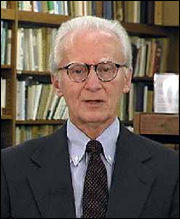
Joseph Bottum, Ralph McInerny (1929-2010)
Please say a prayer for this great American Thomist.
UND
Center of Ethics and Culture
Zenit: Pope Remembers Seminary Days in Freising
Pope Remembers Seminary Days in Freising
"We Knew That Christ Was Stronger Than the Tyranny"
VATICAN CITY, JAN. 29, 2010 (Zenit.org).- Here is a Vatican translation of the German-language address Benedict XVI delivered extemporaneously Jan. 16 upon being made an honorary citizen of the south German city of Freising at a ceremony at the Vatican. He spoke of the time he spent there as a seminarian, and the day of his ordination.
* * *
Dear Mayor,
Your Eminence, Dear Archbishop,
Dear Auxiliary Bishop,
Dear Citizens of Freising,
Dear Friends,
It is a moving moment for me to have now legally become a citizen of Freising and thus belong in a new and deeply profound way to the City to which I feel I intimately belong.
For this reason I can only say from the bottom of my heart "Vergelt's Gott" (may God reward you). My joy at this moment will stay with me.
In my life biography in the biography of my heart, if I may the City of Freising has played a very special role. In this City I received the formation that has marked my life ever since. Thus, in a certain way, Freising is always present in me and I in it. And as you noted, Mr Mayor the inclusion in my coat-of-arms of the Moor and Bear of Freising shows the whole world how closely I belong to it. Then the fact that I am also now legally a citizen of Freising, is the crowning point and I am profoundly glad.
On this occasion a whole horizon of images and memories wells up within me. You have mentioned some of them, dear Mr Mayor. I would like to take up certain points.
To start with there is 3 January 1946. After a long wait, the time came at last when the Seminary of Freising could open its doors to all who were returning home. Indeed, it was still a hospital for former prisoners-of-war, but we were then able to begin. That moment marked a turning point in our lives: being on the path to which we felt called.
In today's context we lived in a very "old-fashioned" way without comforts. We were in dormitories, study halls and so forth, but we were happy and not only because we had at last escaped the wretchedness and threats of war and Nazi domination, but also because we were free and, especially, because we had set out on the path to which we felt called.
We knew that Christ was stronger than the tyranny, than the power of the Nazi ideology and its mechanisms of oppression. We knew that time and the future belong to Christ and we knew that he had called us and that he needed us, that there was a need for us.
We knew that the people of those changed times were waiting for us, they were waiting for priests to arrive with a new impetus of faith to build the house of the living God. On this occasion I must also raise a small hymn of praise to the old athenaeum to which I belonged, first as a student and then as a teacher.
Some were very erudite, and some were even known internationally, but what, to my mind, was most important was that they were not only scholars but also teachers, people who not only offered the first-fruits of their specialization but were concerned to give the students the essential, the healthy bread they needed in order to receive faith from within.
And it was important that we if I may now say we did not feel like individual experts but rather that we were part of a whole, that each one of us was working for theology as a whole; that our work had to make visible the logic of faith as unity and thereby increase our ability to account for our faith, as St Peter said (cf. 1 Pt 3: 15), so as to pass it on in a new epoch with new challenges.
The second image that I would like to mention is the day of my ordination to the priesthood. The Cathedral was always the centre of our life, just as at the seminary where we were one family. And it was Fr Höck who made us a real family. The Cathedral was the centre of it and for our entire life represented the unforgettable day of our priestly ordination.
Three moments are particularly deeply impressed within me.
First of all, lying stretched out on the ground during the litany of the saints. In lying prostrate on the ground, one becomes newly aware of all one's poverty and asks oneself: am I truly capable of it? And at the same time the names of all the saints of history and the entreaty of the faithful ring out: "Hear us; help them".
In this way the awareness grows that, yes, I am weak and inadequate but I am not alone, there are others with me, the entire community of the saints is with me. They accompany me and thus I can make this journey and become a companion and guide for others.
The second moment, the imposition of hands by the elderly, venerable Cardinal Faulhaber who laid his hands upon me, upon all of us, in a profound and intense manner and the knowledge that it was the Lord who was laying his hands upon me and saying: "you belong to me, you do not simply belong to yourself, I want you, you are at my service"; but also the awareness that this imposition of hands is a grace, that it does not only create obligations, but above all is a gift, that he is with me and that his love protects and accompanies me.
Then there was also the old rite in which the power to forgive sins was conferred at a separate moment. It began when the Bishop, pronouncing the Lord's words, said: "No longer do I call you servants... but... friends". And I knew we knew that this is not only a quotation from John 15 but a timely word that the Lord is addressing to me now. He accepts me as a friend; I am in this friendly relationship; he has given me his trust and I can work within this friendship and make others friends of Christ.
You have already alluded to the third image, Mr Mayor: I was able to pass a further unforgettable three and a half years with my parents at Lerchenfeldhof. Thus once again I could feel completely at home. These last three and a half years with my parents were an immense gift to me and truly made Freising my home. I am thinking of the celebrations, of how we celebrated Christmas, Easter and Pentecost together; of our walks through the fields together, of how we would go to the woods to gather fir-tree branches and moss for the crib, and of our outings to the fields on the banks of the Isar. Thus Freising became a real homeland to us, and as a homeland it lives on in my heart.
Today Munich airport is located at the gates of Freising. Those who land or take off from there see the towers of Freising Cathedral, they see the mons doctus, and can perhaps understand a little of its past history and of its present.
Freising has always had a sweeping view of the chain of the Alps. By means of the airport it has become, in a certain sense, also global and open to the world.
And yet I want to say: the Cathedral with its towers points upwards to heights that are loftier by far and very different from those we reach in airplanes; the true heights, the heights of God from whom comes the love that gives us authentic humanity.
Yet the Cathedral does not only indicate the loftiness of God who forms us and shows us the way, but also indicates an expanse, and this is not only because the Cathedral embraces centuries of faith and prayer, because it contains, so to speak, the whole community of saints, of all those who went before us who believed, prayed, suffered and rejoiced. It indicates, in general, the great host of all believers of all time. Thus it also shows a vastness which goes beyond globalization, because, in diversity, even in the different cultures and origins, it gives the strength of inner unity, in other words it gives that which can unite us: the unifying power of being loved by God. Thus for me Freising also continues to point out a path.
In closing, I would like once again to thank you for the great honour you have conferred on me, and to thank the band, which evokes here the true Bavarian culture. My desire my prayer is that the Lord may continue to bless this City and that Our Lady of the Cathedral of Freising may protect it, so that in the future too it may be a place of human life, faith and joy. Many thanks.
© Copyright 2010 -- Libreria Editrice Vaticana
Thursday, January 28, 2010

Wednesday, January 27, 2010
US Lay Theologian Wins Pontifical Academy Prize
ROME, JAN. 26, 2010 (Zenit.org).- A lay theologian from the United States has been selected for a €20,000 ($28,189) prize for his doctoral thesis, "Understanding St. Thomas on Analogy."
John Mortensen, a Wyoming Catholic College professor, was selected to receive the prize given by the Coordination Council of the Pontifical Academies. This was announced today by Archbishop Gianfranco Ravasi, the president of the Pontifical Council for Culture.
Archbishop Ravasi, also president of the coordination council, added that Mortensen will receive the award Thursday at an audience the Pope will have with representatives of the academies.
The archbishop explained that the prize recognizes "young investigators, artists or institutions that have distinguished themselves in the promotion of Christian humanism."
Mortensen earned his doctorate from the Pontifical University of the Holy Cross in Rome in 2006.
From 2002 to 2007 he was assistant professor at the International Theological Institute, an institute of papal right in Gaming, Austria, teaching courses in logic, natural philosophy, metaphysics, fundamental theology, and Trinitarian theology.
The prize given by the Coordination Council of the Pontifical Academies was instituted by Pope John Paul II in 1996.
Wyoming Catholic College
photo
Tuesday, January 26, 2010
Archbishop Bruno Forte on Theology
From Part 2 of his interview by Zenit. (Part 1)
Is theology that takes the modern subjective turn seriously doomed to failure? Is a realist theology better suited to the task? If we are confined by our words, and words are not signs of reality but only of our thoughts, then how can we attain the real? I do not think Gadamer is a (naive) realist, but what sort of understanding of the relationship between language and reality does he offer to replace realism?
How will we respond today to the developments of theology, but also of modern epistemology? I would answer by referring to the great 20th century philosophical and theological conquest, which is the powerful rediscovery of hermeneutics, that is, of the science of interpretation. When many years ago, as dean of the faculty of theology in Naples, I invited Hans Georg Gadamer, the father of contemporary hermeneutics, author of "Truth and Method," to a quaestio quodlibetalis. A first year [student] asked him this question: "What is hermeneutics?" To which Gadamer, without being ruffled, said, after a moment of reflection: "Hermeneutics means that when you and I speak we make an effort to reach the vital world that is behind the other's words, and from which they proceed."
Therefore, epistemology illumined by hermeneutics means not only to understand what is immediately perceptible, the visible, the phenomenalistic, the rational, but to also understand, or at least to try to reach, those vital worlds from which these expressions stem. In this context, one discovers that science is not only that of phenomena, but that there is an ensemble of sciences, which are the sciences of the spirit, which make an effort to reach what is not said, what cannot be said, what cannot be wholly divided into parts, but which is the vital world in which human processes, historical processes, etc. are situated. And there is a further level that points to that experience of the mystery of life and of the world and that all of us have and which cannot be referred to a mere linguistic or rational formula, that is, an excess of the Mystery that surrounds the world, that surrounds the life of each one of us and that we continually perceive with surprise, with wonder, which we can reflect in words only up to a certain point.
However, a science that takes wonder seriously in face of this Mystery, the possibility that the latter be said without betraying oneself, that is, the possibility of Revelation, and that one make it the subject of one's thought, becomes an absolutely precious science. In a similar hermeneutical dimension, interpretative of reality -- which does not stop at the immediate but always seeks the ultimate, the profound connections -- it seems to me that theology is presented with full dignity as a science of which man is in need to live and to die, as he needs God and the meaning of life to live and to die.
Is theology that takes the modern subjective turn seriously doomed to failure? Is a realist theology better suited to the task? If we are confined by our words, and words are not signs of reality but only of our thoughts, then how can we attain the real? I do not think Gadamer is a (naive) realist, but what sort of understanding of the relationship between language and reality does he offer to replace realism?
Disagreements over the nature of papal actions.
The preparatory document prepared by the Joint Coordinating Committee of the Theological Dialogue between the Roman Catholic Church and the Orthodox Church The Role of the Bishop of Rome in the Communion of the Church of the First Millenium is supposed to be the starting point for discussion about the office of the pope and how it was exercised during the first millenium of our Lord. If some sort of common vision can be reached concerning the papacy of the first millenium, then it may serve as a basis of reconciliation of Catholics and Orthodox. I recall that Pope Benedict XVI (as Cardinal Ratzinger?) said that the Orthodox should only be held to an understanding of the papacy as it was exercised during this period. So both sides will look at the historical data, and the relationship between the pope and the general synod, the college of all the bishops -- how much authority does he have apart from a synod, and what consent is required by other bishops, and so on. Will there be any substantial disagreement about papal documents and actions, and how they are to be interpreted? If there cannot be a common (interpretation of) history, then can Catholic and Orthodox dogma on the papacy be harmonized? It seems that would not be possible...
A postscript was published today for the article by Sandro Magister:
A postscript was published today for the article by Sandro Magister:
POSTSCRIPT - The day after the publication of this article on www.chiesa, January 26, 2010, the pontifical council for Christian unity issued the following statement:Is there anything within the document that would be a cause of controversy for either side?
"The Pontifical Council for Promoting Christian Unity has learned with disappointment that a media outlet has published a test currently being examined by the Joint International Commission for Theological Dialogue between the Catholic Church and the Orthodox Church.
"The document published is a draft text consisting of a list of themes to be studied and examined in greater depth, and has been only minimally discussed by the said commission.
"In the last meeting of the Joint International Commission for Theological Dialogue between the Catholic Church and the Orthodox Church, held in Paphos, Cyprus, last October, it was specifically established that the text would not be published until it had been fully and completely examined by the Commission.
"As yet there is no agreed document and, hence, the text published has no authority or official status."
Monday, January 25, 2010
Friday, January 22, 2010
Pope's Address to Doctrine Congregation
Pope's Address to Doctrine Congregation
"Natural Moral Law Is Neither Exclusively Nor Mainly Confessional"
VATICAN CITY, JAN. 22, 2010 (Zenit.org).- Here is a Vatican translation of the address Benedict XVI delivered Jan. 15 upon receiving in audience members of the Congregation for the Doctrine of the Faith at the end of the dicastery's four-day plenary assembly.
* * *
Your Eminences,
Venerable Brothers in the Episcopate and in the Priesthood,
Dear Faithful Collaborators,
It gives me great joy to meet you on the occasion of the Plenary Session and to express to you my sentiments of deep gratitude and cordial appreciation of the work you carry out at the service of the Successor of Peter in his ministry of strengthening his brethren in the faith (cf. Luke 22: 32).
I thank Cardinal William Joseph Levada for his greeting in which he recalled the topics that the Congregation is occupied at this time. He also recalled the new responsibilities that the Motu Proprio Ecclesiae Unitatem has entrusted to the Dicastery by closely joining with it the Ecclesia Dei Commission.
I would now like to reflect briefly on certain aspects that you, Your Eminence, have mentioned.
First of all I wish to emphasize that your Congregation participates in the ministry of unity that is entrusted to the Roman Pontiff in a special way, through his commitment to doctrinal fidelity. This unity, in fact, is primarily a unity of faith, supported by the sacred deposit whose main custodian and defender is the Successor of Peter.
Strengthening brothers and sisters in the faith, keeping them united in the confession of the Crucified and Risen Christ, is the first and fundamental task that Jesus conferred upon the one seated on the Chair of Peter. It is a binding service on which depends the effectiveness of the Church's evangelizing action to the end of time.
The Bishop of Rome, in whose "potestas docendi" your Congregation participates, is bound to proclaim ceaselessly: "Dominus Iesus" "Jesus is Lord". The "potestas docendi," in fact, entails obedience to the faith so that the Truth which is Christ may continue to shine out in its grandeur and resonate in its integrity and purity for all humankind, and thus that there may be one flock gathered round the one Pastor.
The achievement of the common witness to faith of all Christians therefore constitutes the priority of the Church of all time, in order to lead all people to the encounter with God. In this spirit I trust in particular in the Dicastery's commitment to overcome doctrinal problems that are still an obstacle to the achievement of full communion with the Church on the part of the Society of St Pius X.
I would also like to congratulate you on your commitment to fully integrating formerly Anglican groups and individual members of the faithful into the Church's life, in accordance with what is stipulated in the Apostolic Constitution Anglicanorum Coetibus. The faithful adherence of these groups to the truth received from Christ and presented by the Magisterium of the Church is in no way contrary to the ecumenical movement but rather shows its ultimate purpose, which consists in the achievement of the full and visible communion of the Lord's disciples.
In recalling your invaluable service to the Vicar of Christ, I must also mention that in September 2008 the Congregation for the Doctrine of the Faith published the Instruction "Dignitas Personae" on Certain Bioethical Questions.
Following the Encyclical "Evangelium Vitae" by the Servant of God John Paul ii in March 1995 this doctrinal document, centered on the theme of the dignity of the person created in Christ and for Christ, is a new landmark in the proclamation of the Gospel in full continuity with the Instruction "Donum Vitae," published by this Dicastery in February 1987.
Concerning delicate and timely topics such as procreation and the new forms of treatment that involve the manipulation of embryos and the human genetic patrimony, the Instruction recalls that "the ethical value of biomedical science is gauged in reference to both the unconditional respect owed to every human being at every moment of his or her existence, and the defense of the specific character of the personal act which transmits life" ("Instruction Dignitas Personae," No. 10).
In this way the Magisterium of the Church wishes to make its own contribution to the formation of consciences, not only of believers but also of all who seek the truth and want to listen to arguments stemming not only from faith but also from reason. In fact the Church, in proposing moral evaluations for biomedical research on human life, draws on the light of both reason and faith (cf. ibid., No. 3), since she is convinced that "what is human is not only received and respected by faith, but is also purified, elevated and perfected" (ibid., No. 7).
In this context a response is likewise given to the widespread mentality that presents faith as an obstacle to scientific freedom and research, because it presumes that faith is made up of a pattern of prejudices that hinder the objective understanding of reality.
Faced with this attitude that strives to replace truth with a consensus that is fragile and easy to manipulate, the Christian faith, instead, makes a real contribution in the ethical and philosophical context. It does not provide pre-constituted solutions to concrete problems like bio-medical research and experimentation, but rather proposes reliable moral perspectives within which human reason can seek and find valid solutions.
There are in fact specific contents of Christian revelation that cast light on bioethical problems: the value of human life, the relational and social dimension of the person, the connection between the unitive and the procreative aspects of sexuality, and the centrality of the family founded on the marriage of a man and a woman. These matters engraved in the human heart are also rationally understandable as an element of natural moral law and can be accepted also by those who do not identify with the Christian faith.
The natural moral law is neither exclusively nor mainly confessional, even if the Christian Revelation and the fulfillment of Man in the mystery of Christ fully illumines and develops its doctrine. As the Catechism of the Catholic Church says, it "states the first and essential precepts which govern the moral life" (No. 1955).
Established in human nature itself and accessible to every rational creature, the natural moral law thus determines the basis for initiating dialogue with all who seek the truth and, more generally, with civil and secular society. This law, engraved in every human being's heart, touches on one of the essential problems of reflection on law and likewise challenges the conscience and responsibility of legislators.
As I encourage you to persevere in your demanding and important service, I would also like on this occasion to express my spiritual closeness to you, as a pledge of my affection and gratitude, as I warmly impart the Apostolic Blessing to you all.
© Copyright 2010 -- Libreria Editrice Vaticana
Wednesday, January 20, 2010
Last Lecture, by James R. Stoner, Jr.
He lists five goods: constitutionalism, learning, beauty, faith, marriage, freedom, and patriotism. Where is religion? (Faith may be required for religion, but religion is more than faith.) What of friendship and justice? This list of goods reminds me of the New Natural Law Theory and similar attempts to delineate human goods. (Aquinas himself does give a list of goods when explaining how the precepts of the natural law are derived in I II, but he does not give an exhaustive list there. The goods are enumerated through the virtues.) Did Aristotle himself believe in an ultimate end, to which all other goods were ordered? And what is the principle by which goods might be ordered to one another? This has been a point of controversy for Aristotle scholars and for others as well.
In short, I want to talk about human happiness, and what I have called my first and most important thought is simply this: Although no one can be happy who is determined not to be, happiness is not achieved by merely wanting it, much less by getting what you thought you wanted. For to be happy, a person has to know what is good and make it one’s own—not exactly as a possession, for none of the goods I’m going to talk about are material things, but as integral to one’s world and oneself.
He lists five goods: constitutionalism, learning, beauty, faith, marriage, freedom, and patriotism. Where is religion? (Faith may be required for religion, but religion is more than faith.) What of friendship and justice? This list of goods reminds me of the New Natural Law Theory and similar attempts to delineate human goods. (Aquinas himself does give a list of goods when explaining how the precepts of the natural law are derived in I II, but he does not give an exhaustive list there. The goods are enumerated through the virtues.) Did Aristotle himself believe in an ultimate end, to which all other goods were ordered? And what is the principle by which goods might be ordered to one another? This has been a point of controversy for Aristotle scholars and for others as well.
The Catholic Social Science Review: Three Pieces by Charles N. R. McCoy (previously unpublished): Let Israel Hope in the Lord, Peter and Caesar and Contemplation Passes into Practice: Religion and Reality (full text)
Tuesday, January 19, 2010
If the Church's teaching on the Incarnation implicitly affirms that the conceptum is human from conception, then does the Church's teaching on the Immaculate Conception give additional witness to this?
It would seem not. Pope Pius IX's cites his predecessor Pope Alexander VII in the Apostolic Constitution, Ineffabilis Deus:
It would seem not. Pope Pius IX's cites his predecessor Pope Alexander VII in the Apostolic Constitution, Ineffabilis Deus:
So at the instance and request of the bishops mentioned above, with the chapters of the churches, and of King Philip and his kingdoms, we renew the Constitutions and Decrees issued by the Roman Pontiffs, our predecessors, especially Sixtus IV,[8] Paul V,[9] and Gregory XV,[10] in favor of the doctrine asserting that the soul of the Blessed Virgin, in its creation and infusion into the body, was endowed with the grace of the Holy Spirit and preserved from original sin; and also in favor of the feast and veneration of the conception of the Virgin Mother of God, which, as is manifest, was instituted in keeping with that pious belief.Later, Pope Pius IX gives the definition:
We declare, pronounce, and define that the doctrine which holds that the most Blessed Virgin Mary, in the first instance of her conception, by a singular grace and privilege granted by Almighty God, in view of the merits of Jesus Christ, the Savior of the human race, was preserved free from all stain of original sin, is a doctrine revealed by God and therefore to be believed firmly and constantly by all the faithful.As far as I can tell, conception here is therefore identified with the creation and infusion of the rational soul into the body (as stated by Alexander VII), not with the fertilization of the ovum by the spermatazoa. I'd have to double check, but Pius IX does not offer a different definition of conception to replace that of Alexander VII. Hence, the apostolic constitution leaves open the question of whether conception, as defined here, takes place at fertilization.
Saturday, January 16, 2010
Subscribe to:
Posts (Atom)