Pope's Address to Doctrine Congregation
"Natural Moral Law Is Neither Exclusively Nor Mainly Confessional"
VATICAN CITY, JAN. 22, 2010 (Zenit.org).- Here is a Vatican translation of the address Benedict XVI delivered Jan. 15 upon receiving in audience members of the Congregation for the Doctrine of the Faith at the end of the dicastery's four-day plenary assembly.
* * *
Your Eminences,
Venerable Brothers in the Episcopate and in the Priesthood,
Dear Faithful Collaborators,
It gives me great joy to meet you on the occasion of the Plenary Session and to express to you my sentiments of deep gratitude and cordial appreciation of the work you carry out at the service of the Successor of Peter in his ministry of strengthening his brethren in the faith (cf. Luke 22: 32).
I thank Cardinal William Joseph Levada for his greeting in which he recalled the topics that the Congregation is occupied at this time. He also recalled the new responsibilities that the Motu Proprio Ecclesiae Unitatem has entrusted to the Dicastery by closely joining with it the Ecclesia Dei Commission.
I would now like to reflect briefly on certain aspects that you, Your Eminence, have mentioned.
First of all I wish to emphasize that your Congregation participates in the ministry of unity that is entrusted to the Roman Pontiff in a special way, through his commitment to doctrinal fidelity. This unity, in fact, is primarily a unity of faith, supported by the sacred deposit whose main custodian and defender is the Successor of Peter.
Strengthening brothers and sisters in the faith, keeping them united in the confession of the Crucified and Risen Christ, is the first and fundamental task that Jesus conferred upon the one seated on the Chair of Peter. It is a binding service on which depends the effectiveness of the Church's evangelizing action to the end of time.
The Bishop of Rome, in whose "potestas docendi" your Congregation participates, is bound to proclaim ceaselessly: "Dominus Iesus" "Jesus is Lord". The "potestas docendi," in fact, entails obedience to the faith so that the Truth which is Christ may continue to shine out in its grandeur and resonate in its integrity and purity for all humankind, and thus that there may be one flock gathered round the one Pastor.
The achievement of the common witness to faith of all Christians therefore constitutes the priority of the Church of all time, in order to lead all people to the encounter with God. In this spirit I trust in particular in the Dicastery's commitment to overcome doctrinal problems that are still an obstacle to the achievement of full communion with the Church on the part of the Society of St Pius X.
I would also like to congratulate you on your commitment to fully integrating formerly Anglican groups and individual members of the faithful into the Church's life, in accordance with what is stipulated in the Apostolic Constitution Anglicanorum Coetibus. The faithful adherence of these groups to the truth received from Christ and presented by the Magisterium of the Church is in no way contrary to the ecumenical movement but rather shows its ultimate purpose, which consists in the achievement of the full and visible communion of the Lord's disciples.
In recalling your invaluable service to the Vicar of Christ, I must also mention that in September 2008 the Congregation for the Doctrine of the Faith published the Instruction "Dignitas Personae" on Certain Bioethical Questions.
Following the Encyclical "Evangelium Vitae" by the Servant of God John Paul ii in March 1995 this doctrinal document, centered on the theme of the dignity of the person created in Christ and for Christ, is a new landmark in the proclamation of the Gospel in full continuity with the Instruction "Donum Vitae," published by this Dicastery in February 1987.
Concerning delicate and timely topics such as procreation and the new forms of treatment that involve the manipulation of embryos and the human genetic patrimony, the Instruction recalls that "the ethical value of biomedical science is gauged in reference to both the unconditional respect owed to every human being at every moment of his or her existence, and the defense of the specific character of the personal act which transmits life" ("Instruction Dignitas Personae," No. 10).
In this way the Magisterium of the Church wishes to make its own contribution to the formation of consciences, not only of believers but also of all who seek the truth and want to listen to arguments stemming not only from faith but also from reason. In fact the Church, in proposing moral evaluations for biomedical research on human life, draws on the light of both reason and faith (cf. ibid., No. 3), since she is convinced that "what is human is not only received and respected by faith, but is also purified, elevated and perfected" (ibid., No. 7).
In this context a response is likewise given to the widespread mentality that presents faith as an obstacle to scientific freedom and research, because it presumes that faith is made up of a pattern of prejudices that hinder the objective understanding of reality.
Faced with this attitude that strives to replace truth with a consensus that is fragile and easy to manipulate, the Christian faith, instead, makes a real contribution in the ethical and philosophical context. It does not provide pre-constituted solutions to concrete problems like bio-medical research and experimentation, but rather proposes reliable moral perspectives within which human reason can seek and find valid solutions.
There are in fact specific contents of Christian revelation that cast light on bioethical problems: the value of human life, the relational and social dimension of the person, the connection between the unitive and the procreative aspects of sexuality, and the centrality of the family founded on the marriage of a man and a woman. These matters engraved in the human heart are also rationally understandable as an element of natural moral law and can be accepted also by those who do not identify with the Christian faith.
The natural moral law is neither exclusively nor mainly confessional, even if the Christian Revelation and the fulfillment of Man in the mystery of Christ fully illumines and develops its doctrine. As the Catechism of the Catholic Church says, it "states the first and essential precepts which govern the moral life" (No. 1955).
Established in human nature itself and accessible to every rational creature, the natural moral law thus determines the basis for initiating dialogue with all who seek the truth and, more generally, with civil and secular society. This law, engraved in every human being's heart, touches on one of the essential problems of reflection on law and likewise challenges the conscience and responsibility of legislators.
As I encourage you to persevere in your demanding and important service, I would also like on this occasion to express my spiritual closeness to you, as a pledge of my affection and gratitude, as I warmly impart the Apostolic Blessing to you all.
© Copyright 2010 -- Libreria Editrice Vaticana
Friday, January 22, 2010
Pope's Address to Doctrine Congregation

Wednesday, January 20, 2010
Last Lecture, by James R. Stoner, Jr.
He lists five goods: constitutionalism, learning, beauty, faith, marriage, freedom, and patriotism. Where is religion? (Faith may be required for religion, but religion is more than faith.) What of friendship and justice? This list of goods reminds me of the New Natural Law Theory and similar attempts to delineate human goods. (Aquinas himself does give a list of goods when explaining how the precepts of the natural law are derived in I II, but he does not give an exhaustive list there. The goods are enumerated through the virtues.) Did Aristotle himself believe in an ultimate end, to which all other goods were ordered? And what is the principle by which goods might be ordered to one another? This has been a point of controversy for Aristotle scholars and for others as well.
In short, I want to talk about human happiness, and what I have called my first and most important thought is simply this: Although no one can be happy who is determined not to be, happiness is not achieved by merely wanting it, much less by getting what you thought you wanted. For to be happy, a person has to know what is good and make it one’s own—not exactly as a possession, for none of the goods I’m going to talk about are material things, but as integral to one’s world and oneself.
He lists five goods: constitutionalism, learning, beauty, faith, marriage, freedom, and patriotism. Where is religion? (Faith may be required for religion, but religion is more than faith.) What of friendship and justice? This list of goods reminds me of the New Natural Law Theory and similar attempts to delineate human goods. (Aquinas himself does give a list of goods when explaining how the precepts of the natural law are derived in I II, but he does not give an exhaustive list there. The goods are enumerated through the virtues.) Did Aristotle himself believe in an ultimate end, to which all other goods were ordered? And what is the principle by which goods might be ordered to one another? This has been a point of controversy for Aristotle scholars and for others as well.
The Catholic Social Science Review: Three Pieces by Charles N. R. McCoy (previously unpublished): Let Israel Hope in the Lord, Peter and Caesar and Contemplation Passes into Practice: Religion and Reality (full text)
Tuesday, January 19, 2010
If the Church's teaching on the Incarnation implicitly affirms that the conceptum is human from conception, then does the Church's teaching on the Immaculate Conception give additional witness to this?
It would seem not. Pope Pius IX's cites his predecessor Pope Alexander VII in the Apostolic Constitution, Ineffabilis Deus:
It would seem not. Pope Pius IX's cites his predecessor Pope Alexander VII in the Apostolic Constitution, Ineffabilis Deus:
So at the instance and request of the bishops mentioned above, with the chapters of the churches, and of King Philip and his kingdoms, we renew the Constitutions and Decrees issued by the Roman Pontiffs, our predecessors, especially Sixtus IV,[8] Paul V,[9] and Gregory XV,[10] in favor of the doctrine asserting that the soul of the Blessed Virgin, in its creation and infusion into the body, was endowed with the grace of the Holy Spirit and preserved from original sin; and also in favor of the feast and veneration of the conception of the Virgin Mother of God, which, as is manifest, was instituted in keeping with that pious belief.Later, Pope Pius IX gives the definition:
We declare, pronounce, and define that the doctrine which holds that the most Blessed Virgin Mary, in the first instance of her conception, by a singular grace and privilege granted by Almighty God, in view of the merits of Jesus Christ, the Savior of the human race, was preserved free from all stain of original sin, is a doctrine revealed by God and therefore to be believed firmly and constantly by all the faithful.As far as I can tell, conception here is therefore identified with the creation and infusion of the rational soul into the body (as stated by Alexander VII), not with the fertilization of the ovum by the spermatazoa. I'd have to double check, but Pius IX does not offer a different definition of conception to replace that of Alexander VII. Hence, the apostolic constitution leaves open the question of whether conception, as defined here, takes place at fertilization.
Saturday, January 16, 2010
Friday, January 15, 2010
30 Giorni: If everything is grace there is no longer grace by Cardinal Georges Cottier, OP
The distinctions are essential especially in a time in which Gnosticism is the evident alternative to the reality of faith
And Catholics have become Pelagians, or semi-Pelagians...
The distinctions are essential especially in a time in which Gnosticism is the evident alternative to the reality of faith
Today, the absolute necessity of grace for every moment of the Christian experience, and the dynamics of its action, seem to have disappeared from theological debate and preaching. On this point, even in the ordinary pastoral, one notes confusions, ambiguities, misconstruction, misunderstandings, which are indications of a general obfuscation regarding the terms and basic criteria of Christian doctrine and the life of faith, and they risk misleading the people of God.
And Catholics have become Pelagians, or semi-Pelagians...
Thursday, January 14, 2010
Is it permissible to euthanize an enemy soldier?
In the movie Saving Private Ryan, after the Americans are able to scale the cliffs, they begin to assult the machine gun bunkers with grenades and flame throwers. Some of the German soldiers, on fire from the flame throwers, jump out of the forward slits and in front of some of the Americans still on Omaha beach. Their NCO (or officer) tells them to hold them fire, "Let them burn." (A paraphrase.) Might it be that they would not be allowed to shoot them in order to euthanize them? One cannot take away the life of those who are innocent, even for a "good end" such as to relieve them from further pain and suffering. But what of enemy soldiers? If it is lawful to take their lives in defense of a community, then might it not also be lawful to euthanize them in order to prevent them from suffering even further?
However, it seems that one is permitted to kill enemy soldiers, not in order to take their lives, but in order to neutralize them. If they have been neutralized, i.e. incapacitated, by being set on fire, or rendered ineffective as a threat (and thus ready to be taken prisoner) then to kill them would be wrong, and considered a war crime. How then can euthanasia be acceptable in this case, if the act itself is wrong, regardless of its further purpose? It would seem that the prohibition against euthanasize is absolute, applicable even to enemy soldiers during war.
Of course, one can ask if the use of flame throwers and other weapons which seriously maim or injure and cause great suffering go against Christian charity.
However, it seems that one is permitted to kill enemy soldiers, not in order to take their lives, but in order to neutralize them. If they have been neutralized, i.e. incapacitated, by being set on fire, or rendered ineffective as a threat (and thus ready to be taken prisoner) then to kill them would be wrong, and considered a war crime. How then can euthanasia be acceptable in this case, if the act itself is wrong, regardless of its further purpose? It would seem that the prohibition against euthanasize is absolute, applicable even to enemy soldiers during war.
Of course, one can ask if the use of flame throwers and other weapons which seriously maim or injure and cause great suffering go against Christian charity.
Wednesday, January 13, 2010
A discussion of essences and substantial forms (viz-a-viz a debate between a Thomist and a Scotist) here: A nominalism you must refuse.
Edward Feser recommends to those with an analytic background David S. Oderberg's Real Essentialism (GB).
Edward Feser recommends to those with an analytic background David S. Oderberg's Real Essentialism (GB).
The International Society of Scholastics has as forum for online Scholastic disputation: Disputatio.
Tuesday, January 12, 2010
All Together Now -- Russell Hittinger reviews Biblical Natural Law: A Theocentric and Teleological Approach by Matthew Levering
Sunday, January 10, 2010
Scholasticism and philosophy
It should be obvious to educated people that the art of teaching and the art of writing essays are two separate habits, and that the possession of knowledge does not mean that one can write well. Neither is the converse true, that one who is able to write also possesses knowledge, much less wisdom. We may reject the rather dry and bare, terse writing of the scholastics, but can it be denied that their treatises are generally more clear than contemporary essays? How much of the essay's being the standard for academic writing is linked to the 19th century model of the research university and the rise of modern literature, and how much to Renaissance ideals?
As teachers of philosophy, what do we seek to impart first? Reasoned-out knowledge? Or the art of writing an essay?
As teachers of philosophy, what do we seek to impart first? Reasoned-out knowledge? Or the art of writing an essay?
Saturday, January 09, 2010
Robert Merrihew Adams
I don't know much about him, and I haven't read any of his books, but was reminded of his existence when I was perusing the website of Oxford University Press. Apparently he does not believe in the unity of the virtues; when he speaks of God wand His foundational place in morality, does he subscribe to a form of Pelagianism? Or is he sneaking theology in under the guise of philosophy?
His wife is Marilyn McCord Adams. (Who is apparently a liberal Episcopalian.)
Marilyn and Bob Adams join Chapel Hill Philosophy Department
Faculty page and CV (MMA's page)
Gifford Lecture Series - Biography - Robert Adams
Photo at wiki.
From OUP:
A Theory of Virtue (a review)
Finite and Infinite Goods: A Framework for Ethics (GB)
Also from Google Books:
The virtue of faith and other essays in philosophical theology
His wife is Marilyn McCord Adams. (Who is apparently a liberal Episcopalian.)
Marilyn and Bob Adams join Chapel Hill Philosophy Department
Faculty page and CV (MMA's page)
Gifford Lecture Series - Biography - Robert Adams
Photo at wiki.
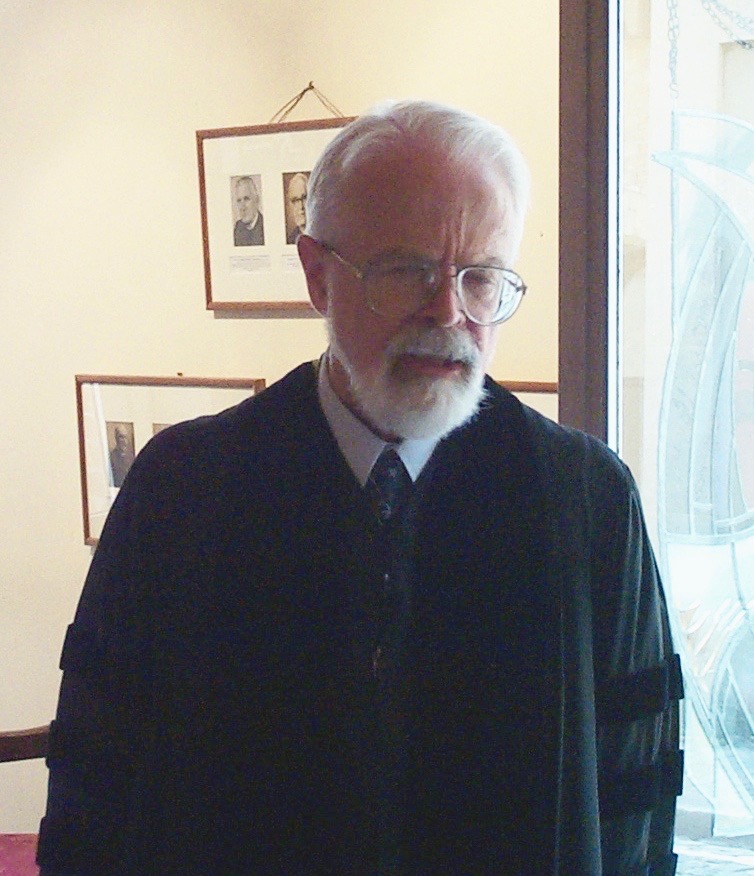
From OUP:
A Theory of Virtue (a review)
Finite and Infinite Goods: A Framework for Ethics (GB)
Also from Google Books:
The virtue of faith and other essays in philosophical theology
Friday, January 08, 2010
James Chastek, Nature, operation, and esse
Metaphysics analyses being, and Aristotle showed two different ways to do this. First, he studied how being was said per se. In this line, being is primarily substance as opposed to accident. Second, he studied being so far as it was opposed to becoming. In this line, being is primarily act as opposed to potency. In this second sense, it is helpful to see “act” as meaning “rising above becoming”. Now rising above becoming happens in three ways:
1.) Being constituted in nature, whether as a substance or an accident. This is the term of generation or change.
2.) Operation/ proper activity. Nature is nothing other than a principle or source of motion and rest. For example, “Rational” or “sentient” are natures, and these are perfected by actually reasoning and actually sensing. Just as a constituted nature rises above becoming, operation rises above the nature. It is substance as operating that most of all rises above becoming, and therefore is most of all “being”.
3.) Esse or the act of being. All becoming is between contraries, but there is no contrary of existence. So taken, esse is absolutely set apart from becoming. Esse, considered in its pure communicability to many, is outside of motion and becoming, even if, in some particular case, it is only present at the term of a motion.
There is a clear order between 1 and 2: nature is the goal of becoming, operation the goal of nature. There is also a clear relation between 1 and 3: sense 1 is existence in a secondary and indirect sense; sense 3 is existence considered in its pure communicability to many, or existence primo et per se. Sense 1 is existence as the term of a natural agent as agent; sense 3 is the properly the term of divine action.
(One difficulty is that the word “esse” or “form” is frequently used for 1 and 3)
But what is the order between 2 and 3? This is a crucial problem, and until we recognize it as a problem our notion of “esse” is likely to slump towards essentialism; where “pure being’ is seen as the lifeless crystalline forms of the platonic museum (Plato distanced himself from these things later in his career). We see “pure act” too easily as mere existence- which makes our opinion of God be more or less the same as a giant stone in the sky. We overlook that an act is an act. The word was not chosen at random. To call God pure act is the same thing as saying that he is the highest operation. After one sees that God is pure act (as Aristotle did) he can immediately know that God is alive, intelligent, blessed, loving (though not in Plato’s sense of “love” in the Symposium- but simply as the perfect operation of will) and with all transcendental perfection: power, goodness, unity, truth, etc.
Thursday, January 07, 2010
Zenit: Ralph McInerny on a Forgotten Thomist
Don't know how I missed this last year...
Ralph McInerny on a Forgotten Thomist
Calls Charles De Koninck a Man of Faith, Philosopher of Science
By Annamarie Adkins
SOUTH BEND, Indiana, NOV. 6, 2009 (Zenit.org).- The renewed interest in the works of St. Thomas Aquinas in the early-to-mid 20th century produced a flowering of Catholic thought that formulated a coherent intellectual critique and alternative to modernity.
But Thomism fell out of fashion after the Second Vatican Council as the perennial philosophy and leading intellectual framework for the Catholic synthesis of faith and reason.
Today, however, Thomism is experiencing somewhat of a revival, and that can be attributed to the work of Thomists such as Ralph McInerny, who, among others, kept the flame of Thomism burning during the tumultuous intellectual milieu that followed the council.
Now, in an act of gratitude, McInerny seeks to introduce a new generation to his own teacher -- a man who helped lay the groundwork for the recent Thomistic revival: Charles De Koninck.
McInerny is in the process of editing and translating into English the collected works of De Koninck (Notre Dame Press), a layman who inspired a whole generation of Thomists that eventually took up positions in the philosophy departments of many Catholic colleges and universities.
Those professors served as an intellectual bridge between an earlier generation of Thomists and the revival going on today.
McInerny is a writer of philosophy, fiction, and cultural criticism, who has taught at Notre Dame since 1955.
He spoke with ZENIT about his relationship with De Koninck, the motivation for making the great professor's writings known to a wider audience, and what they offer us in the challenge of confronting contemporary problems.
ZENIT: Who was Charles De Koninck? What role did he play in your own formation and intellectual training?
McInerny: De Koninck was dean of the Faculté de Philosophie at the Université Laval in Quebec, and played an enormous role in the formation of American Thomists who began to study there in the 1940s.
For almost two decades this phenomenon continued.
Easily recognizable “Laval Thomists” went on to join the faculties of colleges throughout the nation.
I myself took a licentiate and doctorate at Laval, with Professor De Koninck as my director, going there after taking a master's in philosophy from the University of Minnesota.
There is a marvelous biographical essay by his son Thomas in volume one of the Collected Writings.
ZENIT: Why did you decide to compile and translate his collected works? For what reasons does he deserve a wider, contemporary audience?
McInerny: One night I was rereading an essay by De Koninck on the Eucharist and I fell back in my chair and thanked God that I had studied under this man. But he is now all but unknown, his writings are difficult to find, and few had been translated.
I conceived the project of the collected works as an instance of pietas and gratitude.
ZENIT: How did De Koninck understand the task of philosophy and the philosopher?
McInerny: His principal mentors were Aristotle and Thomas Aquinas. He taught by subjecting the texts to a close reading, conveying a technique that one could continue to employ for a lifetime.
ZENIT: De Koninck wrote eloquently about how the Mother of God personifies Wisdom. What role did the Catholic faith play in his philosophical explorations?
McInerny: De Koninck was a Catholic philosopher, which meant that the faith – the magisterium – was always the guide for his work.
His devotion to Mary followed the teaching of St Louis Grignion de Monfort. His work "Ego Sapientia" is a florilegium of texts brought together under titles of Mary drawn from the great masters of Mariology: Bernard and Bonaventure.
ZENIT: His most notable work seems to be his treatise on the common good. What did De Koninck have to say about this often-misunderstood concept? In what contemporary context could his insights have significant value?
McInerny: The book, "The Primacy of the Common Good," was aimed at the personalists.
Who were they? Marx, Engels, various Renaissance figures whose thought on the primacy of man De Koninck regarded as tempting to contemporaries.
The book was regarded as an attack on Jacques Maritain. This is nonsense; Yves Simon saw the teaching of the two men as identical on this matter.
Father I.T. Eschmann, OP, in a lengthy and condescending study, sought to show that De Koninck's teaching was at variance with that of St. Thomas. Eschmann called his essay "A Defense of Jacques Maritain."
Maritain is not mentioned in the "Primacy," nor does he figure much in Eschmann's defense. But the unfortunate myth was created that De Koninck was attacking Maritain.
ZENIT: In the first volume, you've compiled a number of works that address the philosophy of science, as well as themes related to creation and evolution. What audiences might find these writings particularly helpful?
McInerny: De Koninck's views of evolution are of fundamental importance.
His account of the relation between natural philosophy and natural science still awaits a serious appraisal by philosophers of science.
ZENIT: Where is De Koninck's intellectual legacy found today?
McInerny: In many respects, his legacy is embodied in the approach of Thomas Aquinas College, founded by De Koninck's students and flourishing in a time of chaos in higher education.
And, of course, in his writings, which are ripe for reconsideration.
--- --- ---
On the Net:
For more information: http://undpress.nd.edu/book/P01230
Edward Feser, The ethics of property
pdf
html
I'll try to print this out so I can read it at my leisure.
html
I'll try to print this out so I can read it at my leisure.
Subscribe to:
Posts (Atom)