The Role of the Bishop of Rome in the Communion of the Church in the First Millennium
Link from Sandro Magister, "The Pope Is the First Among the Patriarchs." Just How Remains to Be Seen
Monday, January 25, 2010

Friday, January 22, 2010
Pope's Address to Doctrine Congregation
Pope's Address to Doctrine Congregation
"Natural Moral Law Is Neither Exclusively Nor Mainly Confessional"
VATICAN CITY, JAN. 22, 2010 (Zenit.org).- Here is a Vatican translation of the address Benedict XVI delivered Jan. 15 upon receiving in audience members of the Congregation for the Doctrine of the Faith at the end of the dicastery's four-day plenary assembly.
* * *
Your Eminences,
Venerable Brothers in the Episcopate and in the Priesthood,
Dear Faithful Collaborators,
It gives me great joy to meet you on the occasion of the Plenary Session and to express to you my sentiments of deep gratitude and cordial appreciation of the work you carry out at the service of the Successor of Peter in his ministry of strengthening his brethren in the faith (cf. Luke 22: 32).
I thank Cardinal William Joseph Levada for his greeting in which he recalled the topics that the Congregation is occupied at this time. He also recalled the new responsibilities that the Motu Proprio Ecclesiae Unitatem has entrusted to the Dicastery by closely joining with it the Ecclesia Dei Commission.
I would now like to reflect briefly on certain aspects that you, Your Eminence, have mentioned.
First of all I wish to emphasize that your Congregation participates in the ministry of unity that is entrusted to the Roman Pontiff in a special way, through his commitment to doctrinal fidelity. This unity, in fact, is primarily a unity of faith, supported by the sacred deposit whose main custodian and defender is the Successor of Peter.
Strengthening brothers and sisters in the faith, keeping them united in the confession of the Crucified and Risen Christ, is the first and fundamental task that Jesus conferred upon the one seated on the Chair of Peter. It is a binding service on which depends the effectiveness of the Church's evangelizing action to the end of time.
The Bishop of Rome, in whose "potestas docendi" your Congregation participates, is bound to proclaim ceaselessly: "Dominus Iesus" "Jesus is Lord". The "potestas docendi," in fact, entails obedience to the faith so that the Truth which is Christ may continue to shine out in its grandeur and resonate in its integrity and purity for all humankind, and thus that there may be one flock gathered round the one Pastor.
The achievement of the common witness to faith of all Christians therefore constitutes the priority of the Church of all time, in order to lead all people to the encounter with God. In this spirit I trust in particular in the Dicastery's commitment to overcome doctrinal problems that are still an obstacle to the achievement of full communion with the Church on the part of the Society of St Pius X.
I would also like to congratulate you on your commitment to fully integrating formerly Anglican groups and individual members of the faithful into the Church's life, in accordance with what is stipulated in the Apostolic Constitution Anglicanorum Coetibus. The faithful adherence of these groups to the truth received from Christ and presented by the Magisterium of the Church is in no way contrary to the ecumenical movement but rather shows its ultimate purpose, which consists in the achievement of the full and visible communion of the Lord's disciples.
In recalling your invaluable service to the Vicar of Christ, I must also mention that in September 2008 the Congregation for the Doctrine of the Faith published the Instruction "Dignitas Personae" on Certain Bioethical Questions.
Following the Encyclical "Evangelium Vitae" by the Servant of God John Paul ii in March 1995 this doctrinal document, centered on the theme of the dignity of the person created in Christ and for Christ, is a new landmark in the proclamation of the Gospel in full continuity with the Instruction "Donum Vitae," published by this Dicastery in February 1987.
Concerning delicate and timely topics such as procreation and the new forms of treatment that involve the manipulation of embryos and the human genetic patrimony, the Instruction recalls that "the ethical value of biomedical science is gauged in reference to both the unconditional respect owed to every human being at every moment of his or her existence, and the defense of the specific character of the personal act which transmits life" ("Instruction Dignitas Personae," No. 10).
In this way the Magisterium of the Church wishes to make its own contribution to the formation of consciences, not only of believers but also of all who seek the truth and want to listen to arguments stemming not only from faith but also from reason. In fact the Church, in proposing moral evaluations for biomedical research on human life, draws on the light of both reason and faith (cf. ibid., No. 3), since she is convinced that "what is human is not only received and respected by faith, but is also purified, elevated and perfected" (ibid., No. 7).
In this context a response is likewise given to the widespread mentality that presents faith as an obstacle to scientific freedom and research, because it presumes that faith is made up of a pattern of prejudices that hinder the objective understanding of reality.
Faced with this attitude that strives to replace truth with a consensus that is fragile and easy to manipulate, the Christian faith, instead, makes a real contribution in the ethical and philosophical context. It does not provide pre-constituted solutions to concrete problems like bio-medical research and experimentation, but rather proposes reliable moral perspectives within which human reason can seek and find valid solutions.
There are in fact specific contents of Christian revelation that cast light on bioethical problems: the value of human life, the relational and social dimension of the person, the connection between the unitive and the procreative aspects of sexuality, and the centrality of the family founded on the marriage of a man and a woman. These matters engraved in the human heart are also rationally understandable as an element of natural moral law and can be accepted also by those who do not identify with the Christian faith.
The natural moral law is neither exclusively nor mainly confessional, even if the Christian Revelation and the fulfillment of Man in the mystery of Christ fully illumines and develops its doctrine. As the Catechism of the Catholic Church says, it "states the first and essential precepts which govern the moral life" (No. 1955).
Established in human nature itself and accessible to every rational creature, the natural moral law thus determines the basis for initiating dialogue with all who seek the truth and, more generally, with civil and secular society. This law, engraved in every human being's heart, touches on one of the essential problems of reflection on law and likewise challenges the conscience and responsibility of legislators.
As I encourage you to persevere in your demanding and important service, I would also like on this occasion to express my spiritual closeness to you, as a pledge of my affection and gratitude, as I warmly impart the Apostolic Blessing to you all.
© Copyright 2010 -- Libreria Editrice Vaticana
Wednesday, January 20, 2010
Last Lecture, by James R. Stoner, Jr.
He lists five goods: constitutionalism, learning, beauty, faith, marriage, freedom, and patriotism. Where is religion? (Faith may be required for religion, but religion is more than faith.) What of friendship and justice? This list of goods reminds me of the New Natural Law Theory and similar attempts to delineate human goods. (Aquinas himself does give a list of goods when explaining how the precepts of the natural law are derived in I II, but he does not give an exhaustive list there. The goods are enumerated through the virtues.) Did Aristotle himself believe in an ultimate end, to which all other goods were ordered? And what is the principle by which goods might be ordered to one another? This has been a point of controversy for Aristotle scholars and for others as well.
In short, I want to talk about human happiness, and what I have called my first and most important thought is simply this: Although no one can be happy who is determined not to be, happiness is not achieved by merely wanting it, much less by getting what you thought you wanted. For to be happy, a person has to know what is good and make it one’s own—not exactly as a possession, for none of the goods I’m going to talk about are material things, but as integral to one’s world and oneself.
He lists five goods: constitutionalism, learning, beauty, faith, marriage, freedom, and patriotism. Where is religion? (Faith may be required for religion, but religion is more than faith.) What of friendship and justice? This list of goods reminds me of the New Natural Law Theory and similar attempts to delineate human goods. (Aquinas himself does give a list of goods when explaining how the precepts of the natural law are derived in I II, but he does not give an exhaustive list there. The goods are enumerated through the virtues.) Did Aristotle himself believe in an ultimate end, to which all other goods were ordered? And what is the principle by which goods might be ordered to one another? This has been a point of controversy for Aristotle scholars and for others as well.
The Catholic Social Science Review: Three Pieces by Charles N. R. McCoy (previously unpublished): Let Israel Hope in the Lord, Peter and Caesar and Contemplation Passes into Practice: Religion and Reality (full text)
Tuesday, January 19, 2010
If the Church's teaching on the Incarnation implicitly affirms that the conceptum is human from conception, then does the Church's teaching on the Immaculate Conception give additional witness to this?
It would seem not. Pope Pius IX's cites his predecessor Pope Alexander VII in the Apostolic Constitution, Ineffabilis Deus:
It would seem not. Pope Pius IX's cites his predecessor Pope Alexander VII in the Apostolic Constitution, Ineffabilis Deus:
So at the instance and request of the bishops mentioned above, with the chapters of the churches, and of King Philip and his kingdoms, we renew the Constitutions and Decrees issued by the Roman Pontiffs, our predecessors, especially Sixtus IV,[8] Paul V,[9] and Gregory XV,[10] in favor of the doctrine asserting that the soul of the Blessed Virgin, in its creation and infusion into the body, was endowed with the grace of the Holy Spirit and preserved from original sin; and also in favor of the feast and veneration of the conception of the Virgin Mother of God, which, as is manifest, was instituted in keeping with that pious belief.Later, Pope Pius IX gives the definition:
We declare, pronounce, and define that the doctrine which holds that the most Blessed Virgin Mary, in the first instance of her conception, by a singular grace and privilege granted by Almighty God, in view of the merits of Jesus Christ, the Savior of the human race, was preserved free from all stain of original sin, is a doctrine revealed by God and therefore to be believed firmly and constantly by all the faithful.As far as I can tell, conception here is therefore identified with the creation and infusion of the rational soul into the body (as stated by Alexander VII), not with the fertilization of the ovum by the spermatazoa. I'd have to double check, but Pius IX does not offer a different definition of conception to replace that of Alexander VII. Hence, the apostolic constitution leaves open the question of whether conception, as defined here, takes place at fertilization.
Saturday, January 16, 2010
Friday, January 15, 2010
30 Giorni: If everything is grace there is no longer grace by Cardinal Georges Cottier, OP
The distinctions are essential especially in a time in which Gnosticism is the evident alternative to the reality of faith
And Catholics have become Pelagians, or semi-Pelagians...
The distinctions are essential especially in a time in which Gnosticism is the evident alternative to the reality of faith
Today, the absolute necessity of grace for every moment of the Christian experience, and the dynamics of its action, seem to have disappeared from theological debate and preaching. On this point, even in the ordinary pastoral, one notes confusions, ambiguities, misconstruction, misunderstandings, which are indications of a general obfuscation regarding the terms and basic criteria of Christian doctrine and the life of faith, and they risk misleading the people of God.
And Catholics have become Pelagians, or semi-Pelagians...
Thursday, January 14, 2010
Is it permissible to euthanize an enemy soldier?
In the movie Saving Private Ryan, after the Americans are able to scale the cliffs, they begin to assult the machine gun bunkers with grenades and flame throwers. Some of the German soldiers, on fire from the flame throwers, jump out of the forward slits and in front of some of the Americans still on Omaha beach. Their NCO (or officer) tells them to hold them fire, "Let them burn." (A paraphrase.) Might it be that they would not be allowed to shoot them in order to euthanize them? One cannot take away the life of those who are innocent, even for a "good end" such as to relieve them from further pain and suffering. But what of enemy soldiers? If it is lawful to take their lives in defense of a community, then might it not also be lawful to euthanize them in order to prevent them from suffering even further?
However, it seems that one is permitted to kill enemy soldiers, not in order to take their lives, but in order to neutralize them. If they have been neutralized, i.e. incapacitated, by being set on fire, or rendered ineffective as a threat (and thus ready to be taken prisoner) then to kill them would be wrong, and considered a war crime. How then can euthanasia be acceptable in this case, if the act itself is wrong, regardless of its further purpose? It would seem that the prohibition against euthanasize is absolute, applicable even to enemy soldiers during war.
Of course, one can ask if the use of flame throwers and other weapons which seriously maim or injure and cause great suffering go against Christian charity.
However, it seems that one is permitted to kill enemy soldiers, not in order to take their lives, but in order to neutralize them. If they have been neutralized, i.e. incapacitated, by being set on fire, or rendered ineffective as a threat (and thus ready to be taken prisoner) then to kill them would be wrong, and considered a war crime. How then can euthanasia be acceptable in this case, if the act itself is wrong, regardless of its further purpose? It would seem that the prohibition against euthanasize is absolute, applicable even to enemy soldiers during war.
Of course, one can ask if the use of flame throwers and other weapons which seriously maim or injure and cause great suffering go against Christian charity.
Wednesday, January 13, 2010
A discussion of essences and substantial forms (viz-a-viz a debate between a Thomist and a Scotist) here: A nominalism you must refuse.
Edward Feser recommends to those with an analytic background David S. Oderberg's Real Essentialism (GB).
Edward Feser recommends to those with an analytic background David S. Oderberg's Real Essentialism (GB).
The International Society of Scholastics has as forum for online Scholastic disputation: Disputatio.
Tuesday, January 12, 2010
All Together Now -- Russell Hittinger reviews Biblical Natural Law: A Theocentric and Teleological Approach by Matthew Levering
Sunday, January 10, 2010
Scholasticism and philosophy
It should be obvious to educated people that the art of teaching and the art of writing essays are two separate habits, and that the possession of knowledge does not mean that one can write well. Neither is the converse true, that one who is able to write also possesses knowledge, much less wisdom. We may reject the rather dry and bare, terse writing of the scholastics, but can it be denied that their treatises are generally more clear than contemporary essays? How much of the essay's being the standard for academic writing is linked to the 19th century model of the research university and the rise of modern literature, and how much to Renaissance ideals?
As teachers of philosophy, what do we seek to impart first? Reasoned-out knowledge? Or the art of writing an essay?
As teachers of philosophy, what do we seek to impart first? Reasoned-out knowledge? Or the art of writing an essay?
Saturday, January 09, 2010
Robert Merrihew Adams
I don't know much about him, and I haven't read any of his books, but was reminded of his existence when I was perusing the website of Oxford University Press. Apparently he does not believe in the unity of the virtues; when he speaks of God wand His foundational place in morality, does he subscribe to a form of Pelagianism? Or is he sneaking theology in under the guise of philosophy?
His wife is Marilyn McCord Adams. (Who is apparently a liberal Episcopalian.)
Marilyn and Bob Adams join Chapel Hill Philosophy Department
Faculty page and CV (MMA's page)
Gifford Lecture Series - Biography - Robert Adams
Photo at wiki.
From OUP:
A Theory of Virtue (a review)
Finite and Infinite Goods: A Framework for Ethics (GB)
Also from Google Books:
The virtue of faith and other essays in philosophical theology
His wife is Marilyn McCord Adams. (Who is apparently a liberal Episcopalian.)
Marilyn and Bob Adams join Chapel Hill Philosophy Department
Faculty page and CV (MMA's page)
Gifford Lecture Series - Biography - Robert Adams
Photo at wiki.
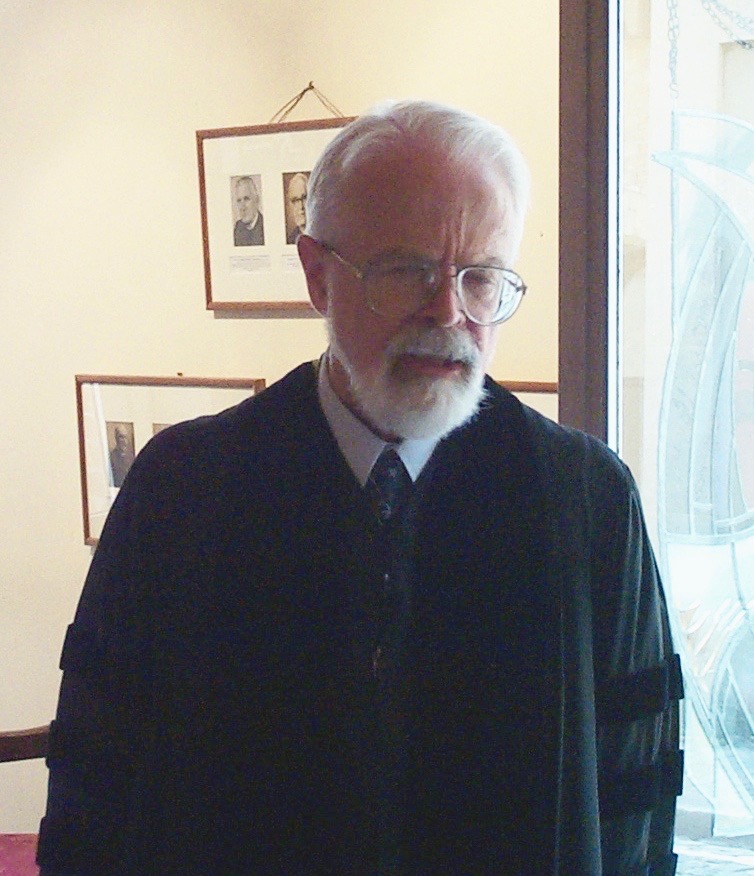
From OUP:
A Theory of Virtue (a review)
Finite and Infinite Goods: A Framework for Ethics (GB)
Also from Google Books:
The virtue of faith and other essays in philosophical theology
Friday, January 08, 2010
James Chastek, Nature, operation, and esse
Metaphysics analyses being, and Aristotle showed two different ways to do this. First, he studied how being was said per se. In this line, being is primarily substance as opposed to accident. Second, he studied being so far as it was opposed to becoming. In this line, being is primarily act as opposed to potency. In this second sense, it is helpful to see “act” as meaning “rising above becoming”. Now rising above becoming happens in three ways:
1.) Being constituted in nature, whether as a substance or an accident. This is the term of generation or change.
2.) Operation/ proper activity. Nature is nothing other than a principle or source of motion and rest. For example, “Rational” or “sentient” are natures, and these are perfected by actually reasoning and actually sensing. Just as a constituted nature rises above becoming, operation rises above the nature. It is substance as operating that most of all rises above becoming, and therefore is most of all “being”.
3.) Esse or the act of being. All becoming is between contraries, but there is no contrary of existence. So taken, esse is absolutely set apart from becoming. Esse, considered in its pure communicability to many, is outside of motion and becoming, even if, in some particular case, it is only present at the term of a motion.
There is a clear order between 1 and 2: nature is the goal of becoming, operation the goal of nature. There is also a clear relation between 1 and 3: sense 1 is existence in a secondary and indirect sense; sense 3 is existence considered in its pure communicability to many, or existence primo et per se. Sense 1 is existence as the term of a natural agent as agent; sense 3 is the properly the term of divine action.
(One difficulty is that the word “esse” or “form” is frequently used for 1 and 3)
But what is the order between 2 and 3? This is a crucial problem, and until we recognize it as a problem our notion of “esse” is likely to slump towards essentialism; where “pure being’ is seen as the lifeless crystalline forms of the platonic museum (Plato distanced himself from these things later in his career). We see “pure act” too easily as mere existence- which makes our opinion of God be more or less the same as a giant stone in the sky. We overlook that an act is an act. The word was not chosen at random. To call God pure act is the same thing as saying that he is the highest operation. After one sees that God is pure act (as Aristotle did) he can immediately know that God is alive, intelligent, blessed, loving (though not in Plato’s sense of “love” in the Symposium- but simply as the perfect operation of will) and with all transcendental perfection: power, goodness, unity, truth, etc.
Thursday, January 07, 2010
Zenit: Ralph McInerny on a Forgotten Thomist
Don't know how I missed this last year...
Ralph McInerny on a Forgotten Thomist
Calls Charles De Koninck a Man of Faith, Philosopher of Science
By Annamarie Adkins
SOUTH BEND, Indiana, NOV. 6, 2009 (Zenit.org).- The renewed interest in the works of St. Thomas Aquinas in the early-to-mid 20th century produced a flowering of Catholic thought that formulated a coherent intellectual critique and alternative to modernity.
But Thomism fell out of fashion after the Second Vatican Council as the perennial philosophy and leading intellectual framework for the Catholic synthesis of faith and reason.
Today, however, Thomism is experiencing somewhat of a revival, and that can be attributed to the work of Thomists such as Ralph McInerny, who, among others, kept the flame of Thomism burning during the tumultuous intellectual milieu that followed the council.
Now, in an act of gratitude, McInerny seeks to introduce a new generation to his own teacher -- a man who helped lay the groundwork for the recent Thomistic revival: Charles De Koninck.
McInerny is in the process of editing and translating into English the collected works of De Koninck (Notre Dame Press), a layman who inspired a whole generation of Thomists that eventually took up positions in the philosophy departments of many Catholic colleges and universities.
Those professors served as an intellectual bridge between an earlier generation of Thomists and the revival going on today.
McInerny is a writer of philosophy, fiction, and cultural criticism, who has taught at Notre Dame since 1955.
He spoke with ZENIT about his relationship with De Koninck, the motivation for making the great professor's writings known to a wider audience, and what they offer us in the challenge of confronting contemporary problems.
ZENIT: Who was Charles De Koninck? What role did he play in your own formation and intellectual training?
McInerny: De Koninck was dean of the Faculté de Philosophie at the Université Laval in Quebec, and played an enormous role in the formation of American Thomists who began to study there in the 1940s.
For almost two decades this phenomenon continued.
Easily recognizable “Laval Thomists” went on to join the faculties of colleges throughout the nation.
I myself took a licentiate and doctorate at Laval, with Professor De Koninck as my director, going there after taking a master's in philosophy from the University of Minnesota.
There is a marvelous biographical essay by his son Thomas in volume one of the Collected Writings.
ZENIT: Why did you decide to compile and translate his collected works? For what reasons does he deserve a wider, contemporary audience?
McInerny: One night I was rereading an essay by De Koninck on the Eucharist and I fell back in my chair and thanked God that I had studied under this man. But he is now all but unknown, his writings are difficult to find, and few had been translated.
I conceived the project of the collected works as an instance of pietas and gratitude.
ZENIT: How did De Koninck understand the task of philosophy and the philosopher?
McInerny: His principal mentors were Aristotle and Thomas Aquinas. He taught by subjecting the texts to a close reading, conveying a technique that one could continue to employ for a lifetime.
ZENIT: De Koninck wrote eloquently about how the Mother of God personifies Wisdom. What role did the Catholic faith play in his philosophical explorations?
McInerny: De Koninck was a Catholic philosopher, which meant that the faith – the magisterium – was always the guide for his work.
His devotion to Mary followed the teaching of St Louis Grignion de Monfort. His work "Ego Sapientia" is a florilegium of texts brought together under titles of Mary drawn from the great masters of Mariology: Bernard and Bonaventure.
ZENIT: His most notable work seems to be his treatise on the common good. What did De Koninck have to say about this often-misunderstood concept? In what contemporary context could his insights have significant value?
McInerny: The book, "The Primacy of the Common Good," was aimed at the personalists.
Who were they? Marx, Engels, various Renaissance figures whose thought on the primacy of man De Koninck regarded as tempting to contemporaries.
The book was regarded as an attack on Jacques Maritain. This is nonsense; Yves Simon saw the teaching of the two men as identical on this matter.
Father I.T. Eschmann, OP, in a lengthy and condescending study, sought to show that De Koninck's teaching was at variance with that of St. Thomas. Eschmann called his essay "A Defense of Jacques Maritain."
Maritain is not mentioned in the "Primacy," nor does he figure much in Eschmann's defense. But the unfortunate myth was created that De Koninck was attacking Maritain.
ZENIT: In the first volume, you've compiled a number of works that address the philosophy of science, as well as themes related to creation and evolution. What audiences might find these writings particularly helpful?
McInerny: De Koninck's views of evolution are of fundamental importance.
His account of the relation between natural philosophy and natural science still awaits a serious appraisal by philosophers of science.
ZENIT: Where is De Koninck's intellectual legacy found today?
McInerny: In many respects, his legacy is embodied in the approach of Thomas Aquinas College, founded by De Koninck's students and flourishing in a time of chaos in higher education.
And, of course, in his writings, which are ripe for reconsideration.
--- --- ---
On the Net:
For more information: http://undpress.nd.edu/book/P01230
Edward Feser, The ethics of property
pdf
html
I'll try to print this out so I can read it at my leisure.
html
I'll try to print this out so I can read it at my leisure.
Wednesday, January 06, 2010
On sale at Amazon at a big discount: Aquinas, Aristotle, and the Promise of the Common Good.
I've skimmed through parts -- it deserves closer attention than that, though I am fairly certain from what I've read that I won't agree with everything the author says.
I've skimmed through parts -- it deserves closer attention than that, though I am fairly certain from what I've read that I won't agree with everything the author says.
Monday, December 28, 2009
Sunday, December 27, 2009
MB recommended that I read this piece by Bishop Hilarion Alfeyev: Christ the Conqueror of Hell,
The Descent of Christ into Hades in Eastern and Western Theological Traditions
The Descent of Christ into Hades in Eastern and Western Theological Traditions
I found this old posts at De Unione Ecclesiarum:
Garrigues on the Father
Garrigues on Latin trinitarianism
Apparently Fr. Garrigues left the Dominicans for a while; he was attached to the Pontifical Theological Academy in 2007, but I do not know if he is still there now.
Garrigues on the Father
Garrigues on Latin trinitarianism
Apparently Fr. Garrigues left the Dominicans for a while; he was attached to the Pontifical Theological Academy in 2007, but I do not know if he is still there now.
Saturday, December 26, 2009
Benedict XVI's Address to University Students
Benedict XVI's Address to University Students
"Helping Others to See the True Face of God Is the First Form of Love"
VATICAN CITY, DEC. 25, 2009 (Zenit.org).- Here is a translation of the Dec. 17 address Benedict XVI gave after Vespers in St. Peter's Basilica in a traditional Christmas meeting with university students.
* * *
Your Eminences,
Venerable Brothers in the Episcopate,
Distinguished Ladies and Gentlemen,
Dear Brothers and Sisters,
What is this wisdom born in Bethlehem? I would like to ask myself and all of you this question during this traditional pre-Christmas meeting with the University world of Rome. Today, instead of Holy Mass, we are celebrating Vespers, and to mark the felicitous coincidence with the beginning of the Christmas novena we will soon be singing the first of the "Greater Antiphons": "O Wisdom from the mouth of the Most High, you fill the whole world. With strength and gentleness you order all things: come to teach us the way of prudence" (Liturgy of the Hours, Vespers of 17 December).
This wonderful invocation is addressed to "Wisdom", the central figure in the Books of Proverbs, Wisdom and Sirach. These are in fact called the "Sapiential" Books, and in them the Christian tradition discerns a prefiguration of Christ. This invocation becomes truly stimulating and even provocative when we find ourselves before the Nativity scene that is, before the paradox of a Wisdom that "from the mouth of the Most High" comes to lie in swaddling cloths in a manger (cf. Luke 2: 7, 12, 16).
Already we can anticipate the response to that initial question: the One born in Bethlehem is the Wisdom of God. St. Paul, in writing to the Corinthians, uses the phrase: "a hidden wisdom of God" (1 Cor 2: 7): in other words, a divine plan, which has long been kept hidden and that God himself has revealed in the history of salvation. In the fullness of time, this Wisdom took on a human Face, the Face of Jesus, who as recited in the Apostle's Creed "was conceived by the Holy Spirit, born of the Virgin Mary; suffered under Pontius Pilate, was crucified, died and was buried. He descended into hell; the third day he rose again from the dead; He ascended into heaven, is seated at the right hand of the God the Father Almighty; from hence he shall come to judge the living and the dead".
The Christian paradox consists precisely in the identification of divine Wisdom, that is the eternal Logos, with the man Jesus of Nazareth and with his story. A solution to this paradox cannot be found if not in the word "Love", which naturally in this case is written with a capital "L", in reference to a Love that infinitely exceeds human and historical dimensions. Therefore, the Wisdom that we invoke this evening is the Son of God, the second Person of the Most Holy Trinity. It is the Word who, as we read in John's prologue, "was in the beginning with God", or rather, "was God": who with the Father and the Holy Spirit created all things and who "became flesh" to reveal the God whom no one can ever see (cf. Jn 1: 2-3, 14, 18).
Dear friends, a Christian professor, or a young Christian student, carries within him a passionate love for this Wisdom! He reads everything in her light; he finds Wisdom's imprints in the elementary particles and in the verses of poets; in juridical codes and in the events of history; in works of art and in mathematic formulas. Without Wisdom not anything was made that was made (cf. Jn 1: 3) and therefore in every created reality one can see Wisdom reflected, clearly visible in different ways and degrees. Everything understood by human intelligence can be grasped because in some sense and to a certain extent it participates in creative Wisdom. Herein lies, in the last analysis, the very potential of study, of research, of scientific dialogue in every field of knowledge.
At this point I cannot omit to reflect on something a bit disquieting but nevertheless useful for us here who belong to the academic world. Let us ask ourselves: who was present on Christmas night at the grotto in Bethlehem? Who welcomed Wisdom when he was born? Who hurried to see him, to recognize him and adore him? They were not doctors of law, scribes or sages. There were Mary and Joseph, and then the shepherds. What does this mean?
Jesus was one day to say: "Yes, Father, for such was your gracious will" (Mt 11: 26); you revealed your mystery to the little ones (cf. Mt 11: 25). But then is there no use in studying? Or is it even harmful counterproductive in understanding the truth?
The two thousand-year-old history of Christianity excludes the latter hypothesis, and suggests to us the correct one: studying entails deepening one's knowledge while maintaining a spirit similar to the "little ones," an ever humble and simple spirit, like that of Mary, the "Seat of Wisdom". How often have we been afraid to draw near to the Grotto in Bethlehem for fear that doing so would be an obstacle to our critical sense and to our "modernity"!
Rather, in that Grotto, each of us can discover the truth about God and about humanity, about ourselves. In that Child, born of the Virgin, the two came together: mankind's longing for eternal life softened the heart of God, who was not ashamed to assume the human condition.
Dear friends, helping others to see the true Face of God is the first form of love, which for you takes on the role of intellectual charity. I was glad to learn that the diocesan university ministry's programme will have "The Eucharist and Intellectual Charity" as its theme this year: a demanding but appropriate choice. Indeed, in every Eucharistic Celebration God enters history in Jesus Christ in his Word and in his Body, giving himself in that love which enables us to serve humanity in its concrete existence.
The project "One culture for the city", then, offers a promising proposal of the Christian presence in the cultural sphere. As I express the hope that your itinerary may be fruitful, I cannot fail to invite all the Athenaeums to be places of formation for authentic workers of intellectual charity. The future of society depends largely on them, above all in drawing up a new humanistic synthesis and of a new vision for the future (cf. Encyclical Caritas in Veritate, n. 21).
I encourage all of the heads of academic institutions to continue to collaborate in the construction of a community in which all young people may develop into mature human beings who hold themselves responsible for the creation of a "civilization of love".
At the conclusion of this Celebration, the Australian university student delegation will consign the Icon of Mary Sedes Sapientiae to the delegation from Africa. Let us entrust to the Most Holy Virgin all university students on the African continent; following the Special Synod for Africa, the cooperative commitment has been developing in these months between the Athenaeums of Rome and those in Africa.
I renew my encouragement of this new prospect of collaboration, and I hope it may lead to the creation and growth of cultural projects capable of promoting a truly integral human development. May this Christmas, dear friends, bring joy and hope to you, your families and to the entire university environment, in Rome and throughout the whole world.
© L'Osservatore Romano
Thursday, December 24, 2009
Medieval Sourcebook: Bartolo of Sassoferrato, Treatise on City Government, c. 1330
Related links:
Bartolo da Sassoferrato - Wikipedia
Bartolo's De Insigniis et Armis
I ask then, of the three bad forms of government, which is worse. In this matter all the philosophers says that a tyranny is the worst principate, and occupies the final degree of malice. And the same Aegidius in his book said, as has been said, that a government is called good insofar as it tends toward the common good. But under a tyranny the common good is looked to least: whence a tyranny is the worst principate. Whence if several are ruling, who are held to be wealthy and good, or the multitude rules, even if these rulers incline to their own good, which is indeed not of God, and thus it is a rule "of the bad" or "of a perverse populace," nevertheless it would not diverge much from the intention of the common good; because, since they are many, they know something about the nature of the common good. But if the tyrant is a single person then he does recede from the common good. Furthermore, since virtue united for a good thing is better, virtue united for a bad thing is worse.[70] That a tyrant is the worst is so obvious as to require no demonstration. and what was said above, that the rule of several bad men is not so bad as the rule of a single tyrant, should be understood to be true when the many tend to one purpose, and can do nothing except together: it is a different matter if each exercises his own tyranny, so that one cares not about the other, as I said above concerning the monstrous regime which now exists in Rome. Similarly when in one body there is a single corrupt humor which predominates and is bad; but if all the humors are corrupted they oppose each other etc., as has already
29 been said. Woe then to that city which has many tyrants with no common ground. This warning should be made, that the rule of several bad men or of a perverse people does not last long, but easily turns into a one-man tyranny; we often see this actually happen. This is God's own will, as it is written: "He who makes a hypocrite to rule, for the sins of the people," Job 34, [71] and because Italy today is full up with tyrants.
Related links:
Bartolo da Sassoferrato - Wikipedia
Bartolo's De Insigniis et Armis
Wednesday, December 23, 2009
30 Days: «If everything is grace, then grace is no more»
«The thing that seems most useful to me is the ability to distinguish,proper to the whole Thomist tradition. The refusal to distinguish what is distinct leads to confusion and denies maybe what one wanted to defend in the first place. If everything is grace, then grace is no more». An interview with Cardinal Georges Cottier, the Pope’s theologian
by Gianni Valente
«The thing that seems most useful to me is the ability to distinguish,proper to the whole Thomist tradition. The refusal to distinguish what is distinct leads to confusion and denies maybe what one wanted to defend in the first place. If everything is grace, then grace is no more». An interview with Cardinal Georges Cottier, the Pope’s theologian
by Gianni Valente
Tuesday, December 22, 2009
Wednesday, December 16, 2009
The CCC on abortion:
What the Catechism claims about the conceptum is quite clear. But is this de fide? Or a theological opinion presented in authoritative trappings? I have asked whether the Church has infallibly taught that human life begins at conception (with "human" being understood univocally, not equivocally). It seems that the Feast of the Annunciation also celebrates the conception of Christ, and the humanity of Christ at conception is affirmed as a part of Sacred Tradition. But is this sufficient evidence that the Church has always taught that all concepta are human beings or persons?
Some claim that we have unambiguous evidence that the conceptum is human; I will have to address this question in a later post, having already done so in some notes. As far as I know, nothing the Church has proclaimed in recent years contradicts the teaching of the Council of Vienne, which defined the soul as the substantial form of the body. It seems impossible that the Church could define the formal cause as something else, such as DNA. The question a Catholic physicist would ask, then, is whether we can know (with certainty) that the rational soul is infused at conception. If the activities of the conceptum can also explained by an animal soul, then it would seem that we cannot know with certainty that the conceptum is human, though we may believe it with the certitude of Faith, if this has been revealed by God.
Abortion
2270 Human life must be respected and protected absolutely from the moment of conception. From the first moment of his existence, a human being must be recognized as having the rights of a person - among which is the inviolable right of every innocent being to life.72
- Before I formed you in the womb I knew you, and before you were born I consecrated you.73
My frame was not hidden from you, when I was being made in secret, intricately wrought in the depths of the earth.74
2271 Since the first century the Church has affirmed the moral evil of every procured abortion. This teaching has not changed and remains unchangeable. Direct abortion, that is to say, abortion willed either as an end or a means, is gravely contrary to the moral law:
- You shall not kill the embryo by abortion and shall not cause the newborn to perish.75
God, the Lord of life, has entrusted to men the noble mission of safeguarding life, and men must carry it out in a manner worthy of themselves. Life must be protected with the utmost care from the moment of conception: abortion and infanticide are abominable crimes.76
What the Catechism claims about the conceptum is quite clear. But is this de fide? Or a theological opinion presented in authoritative trappings? I have asked whether the Church has infallibly taught that human life begins at conception (with "human" being understood univocally, not equivocally). It seems that the Feast of the Annunciation also celebrates the conception of Christ, and the humanity of Christ at conception is affirmed as a part of Sacred Tradition. But is this sufficient evidence that the Church has always taught that all concepta are human beings or persons?
Some claim that we have unambiguous evidence that the conceptum is human; I will have to address this question in a later post, having already done so in some notes. As far as I know, nothing the Church has proclaimed in recent years contradicts the teaching of the Council of Vienne, which defined the soul as the substantial form of the body. It seems impossible that the Church could define the formal cause as something else, such as DNA. The question a Catholic physicist would ask, then, is whether we can know (with certainty) that the rational soul is infused at conception. If the activities of the conceptum can also explained by an animal soul, then it would seem that we cannot know with certainty that the conceptum is human, though we may believe it with the certitude of Faith, if this has been revealed by God.
Tuesday, December 15, 2009
If even a republic is governed by a minority of the people who are its parts, and only these few can possess the requisite virtues, then can a liberal education ever be something that is "universal," provided and of benefit to all? If only a minority governs in any good regime, then can the culture it possess be anything but "elite" or limited with respect to the number of people who maintain it and pass it on?
To what sort of teacher do we owe the virtue of observance? One who truly possesses knowledge, especially scientia? Or to anyone who has some measure of "learning," even if that is only the result of memorization? If a "scholar" should be honored for being well-acquainted with the opinions of others (in his study of their works), then why shouldn't a Jeopardy winner be honored for his amassing of trivia? Even if we concede that a scholar as defined above has some measure of perfection that is lacking in the one who is ignorant, should he be given the same honor as the man who possesses widsom or scientia?
Monday, December 14, 2009
Pope: No Justification for Anti-Personnel Mines
US Attends Conference for 1st Time, No Plans to Sign Convention
By Jesús Colina
VATICAN CITY, DEC. 14, 2009 (Zenit.org).- There are no ethical arguments to defend the production and use of anti-personnel landmines, especially given that most victims are innocent civilians, a statement written on Benedict XVI's behalf is reiterating.
The Pope's secretary of state, Cardinal Tarcisio Bertone, affirmed this in a note sent on the Holy Father's behalf to a six-day summit that concluded Dec. 4 in Cartagena, Colombia.
The Cartagena Summit was the second review conference on the 1997 Convention on the Prohibition of the Use, Stockpiling, Production and Transfer of Anti-Personnel Mines and on Their Destruction. The convention is also known as the Ottawa Treaty.
The Holy See reiterated its appeal to all nations to join the 156 countries that have adopted this convention, which has been in force since 1999. China, India, the United States and Russia are the four most important states that have yet to sign it.
In the letter, the Holy See also appeals "to all states to recognize the deplorable humanitarian consequences of anti-personnel mines."
Cardinal Bertone wrote: "Experience shows that these weapons have caused more victims and damages among the civilian population, which should be defended, than they have served to defend states.
"The thousands of victims that they continue to bring remind us, in case it should still be necessary to repeat it, of the chimera of wanting to build peace and stability with an exclusively military vision."
The Holy Father's closest collaborator reiterated that "peace, security and stability cannot depend only on military security, but above all depend on the existence of all those conditions that allow for the full development of the human person, which so many times are impeded by the use and presence of anti-personnel mines."
Victims
The letter expressed Benedict XVI's closeness "to all the victims, their families and the affected countries."
"They all need will power and courage to undertake a process of rehabilitation, and they also need our help and human closeness," the cardinal wrote.
The papal statement reiterated "the Holy See's unconditional support to all those involved in the great task of freeing our world from anti-personnel mines."
The Cartagena Summit concluded with the resolution to give greater assistance to victims. It also noted that four countries -- Albania, Greece, Rwanda and Zambia -- have cleaned all their areas of these mines, in compliance with the treaty.
The Cartagena Action Plan to guide efforts between 2010 and 2014 pivots on two main goals: assistance to the victims of anti-personnel mines and the humanitarian clean-up of contaminated fields.
On behalf of the Pontiff, the letter thanked Norway's Susan Eckey, president of the conference, for her work.
Holding back and watching
During the closing of the event, Eckey pointed out that there has been success in efforts to support survivors and people who live with the risk of anti-personnel mines.
Twenty of the 39 countries that have not adhered to the Ottawa Treaty attended as observers. Among them -- for the first time -- was the United States, which announced a review of its anti-personnel mines policy, although for the time being there is no sign of intentions to adopt the convention.
In 2008 only the armies of Russia and Myanmar used anti-personnel mines. However, insurgents such as the Armed Revolutionary Forces of Colombia and the Tamil Tigers of Sri Lanka utilize them.
1997 Convention on the Prohibition of the Use, Stockpiling, Production and Transfer of Anti-Personnel Mines and on Their Destruction
International Humanitarian Law - Ottawa Treaty, 1997
Mine Action
James Chastek, Thought in algebra (or calculus, analytic geometry, trig, etc) (See his previous post on algebra.)
Saturday, December 12, 2009
Tyrant is usually reserved for the man who embodies the degenerate form of kingship. Would it nonetheless help us understand why the ancients thought democracy was so bad, if we were to call its citizens little "tyrants"? If not the meaning, then the emotional association with the word when it is used properly may prevent us from grasping the point, since we reasonably think that a tyrant is worse than a democracy with respect to the immediate effects of his rule.
Pope's Letter to Conference on the God Question
"When God Disappears From Man's Horizon, Humanity Loses Its Direction"
VATICAN CITY, DEC. 11, 2009 (Zenit.org).- Here is a translation of the message that Benedict XVI sent to Cardinal Angelo Bagnasco, archbishop of Genoa and president of the Italian episcopal conference, on the occasion of the three-day international congress taking place in Rome through Saturday titled "God Today: With Him or Without Him Everything Changes."
* * *
To the Venerated Brother
Lord Cardinal Angelo Bagnasco
Metropolitan Archbishop of Genoa
President of the Italian Episcopal Conference
On the occasion of the Congress "God Today: With or Without Him Everything Changes," which is taking place in Rome from December 10-12, I wish to express to you, venerated Brother, to the Italian Episcopal Conference and, in particular, to the Committee for the Cultural Project, my profound appreciation for this important initiative, which addresses one of the great topics that has always fascinated and questioned the human spirit.
The question of God is also central in our time, in which man is often reduced to one dimension, the "horizontal," considering openness to the Transcendent as irrelevant for his life. The relationship with God, instead, is essential for humanity's journey and, as I have had the occasion to affirm many times, the Church and every Christian, in fact, have the task to make God present in this world, to attempt to open to men access to God.
Planned from this perspective is the international event of these days. The breadth of the approach to the important topic that characterizes the meeting, will make possible the sketching of a rich and articulated picture of the question of God, but above all it will be a stimulation for a profound reflection on God's place in the culture and life of our time.
On one hand, in fact, an attempt is being made to show the different ways that lead to affirming the truth about the existence of God, that God which humanity has always known in some way, even in the chiaroscuro of his history, and who revealed himself with the splendor of his face in the covenant with the people of Israel and, beyond that, in every measure and hope, in a full and definitive way, in Jesus Christ.
He is the Son of God, the Living who enters into the life and history of man to illumine him with his grace, with his presence. On the other hand, the desire is precisely to bring to light the essential importance that God has for us, for our personal and social life, for understanding ourselves and the world, for the hope that illumines our way, for the salvation that awaits us beyond death.
Directed to these objectives are the numerous interventions, according to the many points of view which will be the object of study and exchange: from philosophical and theological reflection on the witness of the great religions; from the impulse to God, which finds its expression in music, literature, the figurative arts, the cinema and television; to the development of the sciences, which attempt to read in depth the mechanisms of nature, fruit of the intelligent work of God the Creator; from the analysis of the personal experience of God to the consideration of the social and political dynamics of an already globalized world.
In a cultural and spiritual situation such as the one we are living in, where the tendency grows to relegate God to the private sphere, to consider him irrelevant and superfluous, or to reject him explicitly, it is my heartfelt hope that this event might at least contribute to disperse that semi-darkness that makes openness to God precarious and fearful for the men of our time, though he never ceases to knock on our door.
The experiences of the past, although not remote to us, teach us that when God disappears from man's horizon, humanity loses its direction and runs the risk of taking steps to its own destruction. Faith in God opens man to the horizon of certain hope, which does not disappoint; it indicates a solid foundation on which to base life without fear; it calls for abandoning oneself with confidence in the hands of the Love which sustains the world.
To you, cardinal, to all those who have contributed to prepare this congress, to the speakers and to all the participants I express my cordial greeting with the desire for the full success of the initiative. I support the works with prayer and with my apostolic blessing, propitiator of that light from on High, which makes us capable of finding God, our treasure and our hope.
In the Vatican, December 7, 2009
[Translation by ZENIT]
Thursday, December 10, 2009
James Chastek, Justice and Right
sa
Political theories based on right can very easily dissolve justice into right. Such a dissolution involves saying that there is nothing to justice beyond preserving, delineating, and defending rights. Let’s stipulate that all accounts of justice are in fact rights- relative, that is, that every act of justice is inseparable from the reality that such and such is owed to someone by right. What problem is there in simply using “right” as a proxy for “justice”? Won’t we get exactly the same results?A full rights theory can only be developed within ethics, or a political theory that is built upon "ethics" and the good. The problem is not with rights language, but with the ethical foundation that supports it.
Justice is the virtue of right operation to others. As a virtue, it is confers good on the one who has it, as giving right operation to others it confers some good on others. Notice that from one and the same action, good necessarily flows into a multitude: the one who acts and another. Right is not like this. Right captures the aspect of justice that speaks of “right operation to others”, but it prescinds from how such an operation needs to be perfective of the one from whom the operation flows. Right is a kind of abstraction in the mind that cannot be an abstraction in reality: the separation of “giving what is due” from the moral perfection of the giver. There is nothing wrong with these abstractions, and political thought needs to make them, but there is a blind side to the abstraction that we need to be aware of.
A full rights theory needs to recognize how the actuality of right- the satisfaction of right- is a good that is not limited to the one with the right, but it belongs both to the one who receives the good by right and the one who provides it to him. There is a single good which flows into two persons in different modes; but it flows in a higher mode into the one who acts or gives since it flows into him as virtue. A full rights theory would be a way of leading to a recognition of the superabundance of justice (where “superabundance” means “a good not limited to one nor diminished by being common”)
Notice that it is not enough to include a notion of “duty” as a correlative of right, though this is necessary. Neither right nor duty speaks to a superabundant good, flowing in diverse modes. Rights based theories must be perfected in one way by relating them to duties and in another way by relating them to justice.
sa
Tuesday, December 08, 2009
When I first saw the headline, without the body of the article, I thought perhaps someone was trying to present an alternative to the theologoumenon that the Blessed Virgin Mary is Mediatrix and Co-Redemptrix. (Orthodox if understood correctly, but liable to be misunderstood by Protestants and maybe the Orthodox.)
More:
The Fifth Marian Dogma: Co-Redemptrix, Mediatrix of All Graces and Advocate
Mother of All Peoples - Home - Petition for the Fifth Marian Dogma
Catholic Culture : Library : A New Marian Dogma?
Voice of the People for Mary Mediatrix
Mary: Coredemptrix, Mediatrix, Advocate by Mark I Miravale, S.T.D., Chapter 3
Dr. Mark Miravalle - The Official Home Page
Update on Defining Mary Spiritual Mother of Humanity
"Could Constitute a Historic Benefit of Grace and Blessing for All"
SAN JUAN, Puerto Rico, DEC. 8, 2009 (Zenit.org).- Here is the letter sent today, the solemnity of the Immaculate Conception, by Cardinal Luis Aponte-Martinez, the retired archbishop of San Juan, to the cardinals and bishops of Latin America on the petition to define the "Blessed Virgin Mary as the Spiritual Mother of All Humanity, under its threefold aspects of Coredemptrix, Mediatrix of All Graces, and Advocate."
* * *
8 December 2009
Solemnity of the Immaculate Conception
My Dear Brother Cardinals and Bishops,
On January 1, 2008, five cardinals wrote to all bishops of the world to notify them of the petition made by an international group of cardinals and bishops assembled at Fatima to His Holiness, Pope Benedict XVI, in humble request for the solemn definition of the Blessed Virgin Mary as the Spiritual Mother of All Humanity, under its threefold aspects of Coredemptrix, Mediatrix of All Graces and Advocate. Already in the past, hundreds of bishops and millions of faithful have made this appeal. Again many bishops have recently responded. As one of those five cardinals who sent this global petition, I now wish to provide you with an update concerning this universal Church request.
Recently the Philippines submitted to His Holiness a petition for this solemn definition from Cardinal Vidal, Archbishop Lagdameo, President of the Philippine Conference of Catholic Bishops, and several other archbishops and bishops. The petition was accompanied by a personal letter from Philippines President, Madame Gloria Arroyo, in which she strongly supported the request of the bishops.
Also representative groups of cardinals and bishops from India and nearby countries, including Cardinal Vithayathil, President of the National Conference of the Bishops of India, have submitted their own petition for this fifth Marian dogma to Pope Benedict XVI. A similar petition has been sent from Africa by Archbishop Felix Job, President of the Catholic Conference of the Bishops of Nigeria, and various other African bishops. Bishops from Eastern Europe, including Archbishop Kramberger of Slovenia, have likewise sent in their own petition for this Marian papal proclamation. Along with bishops from numerous countries from Latin America, I have sent in our own petition to Pope Benedict for the papal definition of Our Lady’s Spiritual Motherhood.
All over the world, lay faithful have joined their bishops. Numerous prayer days, conferences, individual prayers and petitions to the Holy Father from the laity constitute a positive manifestation for this potential Marian dogma from the sensus fidelium.
We all perceive a worldwide urgency for the greatest possible intercession of our heavenly Mother for the unprecedented crises of faith, family, society, and peace, which marks the present human condition. We see the papal definition of Holy Mary's Spiritual Motherhood of all peoples as an extraordinary remedy to these global crises which today threaten a great part of humanity. The more we freely acknowledge Mary’s intercessory power, the more she is able to exercise this power for the peoples of the world entrusted to her care at Calvary.
I therefore invite you, dear brother, to join your brother cardinals and bishops from throughout the world in this renewed petition to our Holy Father, Pope Benedict XVI, by sending in your own letter for his prayerful discernment of what might constitute a next positive step for the solemn proclamation of the Spiritual Motherhood of Mary. Thank you for your own prayerful discernment of this most important work in honour of Our Lady, which we believe could constitute a historic benefit of grace and blessing for all humanity.
+Luis Cardinal Aponte Martinez
Archbishop-Emeritus,
San Juan, Puerto Rico,
email:cardinalaponte@gmail.com
More:
The Fifth Marian Dogma: Co-Redemptrix, Mediatrix of All Graces and Advocate
Mother of All Peoples - Home - Petition for the Fifth Marian Dogma
Catholic Culture : Library : A New Marian Dogma?
Voice of the People for Mary Mediatrix
Mary: Coredemptrix, Mediatrix, Advocate by Mark I Miravale, S.T.D., Chapter 3
Dr. Mark Miravalle - The Official Home Page
The Western Confucian: We All Know Christmas Was First a Pagan Holiday, Right? \
I have earlier speculated that there is insufficient witness within Sacred Tradition to the humanity or personhood of the conceptum. But, if Christ was acknowledged as being fully human at His conception, might not that be an argument for human personhood? (Unless one wants to argue that Christ was an exception to normal human development.)
I have earlier speculated that there is insufficient witness within Sacred Tradition to the humanity or personhood of the conceptum. But, if Christ was acknowledged as being fully human at His conception, might not that be an argument for human personhood? (Unless one wants to argue that Christ was an exception to normal human development.)
Monday, December 07, 2009
Roman Christendom: SPECIAL RELATIVITY:CHALLENGING THE DOGMATIC MAGISTERIUMOF MODERN SECULAR SCIENTISTS(Post 4)
Christoph von Mettenhem ALBERT EINSTEIN oder Der Irrtum eines Jahrhunderts
The hermeneutic of continuity: Statue of Galileo
The Theses of Christoph von Mettenheim
Thesis No. 1: The special theory of relativity rests on the premise that the velocity of light in a vacuum will be constant and cannot be influenced by the velocity of the source from which the light is coming. From this premise Einstein concluded that time itself must be relative.
Thesis No. 2: In everyday language the concept of ‘velocity’ will designate the relation of distance and time. This concept of everyday language has never been called into question in the theory of relativity. It implies, and presupposes, a concept of ‘time’.
Thesis No. 3: If velocity is to be constant, then this concept of ‘time’ must not change on the distance observed. In the terminology of the theory of relativity it must therefore be ‘absolute’.
Thesis No. 4: Special relativity therefore presupposes in the premise of the constant
spreading velocity of light that time is absolute, and infers from this that time is not absolute. It therefore includes a logical contradiction.
Thesis No. 5: The formulae of special relativity were regarded by Einstein, and are still being regarded today, as practicable approximations to the formulae of general relativity for circular and elliptical motions.
Thesis No. 6: Whenever observations (experiments) were considered to be confirmations of a relativistic time dilation it was always a presupposed interpretation that the formulae of special relativity can be used as approximations to establish relativistic time dilation.
Thesis No. 7: Any application of the special theory of relativity to facts occurring in reality, in particular to measurements of a relativistic time dilation, presupposes some unit of measurement which must first be defined.
Thesis No. 8: Einstein and the adherents of the theory of relativity have never defined units of ‘relative time’ differing from conventional units of time. Where they make exact calculations, they employ ‘hours’, or ‘minutes’ or ‘seconds’, or units derived from these.
Thesis No. 9: ‘Hours’, and ‘minutes’ and ‘seconds’ have been derived from the conventional standard given by the Earth’s rotation.
Thesis No. 10: Any application of the formulae of special relativity in connection with the time units of ‘hours’, or ‘minutes’ or ‘seconds’ for calculating the relativistic time dilations of circular or elliptical motions will lead to logical contradictions.
Thesis No. 11: The same logical contradictions will arise from the application of other standards of measurement (e.g. caesium beam clocks), provided they are employed consistently.
Thesis No. 12: Hence, the mathematical formulae of special relativity are inadequate to establish the relativity of time. They are, however, logically consistent, and can therefore be employed to refute the original hypothesis that the velocity of light in a vacuum will be constant and cannot be influenced by the velocity of the source from which the light is coming.
Q. E. D.
Christoph von Mettenhem ALBERT EINSTEIN oder Der Irrtum eines Jahrhunderts
The hermeneutic of continuity: Statue of Galileo
Sunday, December 06, 2009
Thomistica.net: John Deely Awarded for World-Wide Scholarly Achievement
Realism for the 21st Century: A John Deely Reader, Edited by Paul Cobley
Four Ages of Understanding: The first Postmodern Survey of Philosophy from Ancient Times to the Turn of the Twenty-First Century
Google Books
John N. Deely: Intentionality and Semiotics
Related links:
Semiootika osakond : John Deely
Dr. Deely Earns Aquinas Medal for Excellence in Christian Philosophy
Semiotic Bibliography
Semiotics and ontology: John Poinsot (John of St. Thomas)
Utopian Realism
Realism for the 21st Century: A John Deely Reader, Edited by Paul Cobley
Four Ages of Understanding: The first Postmodern Survey of Philosophy from Ancient Times to the Turn of the Twenty-First Century
Google Books
John N. Deely: Intentionality and Semiotics
Related links:
Semiootika osakond : John Deely
Dr. Deely Earns Aquinas Medal for Excellence in Christian Philosophy
Semiotic Bibliography
Semiotics and ontology: John Poinsot (John of St. Thomas)
Utopian Realism
Saturday, December 05, 2009
Is the public good the same as the common good?
I believe "public good" is used in Dignitatis Humanae rather than the "common good." Can it be identified with the classical notion of the common good, or is it a subordinate good, akin to peace? One could argue that peace is an instantiation of the common good, in so far as it is not merely the absence of strife and violence (and injustice), but caused by the members of a community abstaining from such acts. On the part of the majority, such acts may not result from virtue, but from the fear of punishment--nonetheless, it would be the barest instantiation of the common good, as it is understood in Aristotle and Aquinas, since it can only come about through the compliance of the members with the laws, and the enforcement of the law by the public authorities.
I'm going to have to read Finnis again on the instrumental common good and see how he explains it.
I'm going to have to read Finnis again on the instrumental common good and see how he explains it.
Mark Shea posts this Zenit article: Scholars Aim to Disprove Darwin. Abstracts of the presentations. In the comments to Mr. Shea's post there is this message from Hugh Owen of the Kolbe Center for the Study of Creation:
Pax Christi!
As we reach the end of the Church year, I would like to thank you for your prayers and gestures of support which have opened so many doors for our apostolate during the past twelve months. In this letter, I would like to summarize some of the highlights of the past year, and introduce you to some new books that would make ideal Christmas presents for your friends and loved ones.
Thanks to your prayers and support, Pope Pius XII’s plea to Catholic scholars in his encyclical Humani generis (in 1950) to examine the evidence for and against the evolutionary hypothesis was finally answered when Catholic scholars gathered at four major academic centers in Europe during the “year of Darwin” to present the evidence against the evolutionary hypothesis. During the past 59 years, there has been no shortage of conferences in support of evolution, but now, for the first time, Catholic experts in natural science and philosophy have presented what a recent conference at Villanova University called “the untold story”—the fatal weaknesses of the evolutionary hypothesis. Perhaps more important than the actual conferences has been the publication of the conference proceedings. In the spring, the proceedings of the conference “A Scientific Critique of Evolution” were published by Sapienza University in Rome and, two weeks ago, the proceedings of a conference on evolution at the National Research Council in Rome were published by a major Italian publishing house, Cantagalli, under the title Evolution: The Decline of an Hypothesis.
In September, natural scientists and philosophers gathered at Gustav Siewerth Akademie, a Catholic university in Germany founded with the help of then-Bishop Josef Ratzinger, to present arguments from natural science and philosophy against evolutionary theory. In a letter to the Rector of the Akademie, through the Vatican Secretariat of State, Pope Benedict XVI gave his blessing to the conference. In the words of the correspondent:
Pope Benedict XVI has attentively taken note of the program and of the publication. Under the guidance of the Holy Spirit, may your scientific discussions during your event lead you to a deeper knowledge of Creation and of its divine plan.
In the near future, the proceedings of the Akademie conference will also be published in English. Finally, on November 9, 2009. the conference “The Scientific Impossibility of Evolution” was held at St. Pius V University in Rome to an audience including quite a few priests and seminarians studying at various Pontifical universities.
As Christmas approaches, I would like to draw your attention to several important new publications that will greatly enrich the holiday season for your friends and loved ones. For those interested in the scientific evidence against the evolutionary hypothesis, the proceedings of the Sapienza University conference “A Scientific Critique of Evolution” are now available in English for a suggested donation of only $10.00.
Thanks to the generosity of several benefactors, we have also been able to publish a second edition of Fr. Victor Warkulwiz’s masterpiece The Doctrines of Genesis 1-11. If you are looking for a Christmas gift for a priest or educated layman, this is a reference book that changes lives—now reduced from $32.95 to a suggested donation of $19.95, and available on a special website of its own www.genesis1-11.org
For those who would like a clear, readable introduction to the origins controversy from a Catholic perspective, an experienced director of religious education from the Diocese of Arlington, Virginia, Olivia McFadden, has written just such a book. Entitled A Bird in Hand, Mrs. McFadden’s little book provides an excellent summary of the case for the traditional Catholic doctrine of creation—available for a suggested donation of $15.00.
Finally, thanks to the hard work of Fr. Victor Warkulwiz and the excellent scholarship of translator Craig Toth, the Kolbe Center is pleased to announce the publication of the first ever English translation of St. Lawrence of Brindisi’s Commentary on the first three chapters of Genesis. Named a Doctor of the Church by Blessed Pope John XXIII in 1959, St. Lawrence was perhaps the most eminent commentator on the Bible of the past 500 years. A master of all of the Biblical languages, St. Lawrence is said to have known the entire text of the Bible by heart. His commentary on Genesis 1-3 firmly upholds the traditional, Catholic doctrine of creation, and answers many of the principal objections to that doctrine which had already been raised before his time. With the help of Fr. Victor’s footnotes, you will find this work by a great Doctor of the Church a rich source of wisdom and spiritual insight—available this Advent for the first time, for a suggested donation of $20.00
Many of you have noted that our recent conference “The Scientific Impossibility of Evolution” received favorable coverage from secular and Catholic news outlets and blogs all over the world, including Zenit News and EWTN news. With the help of your prayers and sacrifices, we are determined not to slacken our efforts, but to seize every opportunity to further expose the scientific bankruptcy of the evolutionary hypothesis and to defend the traditional Catholic doctrine of creation, which is the foundation of the Gospel. As a major new initiative, several Kolbe advisors have spent countless hours designing a new website for our apostolate, one which will undoubtedly attract many new visitors and greatly extend our influence throughout the world. Please keep their sacrificial labors in your prayers.
In the final analysis, the primary purpose of our apostolate is the salvation and sanctification of souls, and the protection of souls from evolutionary errors that weaken and often extinguish the Faith. On my recent trip to Estonia on the western border of Russia, one of my hosts told me of a young Catholic boy at a local school who had just announced to his mother that he was not going to go to church any longer—he had studied enough evolutionary “science” to know that the Christian account of creation and the Fall was a “fairy tale”! How sad it is that all over the world, millions of young people renounce the “sacred history” of Genesis, for what the great philosopher and critic of evolution Larry Azar rightly called “a fairy tale for adults.” But how beautiful it is to see the faith renewed in souls who rediscover the truth of the traditional doctrine of creation and who regain an unshakable confidence in the perfect goodness of God!
If you have contact with any contemplative communities in your area, please ask them to pray for our apostolate, and please unite your prayers with theirs for the success of our mission. If you are in a position to become a regular financial contributor, please do that, too. By the grace of God, our little apostolate has accomplished a great many things with modest financial resources. But we could accomplish much more, if we had more monthly contributors.
As we enter the holy season of Advent, let us keep our eyes fixed on Our Lord Jesus Christ, the Eternal Word and the Lord of history, who is faithful and true.
Yours in Christ, through the Holy Theotokos,
Hugh Owen
Friday, December 04, 2009
Thursday, December 03, 2009
On the editor's intro on the back of The Mystery of Joseph, by Fr. Philippe, OP, it is written that St. Joseph is "the greatest of saints, after Mary." I thought that position was held by St. John the Baptist? But he was put in the Roman Canon after the BVM by John XXXIII...
Zenit: Adding St. Joseph to the Eucharistic Prayer
Zenit: Adding St. Joseph to the Eucharistic Prayer
Thomas Hibbs reviews The Modern Philosophical Revolution: The Luminosity of Existence by David Walsh
More bad intellectual history?
A review at NDPR.
Dr. Hibbs has his own website now.
More bad intellectual history?
A review at NDPR.
Dr. Hibbs has his own website now.
If the voters merely vote what is in their own private best interest (especially financially), then the form of government which they comprise is a bad regime. It is easy to forget this when dealing with contemporary politics, in which the rhetoric of freedom is bandied about. Nonetheless, democracy is excoriated by Plato and Aristotle for good reason. For many American voters, the ultimate criterion for deciding how to vote is how a proposed law or a politician's platform will affect one's bank accounts.
How would Aristotle judge the beliefs of personalists and proponents of the NNLT that the common good is an instrumental good, ordered to the good of the individual (or of the family)? How is that any different from a society in which the good of the family is privileged over that of society? One could argue that in the former, if it is corrupt, some sort of injustice is being committed against others or society at large by those in power for the benefit of their families. However, in a personalist society, there are laws which punish these sorts of acts.
Is it possible that the legislation produced by a personalist understanding of the common good could turn out to be the same as one produced by an adherent of the classical understanding? Perhaps the "instrumental" common good is not the same as the "classical" or "holistic" common good.
How would Aristotle judge the beliefs of personalists and proponents of the NNLT that the common good is an instrumental good, ordered to the good of the individual (or of the family)? How is that any different from a society in which the good of the family is privileged over that of society? One could argue that in the former, if it is corrupt, some sort of injustice is being committed against others or society at large by those in power for the benefit of their families. However, in a personalist society, there are laws which punish these sorts of acts.
Is it possible that the legislation produced by a personalist understanding of the common good could turn out to be the same as one produced by an adherent of the classical understanding? Perhaps the "instrumental" common good is not the same as the "classical" or "holistic" common good.
Tuesday, December 01, 2009
The more I think about it, the more I think that subsidiarity is emphasized within Catholic Social Teaching not only because it is a sound political principle, but as a reminder to the secular rulers that they should be prudent and not over-extend themselves in their legislation. It is a more pragmatic approach to over-sized polities, to the world as it is, rather than focusing on claims of justice and rights, which may be true but will nonetheless be ineffectual, given who has power and the inertia of political culture.
Is it true that the Church would sympathize with those who aspire to a more humane political arrangement, appealing to rights or self-determination or secession? Where is the balance between obedience to a legitimate authority (poorly exercised) and political reform (or even dissolution) to be found? In the impact upon the common good.
Is it true that the Church would sympathize with those who aspire to a more humane political arrangement, appealing to rights or self-determination or secession? Where is the balance between obedience to a legitimate authority (poorly exercised) and political reform (or even dissolution) to be found? In the impact upon the common good.
Monday, November 30, 2009
Saturday, November 28, 2009
Friday, November 27, 2009
Sunday, November 22, 2009
Zenit: Pope's Address to Assembly of Catholic Universities
Pope's Address to Assembly of Catholic Universities
"Be an Instrument of the Evangelical Proclamation"
VATICAN CITY, NOV. 19, 2009 (Zenit.org).- Here is a translation of the address Benedict XVI delivered today to the participants in the 23rd general assembly of the International Federation of Catholic Universities. The audience took place in the Paul VI Hall.
* * *
Cardinals,
Venerated Brothers in the Episcopate and in the Priesthood,
Illustrious Rectors, Academic Authorities and Professors,
Dear Students, Brothers and Sisters,
I receive you with joy and thank you for having come "ad Petri Sedem," to be confirmed in your important and committed duty of teaching, study and research at the service of the Church and of the whole of society. I cordially thank Cardinal Zenon Grocholewski for the words he addressed to me on presenting this meeting, in which we recall two particular anniversaries, the 30th of the apostolic constitution "Sapientia Christiana," promulgated on April 15, 1979, by the Servant of God John Paul II, and the 60th anniversary of the recognition by the Holy See of the Statute of the Federation Internationale des Universites Catholiques (FIUC).
I am happy to recall with you these significant anniversaries, which offer me the possibility to manifest once again the indispensable role of ecclesiastical faculties and Catholic universities in the Church and in society. The Second Vatican Council underlined it clearly in the declaration "Gravissimum Educationis" when it exhorted ecclesiastical faculties to deepen their knowledge in the various sectors of the sacred sciences, to have an ever more profound knowledge of revelation, to explore the treasure of Christian wisdom, foster ecumenical and interreligious dialogue, and respond to the problems that are arising in the cultural realm (cfr No. 11).
The same conciliar document recommend the promotion of Catholic universities, distributing them in the various regions of the world and, above all, taking care of their qualitative level to form persons versed in learning, prepared to give witness to their faith in the world and to carry out tasks of responsibility in society (cfr No. 10).
The council's invitation found a vast echo in the Church. Today there are, in fact, more than 1,300 Catholic universities and almost 400 ecclesiastical faculties, spread over the five continents, many of which have arisen in the last decades, in testimony of a growing attention of local Churches to the formation of ecclesiastics and laity in culture and research.
The apostolic constitution "Sapientia Christiana," from its first expressions, shows the urgency, still present, to overcome the existing breach between faith and culture, inviting to a greater commitment of evangelization, in the firm conviction that Christian revelation is a transforming force, destined to permeate ways of thinking, criteria of judgment, and norms of behavior. It is able to illumine, purify and renew the customs of men and their cultures (cfr Proemio, I), and must constitute the central point of teaching and research, in addition to the horizon that illumines nature and the objects of every ecclesiastical faculty.
From this perspective, while underlining the duty of the cultivators of the sacred disciplines to attain, with theological research, a more profound knowledge of the truth revealed, encouraged at the same time are contacts with the other fields of learning for a fruitful dialogue, above all for the purpose of offering a precious contribution to the mission that the Church is called to carry out in the world.
After 30 years, the basic lines of the apostolic constitution "Sapientia Christiana" still keep all their current importance. What is more, in today's society, where knowledge is increasingly specialized and sectorial, but which is increasingly marked by relativism, it is even more necessary to be open to the wisdom that comes from the Gospel. Man, in fact, is incapable of understanding himself fully and the world without Jesus Christ: Only he illumines his true dignity, his vocation, his ultimate destiny and opens the heart to a solid and lasting hope.
Dear friends, your commitment to serve the truth that God has revealed shares in the evangelizing mission of the Church: It is an ecclesial service. "Sapientia Christiana" quotes, in this regard, the conclusion of the Gospel according to Matthew: "Go therefore and make disciples of all nations, baptizing them in the name of the Father and of the Son and of the Holy Spirit, teaching them to observe all that I have commanded you" (Matthew 28:19-20).
It is important for everyone, professors and students, never to lose sight of the end pursued -- to be an instrument of the evangelical proclamation. The years of the higher ecclesiastical studies can be compared with the experience that the apostles lived with Jesus: Being with him, they learned the truth, to become later heralds everywhere.
At the same time it is important to remember that the study of the sacred sciences must never be separated from prayer, from union with God, from contemplation -- as I reminded in the recent catechesis on Medieval monastic theology -- otherwise reflections on divine mysteries run the risk of becoming a vain intellectual exercise. Every sacred science, in the end, appeals to the "science of the saints," to their intuition of the mysteries of the living God, to wisdom, which is a gift of the Holy Spirit and which is the soul of "fides quaerens intellectum" (cfr general audience, Oct. 21, 2009).
The International Federation of Catholic Universities (FIUC) was born in 1924 by the initiative of some rectors and was recognized 25 years later by the Holy See. Dear rectors of Catholic universities, the 60th anniversary of the canonical erection of your federation is a most propitious occasion to evaluate the activity carried out and to outline future commitments.
To celebrate an anniversary is to thank God who has guided our steps, but it is also to take from one's own history a further impetus to renew the will to serve the Church. In this connection, your motto is also a program for the future of the federation: "Sciat ut Serviat" -- to know in order to serve.
In a culture that manifests a "lack of wisdom, of reflection, of thought capable of operating a guiding synthesis" ("Caritas in Veritate," 31), Catholic universities, faithful to their own identity that considers Christian inspiration as valid, are called to promote a "new humanistic synthesis" (ibid., 21), a learning that is "wisdom capable of guiding man in the light of its first principles and of its ultimate ends" (ibid., 30), a learning illumined by faith.
Dear friends, the service you carry out is valuable for the mission of the Church. While I express to all of you sincere wishes for the academic year initiated a short while ago and for the full success of the FIUC's Congress, I entrust each one of you and the institutions you represent to the maternal protection of Mary Most Holy, Seat of Wisdom, and am pleased to impart to all the apostolic blessing.
[Translation by ZENIT]
Wednesday, November 18, 2009
MB recommends I read this piece by Archimandrite Grigorios Papathomas:
OUR 'POST‐ECCLESIOLOGICAL' AGE (pdf) [alternative link]
Related links:
Our 'Post-ecclesiological' Age Koinonia
pastoral mission by F. Papathomas
Solidarity and Justice in the Baltic Countries
Canon 28 of the 4th Ecumenical Council – Relevant or Irrelevant Today? (alt)
OUR 'POST‐ECCLESIOLOGICAL' AGE (pdf) [alternative link]
Related links:
Our 'Post-ecclesiological' Age Koinonia
pastoral mission by F. Papathomas
Solidarity and Justice in the Baltic Countries
Canon 28 of the 4th Ecumenical Council – Relevant or Irrelevant Today? (alt)
Sunday, November 15, 2009
Saturday, November 14, 2009
Wednesday, November 11, 2009
Sunday, November 08, 2009
Practical truth
"My aim is true." Are analytics and others trying to understand Aquinas' notion of practical truth -- unfamiliar with these other uses of "true" in normal everyday English? I am thinking specifically of these meanings.
One online dictionary has the following meanings for "true":
Merriam-Webster:
While we may understand truth as it is defined with respect to products of art, truth as it is defined with respect to morality may be more difficult. But is it so hard for people to understand and re-present Aquinas's account of practical truth correctly? Perhaps it is the interplay between appetite and reason that trips people up.
One online dictionary has the following meanings for "true":
8. Exactly conforming to a rule, standard, or pattern: trying to sing trueThe Longman English Dictionary Online:
B.
9. Accurately shaped or fitted: a true wheel.
10. Accurately placed,
delivered, or thrown.
11 straight/level[not before noun] technical fitted, placed, or formed in a way that is perfectly flat, straight, correct etc:
If the door's not true, it won't close properly.
12 somebody's aim is trueif your aim is true, you hit the thing that you were throwing or shooting at
Merriam-Webster:
5 a : that is fitted or formed or that functions accurately b : conformable to a standard or pattern : accurateNot only does my action bring about a result that is intended, but the intended result is what is appropriate or in accordance with a standard or rule. So in the case of firing an arrow at a target -- my aim is true when it, coupled with my technique of drawing the bow and releasing it, leads to the arrow hitting the target.
While we may understand truth as it is defined with respect to products of art, truth as it is defined with respect to morality may be more difficult. But is it so hard for people to understand and re-present Aquinas's account of practical truth correctly? Perhaps it is the interplay between appetite and reason that trips people up.
Saturday, November 07, 2009
Subscribe to:
Comments (Atom)